Longitudinal protein associations with impaired fasting glucose (IFG) and diabetes in MESA
Abstract Body (Do not enter title and authors here): Intro: Circulating diabetes protein biomarkers have been studied in large human cohorts using measurements from a single timepoint. There are limited studies, however, on how protein changes over time may be associated with T2D, which could reveal novel, dynamic biomarkers of disease.
Hypothesis: The use of repeated plasma samples from the same individual will identify novel circulating proteins modified by IFG and associated with diabetes development over time.
Methods: We measured 2,943 proteins using Olink in 1,923 participants of the Multi-Ethnic Study of Atherosclerosis (MESA, mean age 57.7 years old, 52% women) without diabetes at baseline and with plasma samples from Exam 1 (2000-2002), 5 (2010-2012), and 6 (2016-2018). The effect of IFG on longitudinal protein time trends were modeled as an interaction between time×presence of IFG at Exam 1 (n=244 with IFG, n=1,676 without) using linear mixed effects models adjusted for sex, race/ethnicity, and time-varying values for age, BMI, and eGFR. Proteins with significant interactions were probed for causality using cis-Mendelian Randomization (cis-MR). Longitudinal protein associations with incident diabetes (mean follow-up=21.6 years) were modeled using time-varying Cox models (TV Cox, 447 cases, 1,476 non-cases) adjusted for sex, race/ethnicity, and time-varying age, BMI, eGFR, total cholesterol, triglycerides, HDL-c, and hypertension. Associations were also compared with Cox models using single-timepoint protein values as the dependent variable in the UK Biobank (UKBB). A false discovery (q)<0.05 was used.
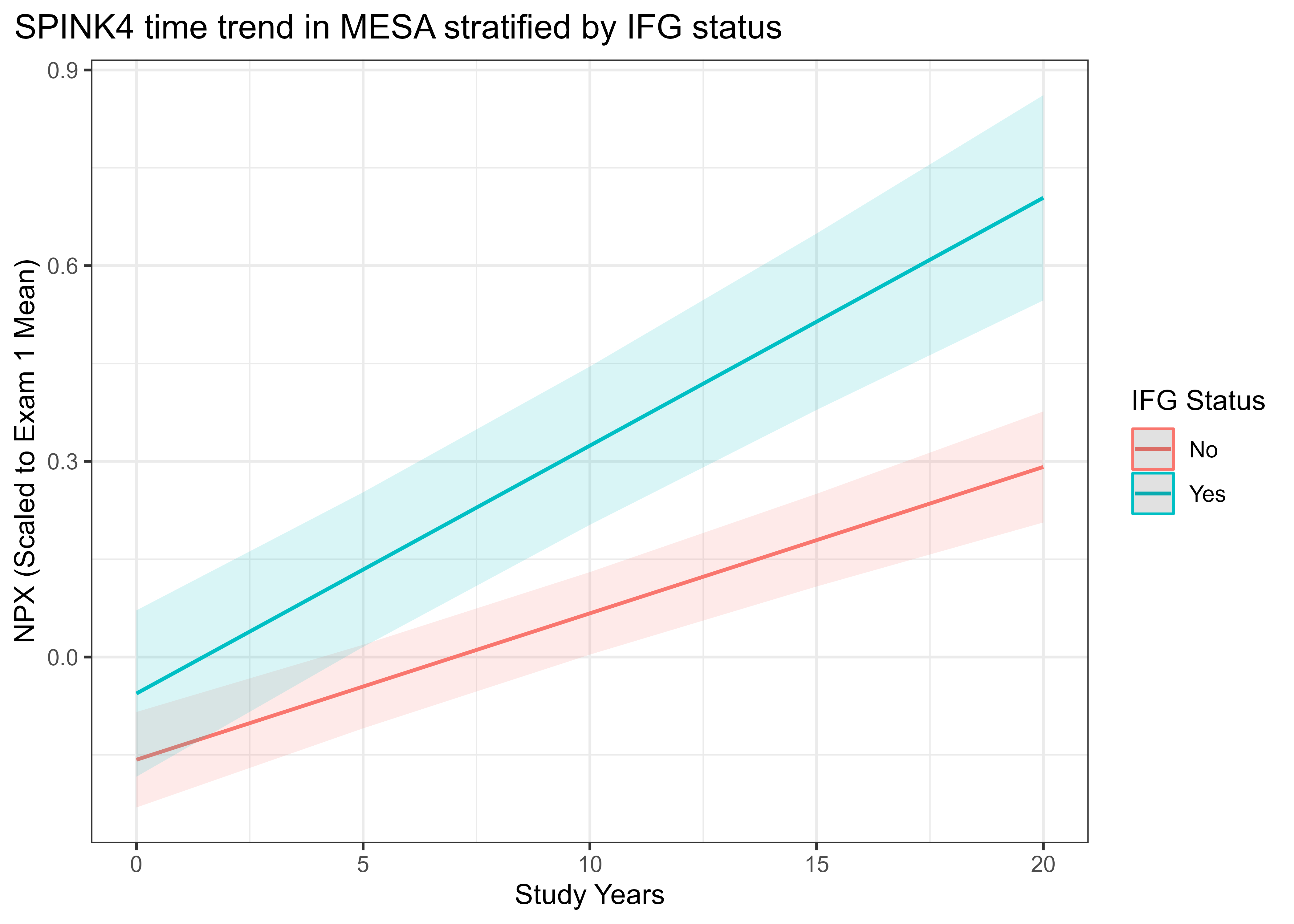
Results: We found 189 proteins with time trends that differed based on IFG status (time×IFG interaction term q<0.05). Of these, 54 (28.6%) were associated with incident diabetes in MESA (q<0.05 TV Cox) and the UKBB (q<0.05 Cox). These included SPINK4, a Kazal-type serine protease inhibitor in the intestinal mucosa that had a greater increase over time among individuals with IFG (Fig 1, q=6.5×10⁻⁴). Inverse weighted cis-MR supported SPINK4 having a possible causal role in fasting glucose levels (β=-0.002, q=5.51×10⁻¹⁰). Circulating SPINK4 was positively associated with incident diabetes in MESA (TV Cox HR 1.25 [1.14-1.37], q=7.12×10⁻⁵) and in UKBB (Cox HR 1.43 [1.36-1.52], q=1.74×10⁻³⁴).
Conclusions: We found 189 protein trajectories modified by IFG, 54 of which were additionally associated with diabetes risk. These proteins can reveal dynamic associations that help further elucidate diabetes pathways.
Chen, Zsu-zsu
(
Beth Israel Deaconess Medical Cente
, Boston , Massachusetts , United States )
Mi, Michael
(
Beth Israel Deaconess Medical Ctr
, Boston , Massachusetts , United States )
Barber, Jacob
(
Beth Israel Deaconess Medical Cente
, Boston , Massachusetts , United States )
Tiwari, Gaurav
(
BIDMC
, Brighton , Massachusetts , United States )
Adams, Charleen
(
Beth Israel Deaconess Medical Cente
, Boston , Massachusetts , United States )
Deng, Shuliang
(
Beth Israel Deaconess Medical Cente
, Boston , Massachusetts , United States )
Farrell, Laurie
(
BIDMC
, Boston , Massachusetts , United States )
Rao, Prashant
(
Beth Israel Deaconess Medical Cente
, Boston , Massachusetts , United States )
Tahir, Usman
(
BIDMC
, Lexington , Massachusetts , United States )
Wood, Alexis
(
Baylor College of Medicine
, Houston , Texas , United States )
Taylor, Kent
(
The Lundquist Institute
, Torrance , California , United States )
Rich, Stephen
(
UNIVERSITY VIRGINIA
, Charlottesville , Virginia , United States )
Rotter, Jerome
(
The Lundquist Institute
, Torrance , California , United States )
Gerszten, Robert
(
Beth Israel Deaconess Medical Ctr
, Boston , Massachusetts , United States )
Author Disclosures:
Zsu-Zsu Chen:DO NOT have relevant financial relationships
| Alexis Wood:No Answer
| Kent Taylor:DO NOT have relevant financial relationships
| Stephen Rich:DO have relevant financial relationships
;
Consultant:Westat:Active (exists now)
| Jerome Rotter:DO NOT have relevant financial relationships
| Robert Gerszten:No Answer
| Michael Mi:DO NOT have relevant financial relationships
| Jacob Barber:No Answer
| Gaurav Tiwari:DO NOT have relevant financial relationships
| Charleen Adams:DO NOT have relevant financial relationships
| Shuliang Deng:DO NOT have relevant financial relationships
| Laurie Farrell:No Answer
| Prashant Rao:DO NOT have relevant financial relationships
| Usman Tahir:DO NOT have relevant financial relationships