
Logo

American Heart Association

  27
  0


Final ID: MP378

Fusion Machine Learning Architectures for Improving ECG classification of acute coronary events

Abstract Body (Do not enter title and authors here): Introduction
Acute coronary syndrome (ACS) is a life-threatening emergency, with occlusion myocardial infarction (OMI) requiring rapid diagnosis and treatment. The 12-lead ECG remains the primary diagnostic tool, and AI-based ECG analysis increasingly shows superior accuracy over clinicians. Most existing models, including our own, use either feature-based machine learning (e.g., random forest) or deep learning on raw waveforms. In this study, we explore fusion architectures that integrate our prior random forest (ECGSMART_RF) and neural network (ECGSMART_CNN) models to improve ACS and OMI classification.
Methods
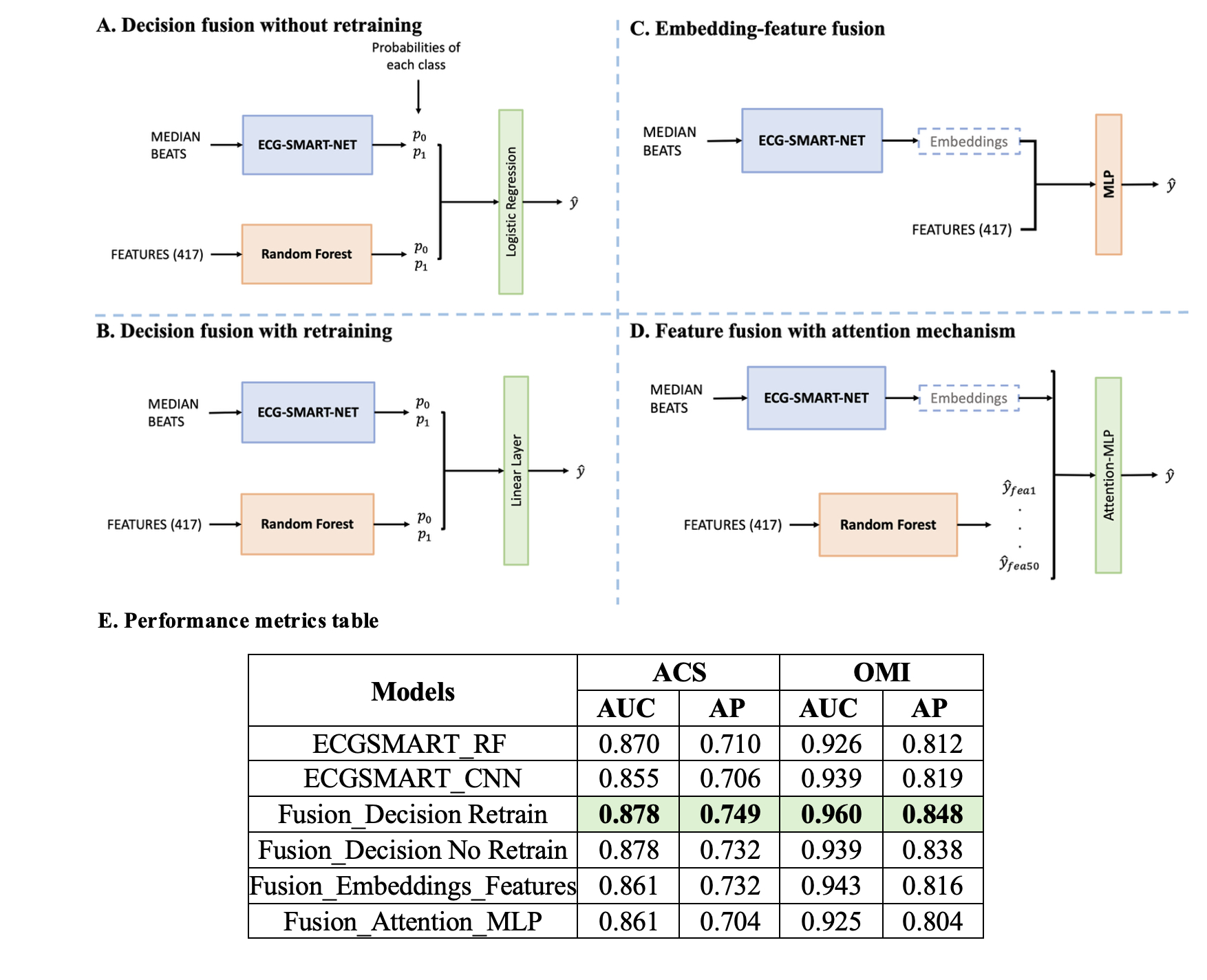
This was a secondary analysis of an observational cohort study that enrolled consecutive patients with chest pain. Patients were followed up for 30 days and outcomes were adjudicated by independent reviewers. Dataset was partitioned 80% training, 10% validation, and 10% testing. We propose four fusion strategies to integrate our existing ECG representations—handcrafted features and median beat waveforms—using two model architectures: random forest and CNN. The first two strategies use decision-level fusion. The fusion without retraining approach combines model outputs directly via logistic regression, while the fusion with retraining method introduces a linear layer that updates the weights of individual models through backpropagation. The other two strategies apply feature-level fusion. One concatenates intermediate embeddings from CNN with handcrafted features; the other combines these embeddings with individual tree predictions from the random forest model and passes them through an attention mechanism to learn the optimal combination. Detailed architectures for each fusion method are shown in Figures 1A–D. Models were evaluated on test set using ROC and PR curves.
Results
Our dataset included 10,393 serial ECGs from 7,397 unique patients from two clinical sites (age 59 ± 16, 46% females). Figure 1E shows performances of the four fusion models on the test set (n=741, OMI = 7.2%, ACS = 13.7%) against baseline performance of individual models. Simple decision fusion architecture outperforms baseline classifiers and more complex embedding-based fusions.
Conclusion
Decision fusion, which integrates models with distinct ECG representations, is capable of adaptively prioritizing the more informative model while incorporating complementary insights.
  • Ji, Rui Qi  ( University of Toronto , Thornhill , Ontario , Canada )
  • Riek, Nathan  ( University of Pittsburgh , Pittsburgh , Pennsylvania , United States )
  • Gokhale, Tanmay  ( University of Pittsburgh , Pittsburgh , Pennsylvania , United States )
  • Akcakaya, Murat  ( University of Pittsburgh , Pittsburgh , Pennsylvania , United States )
  • Sejdic, Ervin  ( University of Toronto , Thornhill , Ontario , Canada )
  • Al-zaiti, Salah  ( UNIVERSITY OF ROCHESTER , Rochester , New York , United States )
  • Author Disclosures:
    Rui Qi Ji: DO NOT have relevant financial relationships | Nathan Riek: DO NOT have relevant financial relationships | Tanmay Gokhale: DO NOT have relevant financial relationships | Murat Akcakaya: No Answer | Ervin Sejdic: No Answer | Salah Al-Zaiti: DO NOT have relevant financial relationships
Meeting Info:

Scientific Sessions 2025

2025

New Orleans, Louisiana

Session Info:
More abstracts on this topic:
A Multi-Tier, Natural-Language Processing Framework to Automate Labeling of Acute Cerebrovascular Events From Radiology Reports and Diagnosis Codes

Erekat Asala, Stein Laura, Delman Bradley, Karp Adam, Kupersmith Mark, Kummer Benjamin

A New Biomarker of Aging Derived From Electrocardiogram Improves Risk Prediction of Incident Myocardial Infarction and Stroke.

Wilsgaard Tom, Rosamond Wayne, Schirmer Henrik, Lindekleiv Haakon, Attia Zachi, Lopez-jimenez Francisco, Leon David, Iakunchykova Olena

More abstracts from these authors:
You have to be authorized to contact abstract author. Please, Login
Not Available