Logo

American Heart Association

  57
  0


Final ID: MP1105

2-Deoxyuridine Associates with Recurrent Coronary Events

Abstract Body (Do not enter title and authors here): Background: Altered metabolic pathways underlie atherosclerosis and acute coronary events.

Objectives: We investigated the association between circulating metabolites and recurrent coronary events among patients with non-ST-segment elevation acute coronary syndrome (NSTE-ACS) and used preclinical models of atherosclerosis to gain mechanistic insights into significant metabolite associations.

Methods: A total of 61 plasma metabolites were quantified in medically managed patients 30 days following the index ACS (N=490) to investigate their association with secondary myocardial infarction (MI). Patients with ACS were eligible if they were selected for a final treatment strategy of medical management without revascularisation within 10 days after the index NSTE-ACS event. To complement this analysis, we assessed the effect of one metabolite significantly associated with subsequent spontaneous MI using LDL receptor-deficient (Ldlr-/-) mice (n=5/group) subjected to carotid wire injury to simulate endothelial disruption.

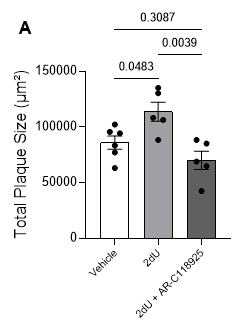
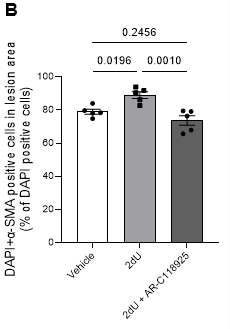
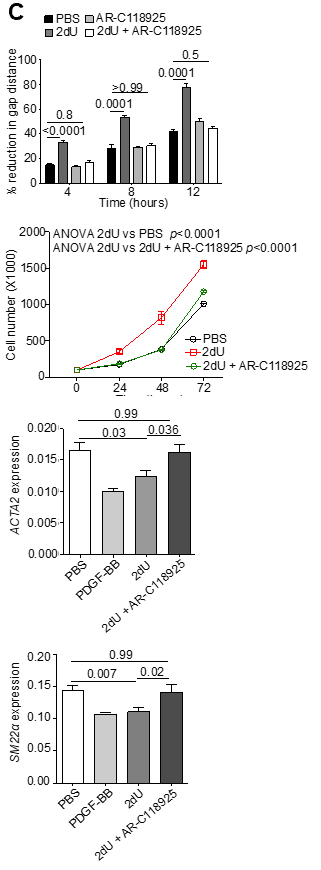
Results: MI occurred in 35 patients (7.14%) during follow-up (median time to MI: 6 months, range 1-31 months). Higher 30-day levels of 2-deoxyuridine (2dU), a pyrimidine substrate of DNA synthesis, were associated with a high risk of subsequent MI (adjusted hazard ratio: 17.0; 95% confidence interval 3.0 to 97; p=0.002), which was confirmed in a replication cohort. Daily administration of 250 mg/kg of 2dU increased neointimal plaques in carotid wire-injured mice (p=0.04), which was reversed by the co-administration of AR-C118925 (7 mg/kg), a specific P2Y2 receptor (P2Y2R) antagonist (p=0.003) (Fig 1A). Additionally, lesional VSMCs (α-SMA+) were significantly increased upon administration of 2dU. This was also reversed with the P2Y2R blockade via AR-C118925 co-administration (Fig 1B). Exposing human coronary artery smooth muscle cells (HCASMC) to 2dU (10µM) increased proliferation, migration, and loss of contractility, effects which were inhibited by AR-C118925 (Fig 1C). Transcriptomic analyses confirmed differential modulation of gene expression by 2dU in HCASMCs versus human coronary artery endothelial cells (HCAECs), with modulation of genes in the MAPK, PI3K-AKT, and TNF signaling pathways in HCASMCs but not HCAECs.

Conclusions: Elevated circulating 2-deoxyuridine levels are associated with an increased risk of MI after NSTE-ACS by increasing neointima formation possibly via P2Y2R-dependent VSMCs alterations following endothelial injury.
  • Pistritu, Dan  ( Yong Loo Lin School of Medicine, National University of Singapore , Singapore , Singapore )
  • Castano, David  ( Yong Loo Lin School of Medicine, National University of Singapore , Singapore , Singapore )
  • Liehn, Elisa  ( Heart Research Institute Singapore, National Heart Centre , Singapore , Singapore )
  • Koh, Cho Yeow  ( Yong Loo Lin School of Medicine, National University of Singapore , Singapore , Singapore )
  • Gerszten, Robert  ( Beth Israel Deaconess Medical Center , Boston , Massachusetts , United States )
  • Singaraja, Roshni  ( Yong Loo Lin School of Medicine, National University of Singapore , Singapore , Singapore )
  • Chan, Mark  ( Yong Loo Lin School of Medicine, National University of Singapore , Singapore , Singapore )
  • Shah, Svati  ( Duke University Medical Center , Hillsborough , North Carolina , United States )
  • Author Disclosures:
    Dan Pistritu: DO NOT have relevant financial relationships | David Castano: No Answer | Elisa Liehn: No Answer | Cho Yeow Koh: No Answer | Robert Gerszten: No Answer | Roshni Singaraja: DO NOT have relevant financial relationships | Mark Chan: DO NOT have relevant financial relationships | Svati Shah: DO NOT have relevant financial relationships
Meeting Info:

Scientific Sessions 2025

2025

New Orleans, Louisiana

Session Info:

Emerging Pathways in Smooth Muscle Cell Biology and Macrophages

Saturday, 11/08/2025 , 03:15PM - 04:30PM

Moderated Digital Poster Session

You have to be authorized to contact abstract author. Please, Login
Not Available