Transcatheter vs. Surgical Treatment in Aortic Stenosis with Coronary Artery Disease: A Meta-Analysis of Time-to-Event Data on 162,305 Patients
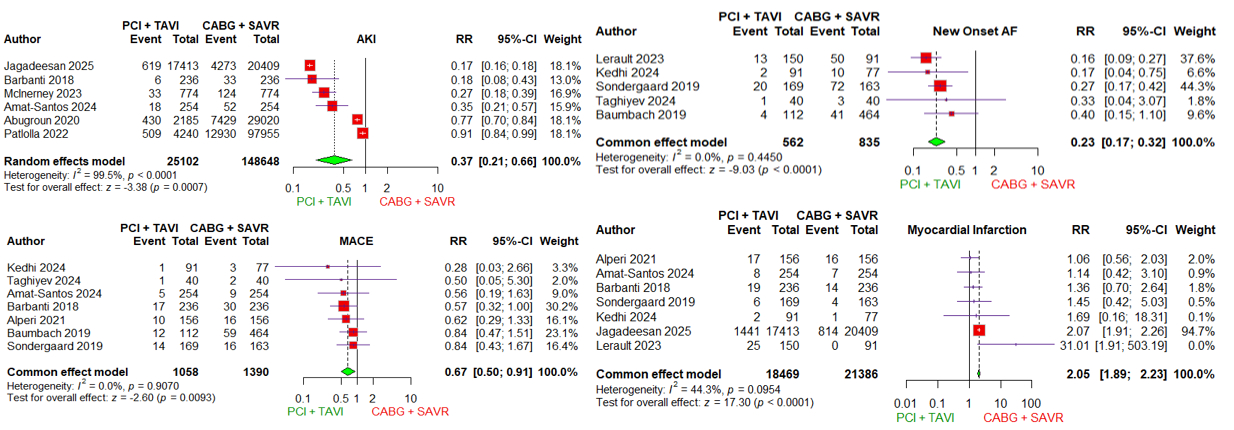
Abstract Body (Do not enter title and authors here): .Background: The optimal treatment for aortic stenosis (AS) with concomitant coronary artery disease (CAD) is controversial. Our meta-analysis of reconstructed time-to-event data aimed to compare percutaneous coronary intervention (PCI) + transcatheter aortic valve implantation (TAVI) with coronary artery bypass graft (CABG) + surgical aortic valve replacement (SAVR) in AS with CAD. Methods: We systematically searched four databases (PubMed, Web of Science, Scopus, and Cochrane Library) up to March 2025. Individual patient data (IPD) reconstructed from time-to-event data were used to estimate hazard ratios (HRs) and 95% confidence intervals (CIs) for all-cause mortality. Dichotomous data were analyzed using risk ratios (RR) and with 95% confidence intervals (CI). Results: Our study included 15 studies with a total of 162,305 patients. PCI + TAVI significantly increased all-cause mortality compared to CABG + SAVR at 48 months (HR 1.29, 95% CI 1.23–1.35, P<0.001), however, reduced the risk of in-hospital acute kidney injury (AKI) (RR 0.37, 95% CI 0.21–0.66, P=0.0007), and on short term: major adverse cardiac event (MACE) (RR 0.67, 95% CI 0.50–0.91, P=0.0093) and new-onset atrial fibrillation (AF) (RR 0.23, 95% CI 0.17–0.32, P<0.0001). Moreover, PCI + TAVI was associated with an increased risk of myocardial infarction on long-term (RR 2.05, 95% CI 1.89–2.23, P<0.0001). Conclusions: PCI + TAVI was associated with a significantly higher all-cause mortality and an increased long-term risk of MI compared to the CABG + SAVR. However, it significantly lowered the risk of in-hospital AKI, as well as the short-term incidence of new-onset AF and MACE. However, high quality prospective clinical trials are warranted to reassess current guidelines and refine treatment recommendations.
Emara, Ahmed
(
Faculty of Medicine, Al-Azhar University
, Cairo , Egypt )
Emara, Mohamed
(
Faculty of Medicine, Al-Azhar University
, Cairo , Egypt )
Gadelmawla, Ahmed Farid
(
Faculty of Medicine, Menoufia University
, Menoufia , Egypt )
Shubietah, Abdalhakim
(
Advocate Illinois Masonic Med Ctr
, Chicago , Illinois , United States )
Murad, Mohamed
(
Faculty of Medicine, Al-Azhar University
, Cairo , Egypt )
Elgendy, Mohamed
(
Faculty of Medicine, Tanta University
, Tanta , Egypt )
Aboeldahab, Heba
(
Clinical Research Department, El-Gomhoria General Hospital, MOHP
, Alexandria , Egypt )
Hassanin, Mohammed Sabri
(
Faculty of Medicine, Al-Azhar University
, Cairo , Egypt )
A. Aldemerdash, Mohamed
(
Faculty of Medicine, Sohag University
, Sohag , Egypt )
Khaled, Mohamed
(
Alexandria Faculty of Medicine
, Alexandria , Egypt )
Othman, Ali
(
Faculty of Medicine, Kafr Elsheikh University
, Kafr Elsheikh , Egypt )
Hammad, Noha
(
Port-Said Faculty of Medicine
, Port-Said , Egypt )
Elbairy, Mariam Khaled
(
Faculty of Medicine, Suez University
, Suez , Egypt )
N. Bapat, Vinayak
(
Minneapolis Heart Institute, Abbott Northwestern Hospital
, Minneapolis , Minnesota , United States )
Author Disclosures:
Ahmed Emara:DO NOT have relevant financial relationships
| Mohamed Khaled:DO NOT have relevant financial relationships
| Ali Othman:DO NOT have relevant financial relationships
| Noha Hammad:DO NOT have relevant financial relationships
| Mariam Elbairy:DO NOT have relevant financial relationships
| Vinayak N. Bapat:No Answer
| Mohamed Emara:No Answer
| Ahmed Farid Gadelmawla:DO NOT have relevant financial relationships
| Abdalhakim Shubietah:DO NOT have relevant financial relationships
| Mohamed Murad:No Answer
| Mohamed Elgendy:DO NOT have relevant financial relationships
| Heba Aboeldahab:No Answer
| Mohammed Sabri Hassanin:DO NOT have relevant financial relationships
| Mohamed A. Aldemerdash:No Answer