
Intra-Arterial Tenecteplase as an Adjunct to Endovascular Thrombectomy in Acute Ischemic Stroke: A Systematic Review and Meta-Analysis
Abstract Body (Do not enter title and authors here): Background: Intra-arterial thrombolytics have emerged as a potential adjunct to endovascular thrombectomy in patients with acute ischemic stroke, due to suboptimal functional outcomes associated with thrombectomy alone. Several studies have evaluated the safety and efficacy of intra-arterial tenecteplase as an adjunctive therapy; however, findings remain variable. To address this, we conducted a systematic review and meta-analysis to synthesize the available evidence.
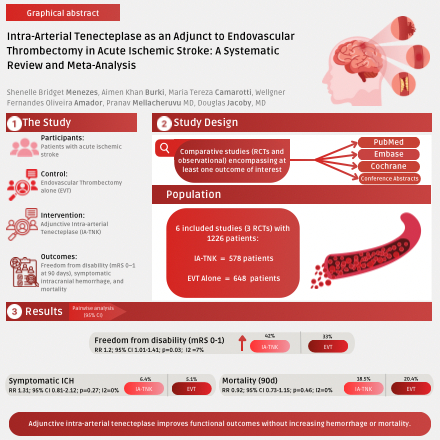
Research question: Does adjunctive intra-arterial tenecteplase improve freedom from disability in patients with acute ischemic stroke without increasing the risk of symptomatic intracranial hemorrhage or mortality when compared to endovascular thrombectomy alone?
Methods: We systematically searched PubMed, Cochrane, Embase and conference abstracts for studies comparing intra-arterial tenecteplase as an adjunct to endovascular thrombectomy versus endovascular thrombectomy alone in patients with acute ischemic stroke. The efficacy outcome was freedom from disability as measured by a modified Rankin Scale (mRS) score of 0 or 1 at 90 days. Safety outcomes included symptomatic intracranial hemorrhage and mortality at 90 days. Risk ratios (RR) with 95% confidence intervals (CI) were pooled using a random effects model. Heterogeneity was assessed using I2 statistics.
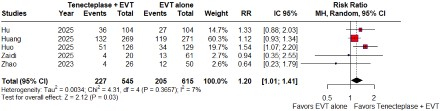
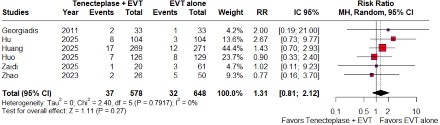
Results: We included 1226 patients from six studies, of which three were randomised controlled trials. A total of 578 patients (47%) were treated with intra-arterial tenecteplase in addition to endovascular thrombectomy. Treatment with adjunctive intra-arterial tenecteplase was associated with an increased likelihood of freedom from disability compared to endovascular thrombectomy alone (RR 1.2; 95% CI 1.01-1.41; p=0.03; I2 =7%; Figure 1A). There was no significant difference in symptomatic hemorrhage (RR 1.31; 95% CI 0.81-2.12; p=0.27; I2=0%; Figure 1B) and mortality at 90 days (RR 0.92; 95% CI 0.73-1.15; p=0.46; I2=0%) in the intra-arterial tenecteplase group compared to endovascular thrombectomy alone. These findings were consistent in a subgroup analysis restricted to randomized controlled trials.
Conclusion: In patients with acute ischemic stroke, adjunctive intra-arterial tenecteplase was associated with a higher likelihood of freedom from disability compared to endovascular therapy alone, without a corresponding increase in symptomatic intracranial hemorrhage or 90-day mortality.
Menezes, Shenelle
( Windsor University, School of medic
, Mumbai
, India
)
Camarotti, Maria Tereza
( Pernambuco Health College
, Recife
, Brazil
)
Khan Burki, Aimen
( University of Bologna
, Bologna
, Italy
)
Fernandes Oliveira Amador, Wellgner
( Universidade Federal de Campina Grande
, Cajazeiras
, Brazil
)
Mellacheruvu, Pranav
( Penn Medicine
, Philadelphia
, Pennsylvania
, United States
)
Jacoby, Douglas
( Penn
, Bala Cynwyd
, Pennsylvania
, United States
)
Author Disclosures:
Shenelle Menezes:DO NOT have relevant financial relationships
| Maria Tereza Camarotti:DO NOT have relevant financial relationships
| Aimen Khan Burki:DO NOT have relevant financial relationships
| Wellgner Fernandes Oliveira Amador:DO NOT have relevant financial relationships
| Pranav Mellacheruvu:No Answer
| Douglas Jacoby:No Answer