
Logo

American Heart Association

  58
  0


Final ID: TP310

The Shifting Evidence for Statin Use in the Setting of Intracerebral Hemorrhage

Abstract Body: Introduction
Intracerebral Hemorrhage (ICH) is associated with a high case fatality and survivors of ICH are at increased risk for ICH recurrence. Roughly 20-30% of patients with ICH take a statin at the time of ICH onset. The role of statins, whether protective or deleterious, in the setting of ICH remains unclear. The SPARCL (Stroke Prevention by Aggressive Reduction of Cholesterol Level) study amongst others, have suggested that statin use may increase risk of ICH in those with prior history ICH, due to increased erythrocyte fragility and inhibition of platelet aggregation. However subsequent observational studies refuted these findings citing statins improve endothelial function and reduce oxidative stress thus theoretically. We reviewed relevant studies discussing the relationship between statin use and risk of ICH.

Methods
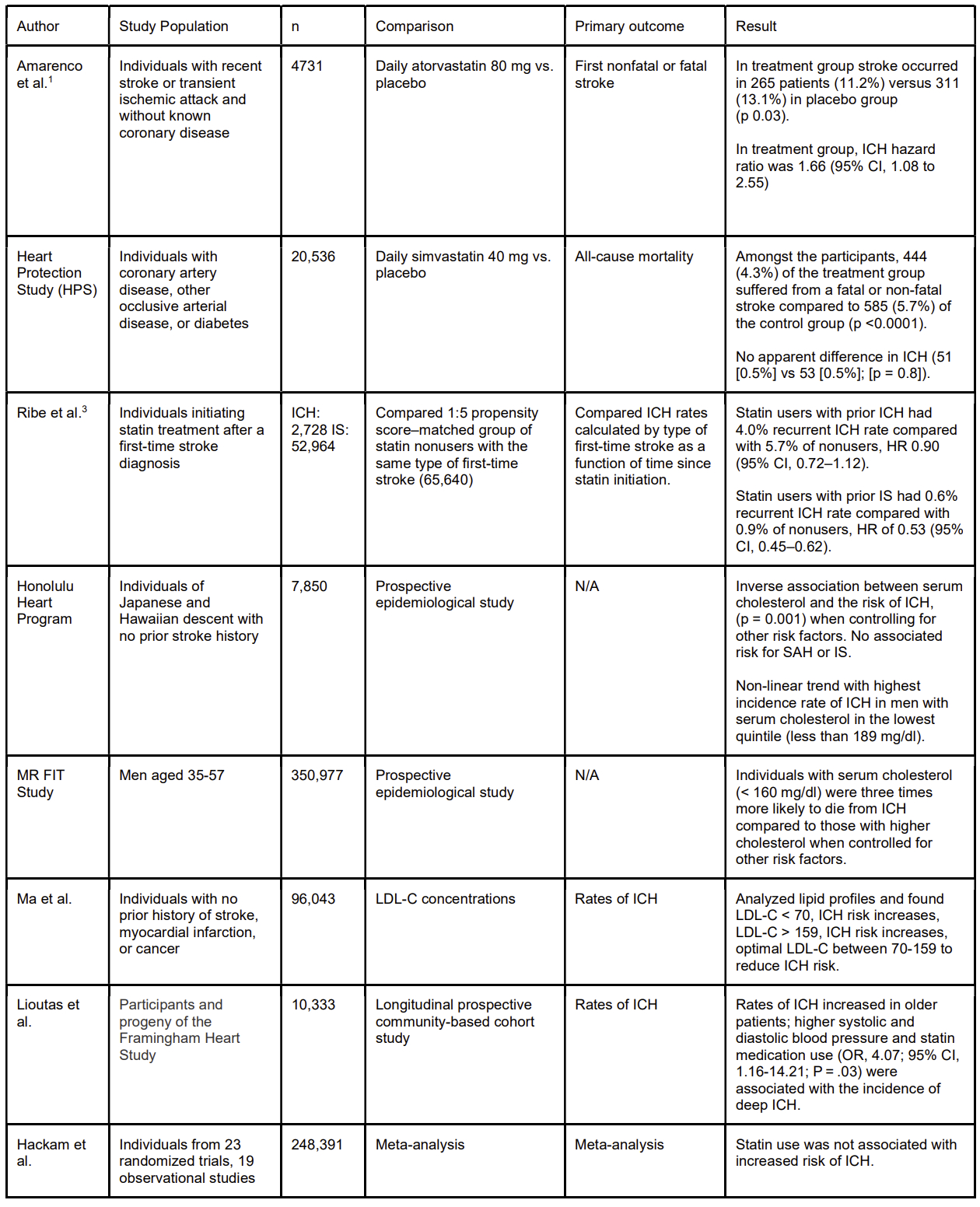
A comprehensive search strategy utilizing the key terms “statin use” and “intracerebral hemorrhage” was performed utilizing four electronic databases: Cochrane, Embase, Google Scholar, PubMed. The search was conducted by two authors (PM and CO). Following the search, articles citing a correlation between statin use and risk of intracerebral hemorrhage were included. Below is a table citing selected studies from our review (Table 1).

Discussion
There continues to be mixed evidence regarding statin use and risk of ICH. Current clinical guidelines do not provide a formal recommendation on statin use restriction in those with prior ICH. However, contrary to the SPARCL study, newer studies have suggested there is neither a statistically nor clinically significant relationship between LDL-C and ICH incidence. Our review also uncovered that one’s genetic signature may play a mediating role in this relationship as evidenced namely by the Honolulu Heart study, which analyzed a relatively monogenic study population. This implies a more nuanced relationship and we posit the burgeoning use of polygenic risk scoring may provide more utility here as well. Ultimately consideration of statin therapy should be determined by weighing one’s atherogenicity versus propensity to develop ICH. An optimal LDL-C goal has yet to be determined however many studies suggest targeting between 70-160 mg/dL is optimal. Additional studies should assess the role of other lipid lowering agents in the setting of ICH such as bempedoic acid and PCSK9 inhibitors, as well as discern optimal ranges for newer Apo-B and Lp(a) lipid biomarkers.
  • Mellacheruvu, Pranav  ( Penn Medicine , Philadelphia , Pennsylvania , United States )
  • Vedamurthy, Deepak  ( Penn Medicine , Philadelphia , Pennsylvania , United States )
  • Odenigbo, Charles  ( Penn Medicine , Philadelphia , Pennsylvania , United States )
  • Burke, Skyler  ( University of Washington , Seattle , Washington , United States )
  • Cucchiara, Brett  ( UNIV PENNSYLVANIA MEDICAL CTR , Philadelphia , Pennsylvania , United States )
  • Soffer, Dan  ( Penn Medicine , Philadelphia , Pennsylvania , United States )
  • Author Disclosures:
    Pranav Mellacheruvu: DO NOT have relevant financial relationships | Deepak Vedamurthy: No Answer | Charles Odenigbo: DO NOT have relevant financial relationships | Skyler Burke: DO NOT have relevant financial relationships | Brett Cucchiara: DO have relevant financial relationships ; Consultant:Bayer:Past (completed) ; Consultant:Anthos:Past (completed) | Dan Soffer: No Answer
Meeting Info:
Session Info:

Risk Factors and Prevention Posters II

Thursday, 02/06/2025 , 07:00PM - 07:30PM

Poster Abstract Session

More abstracts on this topic:
Acceptability of Cardiovascular Prevention Strategies Among People With HIV: a Mixed-Methods Study

Durstenfeld Matthew, Levkova Marta, Schaffer Veronica, De Leon Ivan, Dejong Colette, Sauceda John, Gandhi Monica, Hsue Priscilla

A Novel Approach to Manage Hypercholesterolemia: The Veterans Affairs Lipid Optimization Reimagined Quality Improvement (VALOR-QI) Program

Djousse Luc, Leesch Tharen, Pena David, Gaziano Michael, Ward Rachel, Wellman Helen, Yel Nedim, Santos Abigail, Delgrande Jen, Fink Abigail, Colson Kristin, Pan Eddie

More abstracts from these authors:
Geographic, Gender, and Age Disparities in Aortic Aneurysm Burden: Insights from GBD 2021 U.S. Dat

Majety Sameer Kumar, Vedamurthy Deepak, Anne Himaja, Kamadi Hemanth, Sakalabaktula Krishna Sai Kiran

Forecasting State-Level Healthcare Costs of Atrial Fibrillation by Service Type Through 2050

Burke Skyler, Wahab Feras, Johnson Catherine, Dieleman Joseph, Roth Gregory

You have to be authorized to contact abstract author. Please, Login
Not Available

Readers' Comments

We encourage you to enter the discussion by posting your comments and questions below.

Presenters will be notified of your post so that they can respond as appropriate.

This discussion platform is provided to foster engagement, and simulate conversation and knowledge sharing.


You have to be authorized to post a comment. Please, Login or Signup.


   Rate this abstract  (Maximum characters: 500)