Postoperative Atrial Fibrillation or Flutter Following Mitral Valve Surgery for Primary Mitral Regurgitation
Abstract Body (Do not enter title and authors here): Background: New-onset postoperative atrial fibrillation or flutter (POAF) is a known complication following mitral valve surgery in patients with mitral valve prolapse (MVP) and mitral regurgitation (MR).
Aim: To characterize the types, clinical correlates, and long-term outcomes of POAF in patients undergoing mitral valve surgery for degenerative MR.
Methods: Patients with MVP and moderate or severe degenerative MR who underwent mitral valve surgery between 2010-2024 at Karolinska University Hospital were included. Data were extracted from electronic medical records, ECGs, and echocardiograms. Comprehensive outcome tracking was performed with no patients lost to follow-up. Patients were excluded if they had prior atrial fibrillation/flutter, mitral stenosis, rheumatic mitral valve disease, endocarditis, or prior mitral valve surgery. Cox regression was adjusted for age, sex, BMI, hypertension, hypercholesterolemia, diabetes, hemoglobin, prior PCI or CABG, eGFR, NYHA class, pulmonary hypertension, LVEF, and mitral valve repair vs replacement.
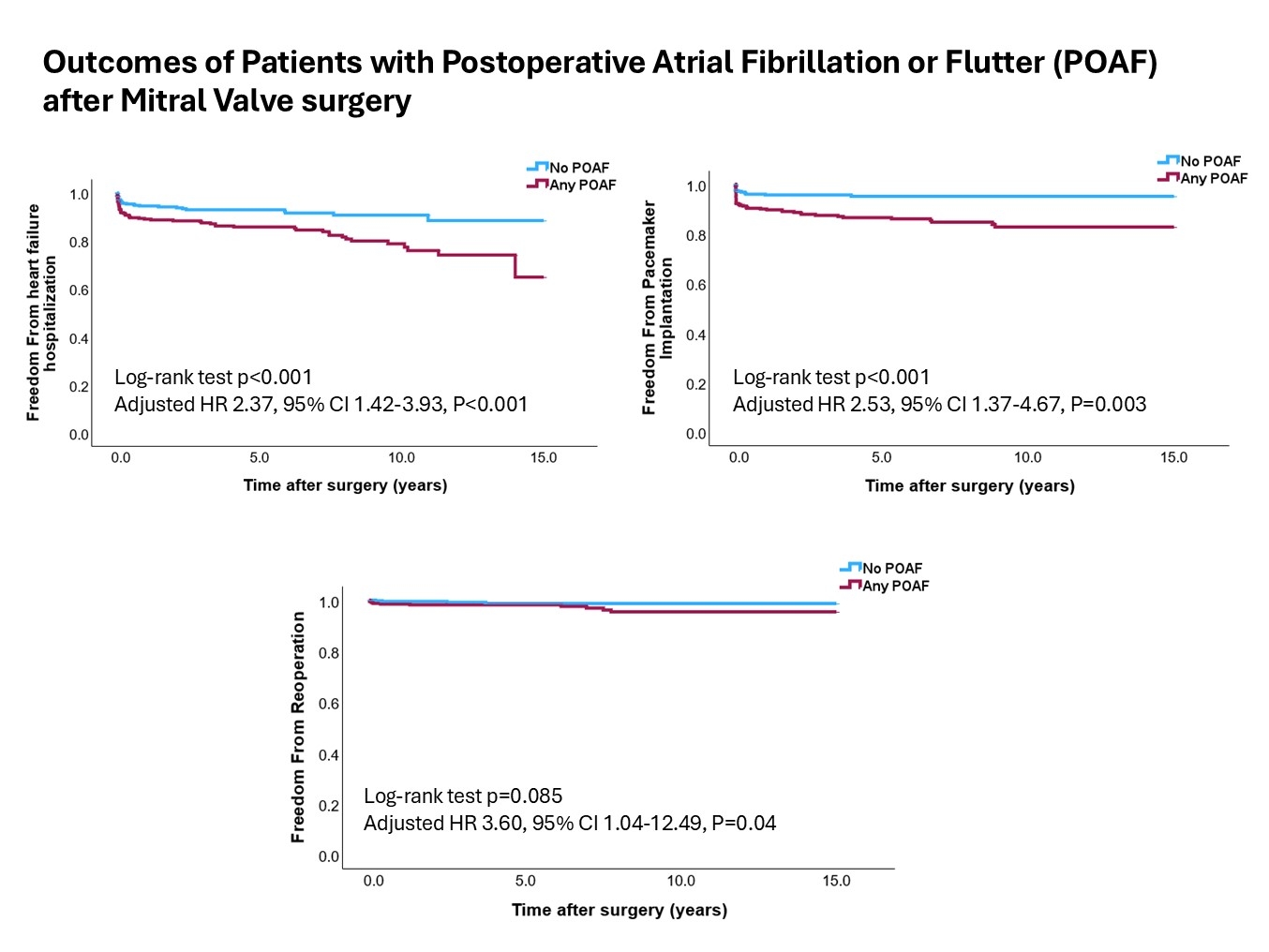
Results: Among 786 patients, 49.7% developed POAF, 82.4% during the index hospitalization. Most events were paroxysmal 89.5%, persistent 6.1%, and permanent 4.3%. Patients with POAF were older, more often in NYHA class III-IV, had lower LVEF and elevated pulmonary artery systolic pressures compared to those without POAF. No differences were observed in preoperative left atrial volume index, MR severity, MVP etiology or anticoagulation use between the groups. Patients with POAF were less likely to have undergone mitral valve repair, had longer cardiopulmonary bypass and cross-clamp time, and more frequently underwent concomitant CABG or tricuspid valve intervention. During a median follow-up time of 4.4 years, POAF was independently associated with increased risk of heart failure hospitalization, permanent pacemaker implantation and mitral valve reoperation, Figure. There were no significant associations with endocarditis, stroke or all-cause mortality.
Conclusions: POAF occurred in nearly half of all patients undergoing mitral valve surgery for degenerative MR, most commonly in paroxysmal form during the index hospitalization. POAF was associated with worse preoperative status, more complex surgical procedures, and significantly increased long-term risk of heart failure, pacemaker implantation and reoperation. These findings highlight the need for strategies to prevent and manage POAF in this high-risk population.
Fayad, Ayah
(
Karolinska Institute
, Vasteras , Sweden )
Jarting, Annica
(
Karolinska Institutet
, Stockholm , Solna , Sweden )
Wang Gottlieb, Anne
(
Karolinska Institutet
, Stockholm , Solna , Sweden )
Lund, Lars
(
Karolinska Institutet
, Stockholm , Solna , Sweden )
Braunschweig, Frieder
(
Karolinska Institutet
, Stockholm , Solna , Sweden )
Svenarud, Peter
(
Karolinska University Hospital
, Stockholm , Sweden )
Dalen, Magnus
(
Karolinska University Hospital
, Stockholm , Sweden )
Shahim, Bahira
(
Karolinska Institutet
, Stockholm , Solna , Sweden )
Author Disclosures:
Ayah Fayad:DO NOT have relevant financial relationships
| Annica Jarting:DO NOT have relevant financial relationships
| Anne Wang Gottlieb:No Answer
| Lars Lund:No Answer
| Frieder Braunschweig:No Answer
| Peter Svenarud:DO NOT have relevant financial relationships
| Magnus Dalen:No Answer
| Bahira Shahim:DO NOT have relevant financial relationships