Immunogenicity of Recaticimab Does Not Impact Its Efficacy in Patients with Dyslipidemia: A Pooled Analysis of Three Phase III and One Phase Ib/II Studies
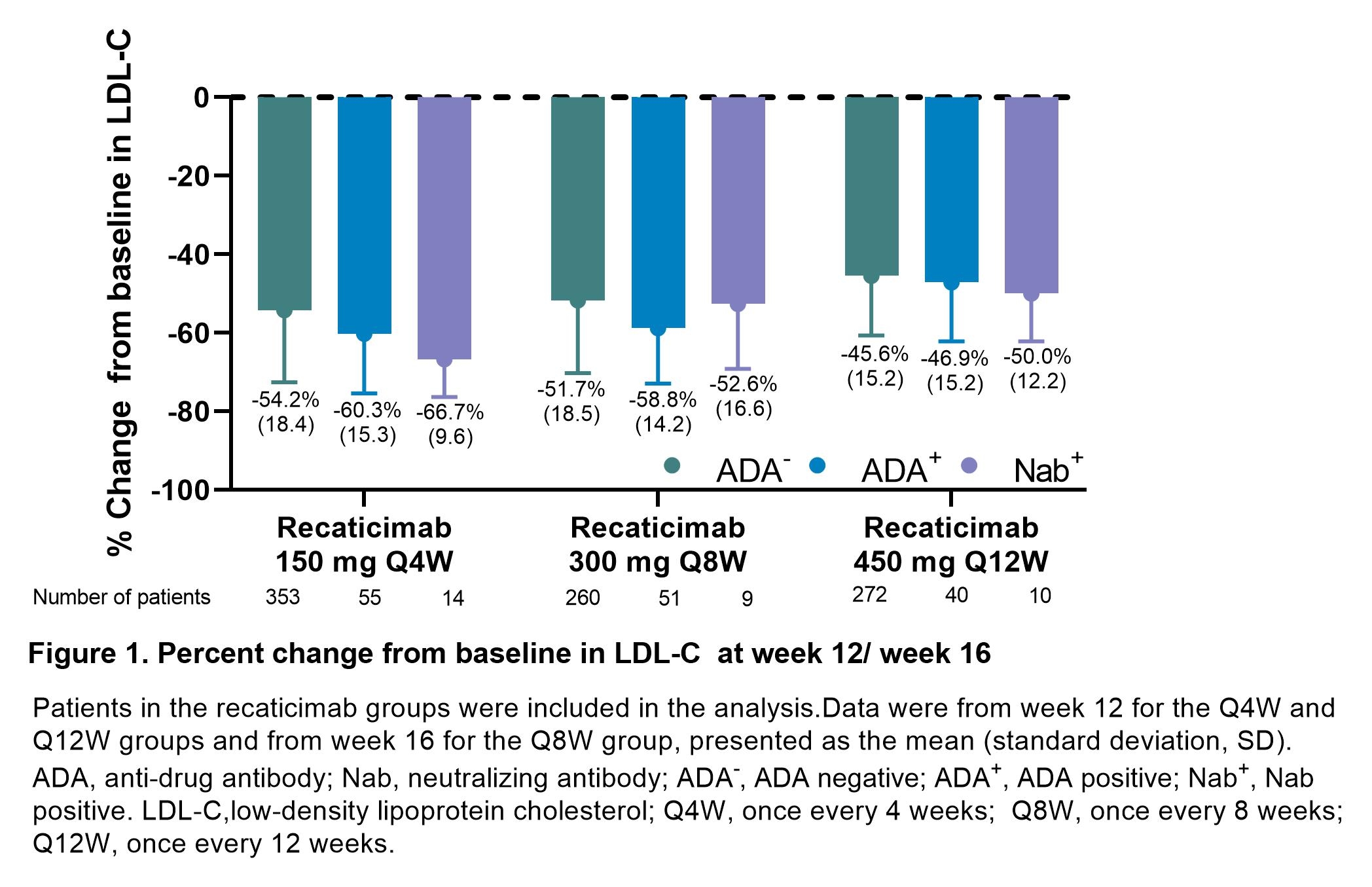
Abstract Body (Do not enter title and authors here): Background: Recaticimab, a humanized monoclonal antibody targeting proprotein convertase subtilisin/kexin type 9 (PCSK9) with a novel YTE mutation, prolongs its half-life by enhancing neonatal Fc receptor (FcRn) binding, making it the longest-acting anti-PCSK9 antibody. Approved for dyslipidemia management, its clinical performance concerning immunogenicity is still under study. Aims: To explore the impact of immunogenicity on the efficacy and safety of recaticimab in patients with dyslipidemia. Methods: The pooled analysis was conducted using data from 3 phase III trials (REMAIN 1-3) and 1 phase Ib/II trial (NCT03944109). Patients with primary hypercholesterolemia (non-familial and heterozygous) and mixed hyperlipemia were randomized to receive subcutaneous recaticimab at doses of 150 mg every 4 weeks (Q4W), 300 mg Q8W, 450 mg Q12W, or matching placebo. Anti-drug antibodies (ADAs) were measured over time, with ADA-positive samples tested for neutralizing antibodies (Nabs). Efficacy outcome (the percent change in low-density lipoprotein cholesterol [LDL-C] from baseline at Week 12 (Q4W and Q12W groups), and Week 16 (Q8W group), and safety outcome were evaluated by ADA and Nab status. Results: Among 1034 patients who received recaticimab, 146 (14.1%) tested positive for treatment-emergent ADA (ADA+), and 33 (3.2%) for Nab (Nab+). In the placebo group (n=507), 10 (2.0%) were ADA+, and none were Nab+. In recaticimab-treated patients, LDL-C reductions from baseline at Week 12/16 were comparable across ADA-, ADA+, Nab+ patients for all dosing regimens (Figure 1). The incidence of treatment-related adverse events (TRAEs) was 22.8% (202 of 885) in ADA- patients, 29.5% (43 of 146) in ADA+ patients, and 42.4% (14 of 33) in Nab+ patients. Injection site reactions were the most common TRAE: 2.8% (25 of 885) in ADA-, 10.3% (15 of 146) in ADA+, and 18.2% (6 of 33) in Nab+ patients. All TRAEs in the ADA+ and Nab+ groups were mild to moderate, with no serious TRAEs reported. Conclusions: The incidence of ADAs (14.1%) and Nabs (3.2%) following recaticimab treatment did not impact efficacy. ADA+ and Nab+ patients had a higher incidence of self-resolving injection site reactions compared to ADA- patients. These findings support the clinical use of recaticimab for lipid-lowering therapy, regardless of immunogenicity status.
Sun, Yanyi
(
Ruijin Hospital,Shanghai Jiaotong University School of Medicine
, Shanghai , China )
Chen, Zhenyue
(
Ruijin Hospital,Shanghai Jiaotong University School of Medicine
, Shanghai , China )
Author Disclosures:
Yanyi Sun:DO NOT have relevant financial relationships
| zhenyue chen:DO NOT have relevant financial relationships