
Pilot study on AI-enhanced smartwatch ECG for detecting left ventricular systolic dysfunction in real-world settings
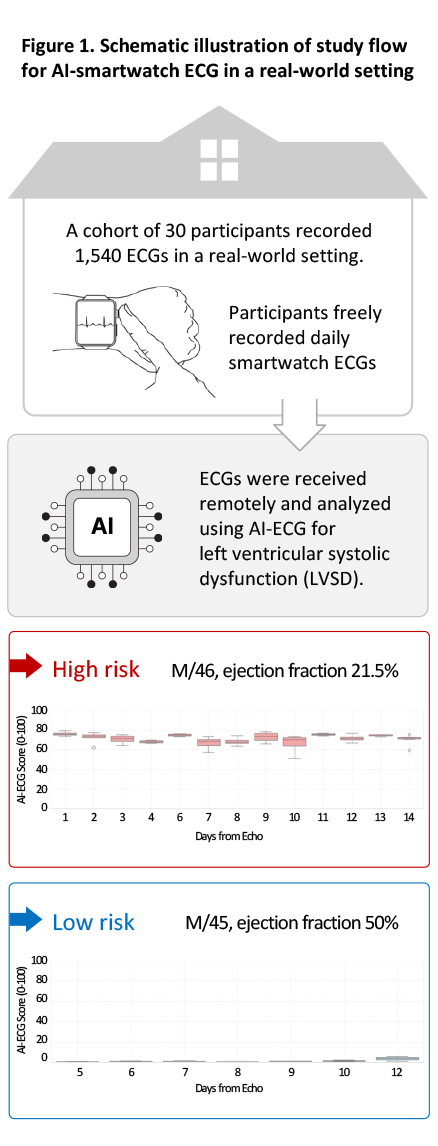
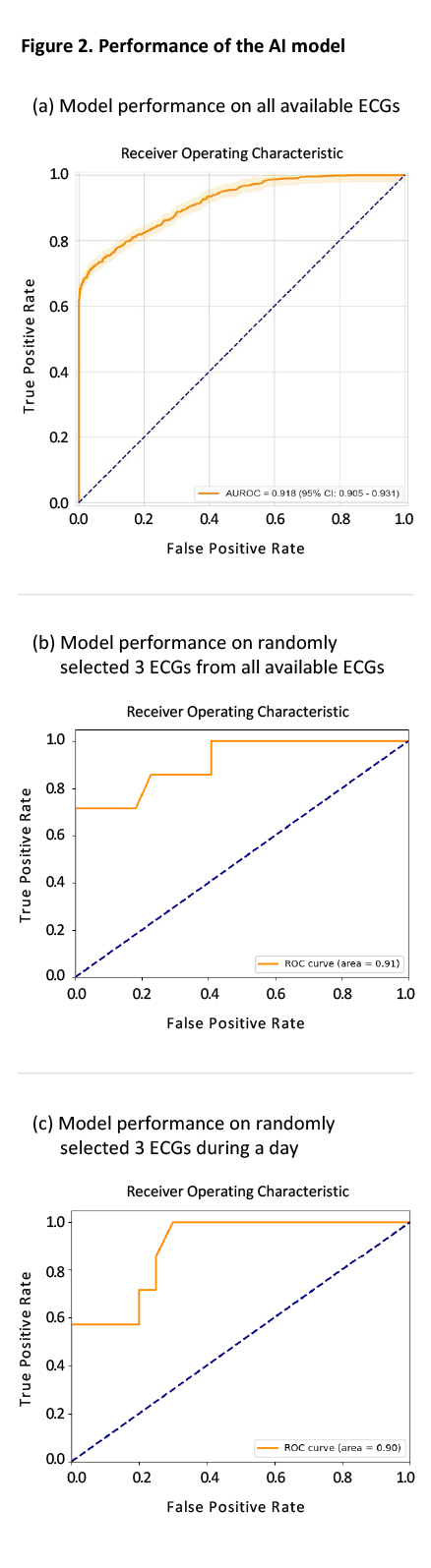
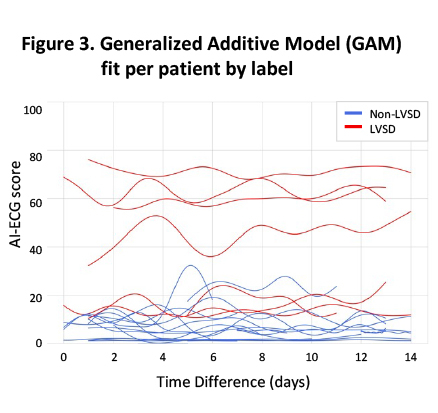
Abstract Body (Do not enter title and authors here): Background Artificial intelligence-enhanced electrocardiograms (AI-ECGs) based on single-lead recordings have demonstrated potential in detecting left ventricular systolic dysfunction (LVSD). However, validation studies remain limited due to a lack of sufficient data from self-recorded smartwatch ECGs. To address this gap, we established a real-world cohort of smartwatch ECG recordings. Hypothesis This study aims to determine whether AI-ECG scores derived from self-recorded smartwatch ECGs can reliably screen for and monitor LVSD in practical settings. Methods Between July and December 2024, we recruited participants who had recently completed or were scheduled for echocardiography (Echo) and instructed them to record smartwatch ECGs (Samsung Galaxy or Apple Watch) at least twice daily for over a week, ensuring an Echo within 14 days. Our previously developed convolutional neural network-based AI-ECG model was fine-tuned for smartwatch ECGs using a foundation model with preprocessing to address smartwatch-specific signal noise. The model outputs a score ranging from 0 to 100, where higher values indicate an increased likelihood of LVSD. We assessed model performance using three approaches: (1) Comprehensive analysis of all available ECGs, (2) Global sampling using three random ECGs from each participant’s entire dataset, and (3) Daily sampling with three random ECGs per day per participant. Results A total of 30 participants were enrolled in the study, with 78.1% using Samsung Galaxy Watches and 21.9% using Apple Watches. Echo identified LVSD in 7 participants (23.3%). The median AI-ECG score was 57.2 among those with LVSD and 4.7 in participants without LVSD. In total, 1,540 ECGs were collected, including 906 from the LVSD group. The AUROC was 0.918 (95% CI: 0.905–0.931) when all available ECGs were analyzed, 0.910 when three random ECGs per participant were analyzed, and 0.900 when three random ECGs per day per participant were analyzed. When the repeated measurements for all participants were plotted using a Generalized Additive Model (GAM), some degree of variability was observed, but the score distribution for each participant remained relatively consistent. Conclusion Our findings show that an AI-driven single-lead ECG method can reliably track LVSD using self-recorded smartwatch data in real-world environments. This evidence strongly supports expanding the application of our AI-ECG model to interpret smartwatch ECG recordings.
Son, Jeong Min
( Medical AI Co., Ltd.
, Seoul
, Korea (the Republic of)
)
Lee, Min Sung
( Medical AI Co., Ltd.
, Seoul
, Korea (the Republic of)
)
Lee, Hak Seung
( Medical AI Co., Ltd.
, Seoul
, Korea (the Republic of)
)
Kang, Sora
( Medical AI Co., Ltd.
, Seoul
, Korea (the Republic of)
)
Jo, Yong-yeon
( Medical AI Co., Ltd.
, Seoul
, Korea (the Republic of)
)
Kwon, Joon-myoung
( Medical AI Co., Ltd.
, Seoul
, Korea (the Republic of)
)
Lee, Soo Youn
( Incheon Sejong Hospital
, Incheon
, Korea (the Republic of)
)
Kim, Kyung-hee
( Incheon Sejong Hospital
, Incheon
, Korea (the Republic of)
)
Author Disclosures:
Jeong Min Son:DO have relevant financial relationships
;
Employee:Medical AI, Co., Ltd.:Active (exists now)
| Min Sung Lee:No Answer
| Hak Seung Lee:DO have relevant financial relationships
;
Employee:Medical AI:Active (exists now)
| Sora Kang:DO NOT have relevant financial relationships
| Yong-Yeon Jo:No Answer
| Joon-myoung Kwon:No Answer
| Soo Youn Lee:No Answer
| Kyung-Hee Kim:No Answer
Yoo Ah-hyun, Kim Kyung-hee, Lee Soo Youn, Lee Hak Seung, Kang Sora, Lee Min Sung, Han Ga In, Son Jeong Min, Jang Jong-hwan, Jo Yong-yeon, Kwon Joon-myoung
Lee Hak Seung, Kwon Joon-myoung, Kim Kyung-hee, Lee Soo Youn, Kang Sora, Han Ga In, Yoo Ah-hyun, Jang Jong-hwan, Jo Yong-yeon, Son Jeong Min, Lee Min Sung
4368006_File000000.jpg
4368006_File000001.jpg
4368006_File000002.jpg
You have to be authorized to contact abstract author. Please, Login