The impact of post-COVID syndrome on plasma endothelial, thrombotic and renal biomarkers
Abstract Body (Do not enter title and authors here): Background: Despite widespread vaccination and reduced SARS-CoV-2 pathogenicity, post-COVID syndrome (PCS) remains a significant public health issue. It is widely thought to represent a single, multi-systemic disorder, yet its pathophysiology remains poorly defined. Endothelial dysfunction and thrombosis have been proposed as central mechanisms.
Aims: To assess the long-term impact of SARS-CoV-2 infection on plasma biomarkers of endothelial, thrombotic and renal function.
Methods: Plasma samples were obtained from prospective observational cohort studies of patients previously infected with SARS-CoV-2, stratified by recovery status. Patients not previously hospitalised provided a single sample at 3–36 months post-infection (recovered: n=22; PCS: n=34-35). Post-hospitalisation patients provided samples at 6, 12, and 24 months (recovered: n=4-6; PCS: n=8-16). Commercial ELISAs and colorimetric assays quantified markers of endothelial-mediated vasomotor control (ET-1, nitrate/nitrite, prostacyclin, ADMA, arginine), thrombosis (sCD40L, P-selectin, PSGL-1, tPA, PAI-1, D-dimer) and renal injury (uromodulin, NGAL, cystatin C, TFF3, OPN). Statistical analysis used a mixed-effects model with Dunnett’s test to correct for multiple comparisons.
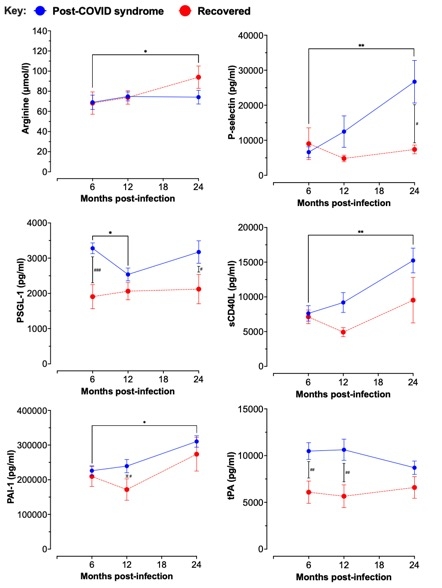
Results: In non-hospitalised cohorts, no significant differences were found between groups across any biomarker. In the post-hospitalisation cohort, arginine levels increased in the recovered group at 24 months (p=0.035; trend vs PCS group p=0.051), with no changes in other markers of endothelial function (Fig. 1). In the PCS group, higher plasma levels of P-selectin (p=0.021), PSGL-1 (p=0.0006), PAI-1 (p=0.018), tPA (p=0.006 & 0.002) and D-dimer (trend; p=0.087) were seen in comparison with the recovered group (Fig. 1). Longitudinally, P-selectin (p=0.003), sCD40L (p=0.013), and PAI-1 (p=0.017) increased between 6 and 24 months in the PCS group. Renal markers were also altered in PCS: cystatin C (p=0.014) and TFF3 (p=0.002 & 0.014) were elevated, while OPN decreased between 6 and 12 months (p=0.034).
Conclusions: Post-hospitalisation PCS is associated within increased markers of thrombosis, indicating persistent platelet and endothelial activation, impaired fibrinolysis and evidence of renal stress up to two years post-infection. We found no change in markers of vasomotor control except for arginine, the ‘recovery’ of which over time may reflect partial vascular restoration and warrants further investigation.
Bakr, Ahmed
(
Imperial College London
, London , United Kingdom )
Kirkby, Nicholas
(
Imperial College London
, London , United Kingdom )
Vaja, Ricky
(
Imperial College London
, London , United Kingdom )
Pearce, Lily
(
University of Sheffield
, Sheffield , United Kingdom )
Strickland, Scarlett
(
University of Sheffield
, Sheffield , United Kingdom )
Gustafsson, Lotta
(
University of Sheffield
, Sheffield , United Kingdom )
Gleeson, Fergus
(
University of Oxford
, Oxford , United Kingdom )
George, Peter
(
Imperial College London
, London , United Kingdom )
Wild, Jim
(
University of Sheffield
, Sheffield , United Kingdom )
Thompson, Alfred
(
University of Sheffield
, Sheffield , United Kingdom )
Jenkins, Gisli
(
Imperial College London
, London , United Kingdom )
Mitchell, Jane A
(
Imperial College London
, London , United Kingdom )
Author Disclosures:
Ahmed Bakr:DO NOT have relevant financial relationships
| Alfred Thompson:No Answer
| Gisli Jenkins:No Answer
| Jane A Mitchell:No Answer
| Nicholas Kirkby:DO have relevant financial relationships
;
Research Funding (PI or named investigator):British Heart Foundation:Active (exists now)
; Research Funding (PI or named investigator):UKRI Medical Research Council:Active (exists now)
| Ricky Vaja:No Answer
| Lily Pearce:No Answer
| Scarlett Strickland:No Answer
| Lotta Gustafsson:No Answer
| Fergus Gleeson:No Answer
| Peter George:No Answer
| Jim Wild:No Answer