Artificial Intelligence-Based Inference of Tissue Activation in Atrial Fibrillation from Noisy Clinical Electrograms
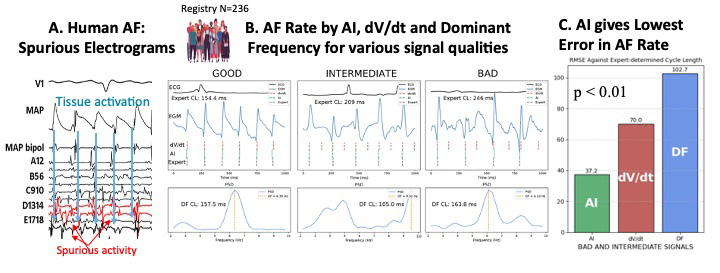
Abstract Body (Do not enter title and authors here): Background: Mapping of atrial fibrillation (AF) remains challenging and has not consistently improved ablation. A common problem, recognized by Galappasinge and Gray, de Groot, and others, is that AF electrograms (EGM) may not faithfully represent tissue activation (i.e. action potentials, AP). Consequently, regions with apparent rapid activation may reflect spurious EGM deflections (fig. A, red). We hypothesized that artificial intelligence (AI) can be trained to infer true tissue activation by matching AF EGMs to corresponding local APs.
Objective: To test whether an AI-based AF beat-detection algorithm ,trained to suppress spurious activations in low-quality AF EGMs (fig. B, top right panel), estimates AF rate more accurately than existing methods including dV/dt or dominant frequency (DF).
Methods: We developed coMap, an AI-system trained on >20 million EGMs from a registry of N=236 AF patients (69.0±8.3 years, 72.6% non-paroxysmal AF). We estimated AF rates using AI-derived beat detections, dV/dt maxima, and DF of the Fourier Transform in a validation cohort of N=62 patients and >5 million EGMs, across high, intermediate and low recordings. Expert consensus served as the reference standard.
Results: AI-beat detection is illustrated in Fig. B, showing performance across signal qualities relative to expert-annotated ground truth (black). dV/dt often marked spurious deflections. While DF was accurate in high-quality signals, it did poorly for intermediate and low quality signals. In these lower quality signals, Fig. C shows that root mean squared error (RMSE)was significantly lower for AI (37.2 [30.1 - 43.5]) compared to dV/dt (70.0 [66.6 - 73.3]) and DF (102.7 [78.1 - 123.1]), p<0.01. Similar trends were observed for high quality signals, where AI (RMSE: 23.0) also outperformed standard approaches (dV/dt 87.2, DF 58.2, p<0.01).
Conclusions: Rate detection in AF is more accurate using a novel AI-based beat tracking approach than conventional EGM marking or frequency-based approaches, especially for lower quality signals. Future work could incorporate this approach to guide the identification of ablation targets and potentially enhance clinical outcomes.
Ruiperez-campillo, Samuel
(
ETH Zurich
, Zurich , Switzerland )
Fillon, Thomas
(
PhysCade
, PALO ALTO , California , United States )
Narayan, Sanjiv
(
STANFORD MEDICINE
, Stanford , California , United States )