
Logo

American Heart Association

  18
  0


Final ID: MP980

Artificial-Intelligence Based Smart Catheter Guidance for Atrial Fibrillation Ablation: Large Registry Validation

Abstract Body (Do not enter title and authors here): Background:
Ablation of atrial fibrillation (AF) by pulmonary vein (PV) isolation has limited success in some patients. However, identifying additional ablation targets in such patients currently requires mapping the entire atrium, which is time-consuming and poorly accounts for real-time changes.

Objectives:
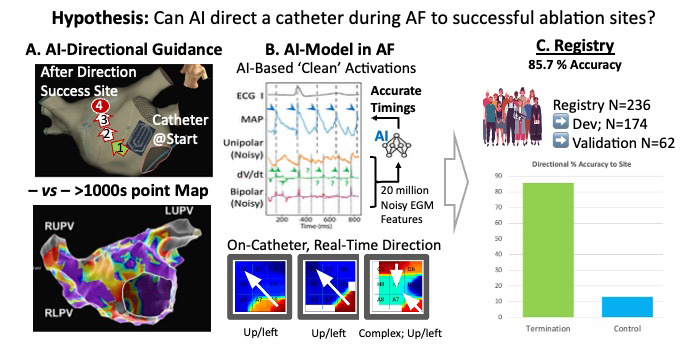
We developed an Artificial-Intelligence (AI) based system that can guide an electrophysiology catheter in real-time (i.e. left/right, superior/inferior) during AF from an arbitrary location directly to sites leading to AF termination or 1Y success (fig. A). We validated the system in a large registry, and evaluated projected time savings from this approach.

Methods:
coPilot is an AI-system developed and tested in separate cohorts on ~20 million electrograms in a N=236 patient registry with physiological and clinical ground truth labels. First, we trained recurrent neural network (RNN) models to estimate AF activation times using unipolar and bipolar electrogram features (first derivative dV/dt, shape), tuned in a random forest classifier to experts informed by monophasic action potential (MAP) tracings (fig. B; top). Second, we applied this AI-model to multi-electrode catheters (e.g. local HDGrid, global Basket), to calculate predominant AF wave direction (fig. B bottom). Third, we validated if moving a catheter in AI-indicated directions reached successful AF ablation sites in a hold-out set not used for training.

Results:
The validation cohort was 69.0±8.3 years’ and 72.6% had non-paroxysmal AF. In Fig. B, AF activation times by traditional electrogram features were noisy versus MAPs (arrows). Fig. B (bottom) shows AI-activation times on a multi-electrode array in a 67Y woman in persistent AF, showing predominantly up/left activity over time. The array was moved accordingly and analysis repeated (steps 1-4 in fig. A, top), until the AF termination site was reached. coPilot pointed to 85.7% of AF termination versus 13.1% of control sites (p<0.01, fig. C). coPilot also reached sites ablated in cases of long-term success (68.8% at 1Y). Time to the successful region was 4.2±1.1 movements (estimated <5 minutes) that was shorter than atrial mapping time (>10-15 minutes).

Conclusions:
A novel AI-based system trained to physiological and clinical gold standards can rapidly steer a clinical catheter during AF to successful ablation sites. This approach has promise for improving the success of AF ablation while reducing case time over existing strategies.
  • Ruiperez-campillo, Samuel  ( ETH Zurich , Zurich , Switzerland )
  • Fillon, Thomas  ( PhysCade Inc , Palo Alto , California , United States )
  • Brodt, Chad  ( Silicon Valley Cardiology , Palo Alto , California , United States )
  • Faddis, Mitchell  ( Washington University Med School , Saint Louis , Missouri , United States )
  • Narayan, Sanjiv  ( STANFORD MEDICINE , Stanford , California , United States )
  • Author Disclosures:
    Samuel Ruiperez-Campillo: DO have relevant financial relationships ; Consultant:Physcade Inc:Active (exists now) ; Individual Stocks/Stock Options:Physcade Inc:Active (exists now) | Thomas Fillon: No Answer | Chad Brodt: No Answer | Mitchell Faddis: No Answer | Sanjiv Narayan: DO have relevant financial relationships ; Consultant:Lifesignals.ai:Active (exists now) ; Consultant:Abbott, Inc.:Past (completed) ; Consultant:PhysCade, Inc.:Active (exists now)
Meeting Info:

Scientific Sessions 2025

2025

New Orleans, Louisiana

Session Info:

Harnessing AI: Innovations in Arrhythmia Detection and Management

Saturday, 11/08/2025 , 09:15AM - 10:30AM

Moderated Digital Poster Session

More abstracts on this topic:
A RETROSPECTIVE EVALUATION OF RESOURCE UTILIZATION AND OUTCOMES IN PATIENTS USING MOBILE ECG DEVICES FOLLOWING ABLATION FOR ATRIAL FIBRILLATION

Fairman Alix, Loh Alexander, Druml Lauren, Triplett Cynthia, Liu Taylor, Pursnani Seema


A Large Animal Model of Persistent Atrial Fibrillation

Mostafizi Pouria, Goldman Steven, Moukabary Talal, Lefkowitz Eli, Ref Jacob, Daugherty Sherry, Grijalva Adrian, Cook Kyle Eric, Chinyere Ike, Lancaster Jordan, Koevary Jen

You have to be authorized to contact abstract author. Please, Login
Not Available