
Logo

American Heart Association

  21
  0


Final ID: Su3048

Mechanisms and Anatomical Localization of Left Atrioventricular Valve Regurgitation Following Atrioventricular Canal Defect Repair Using Two- and Three-Dimensional Echocardiography

Abstract Body (Do not enter title and authors here): Background:
Left atrioventricular valve regurgitation (LAVVR) after atrioventricular canal (AVC) defect repair remains a significant contributor to morbidity and mortality, and often requires reintervention. While previous studies have assessed leaflet morphology and papillary muscle anatomy, limited data exist on the typical mechanisms and anatomic locations of LAVVR in this population. Understanding these factors may inform surgical strategies and improve long-term outcomes.
Hypothesis:
Two- and three-dimensional echocardiography can characterize the anatomical location and mechanism of significant LAVVR in patients with repaired AVC defects.
Methods:
Single center, retrospective analysis of patients who underwent echocardiography following AVC repair. 2D and 3D echocardiography were used to evaluate severity, location, and mechanism of LAVVR. LAVVR was characterized as significant if graded as moderate or greater by color Doppler. Anatomic sites and mechanisms were compared between groups. Inter-modality agreement was assessed using Cohen’s Kappa.
Results:
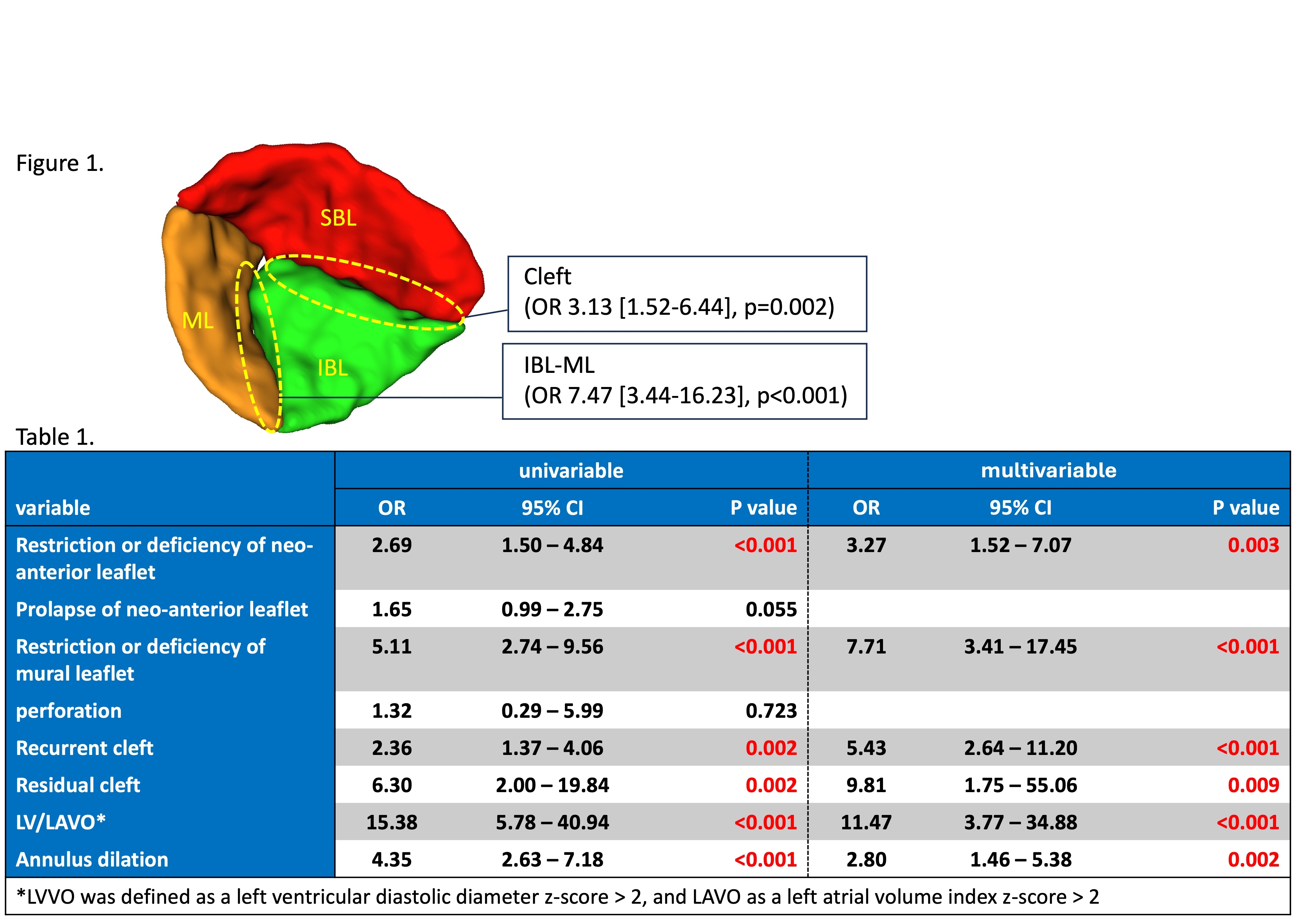
Echocardiography was performed in 299 patients and 109 (36.4%) demonstrated significant LAVVR. Evaluated patients had complete (76.6%), transitional (9.7%), or incomplete (13.7%) AVC. Based on LAVVR severity, there was no differences in AVC type, Rastelli classification, age or trisomy 21 prevalence. Complete cleft closure and annuloplasty were more frequent in the non-significant LAVVR group. Significant LAVVR more commonly involved the cleft (p<0.001) and region of coaptation between the inferior bridging and mural leaflets (IBL-ML) (p=0.009). Multivariable analysis identified these sites independently increased risk (OR: cleft 3.13, IBL-ML 7.47, p<0.01, Figure 1). Mechanisms of LAVVR were often multifactorial. Restriction or deficiency of neo-anterior and ML, recurrent/residual cleft, dilated LAVV annulus and atrial/ventricular dilation remained significant after adjusting for surgical techniques (Table 1). 2D vs. 3D showed moderate agreement in mechanism identification (κ=0.278–0.629), but lower concordance for location.
Conclusion:
Clinically significant LAVVR after AVC repair is frequently associated with specific anatomic locations and mechanisms of regurgitation. 3D echocardiography can provide additional insight into these features. Our novel findings enhance the understanding of a significant source of morbidity in this vulnerable patient population.
  • Numata, Ryusuke  ( Children's Hospital of Philadelphia , Philadelphia , Pennsylvania , United States )
  • Jolley, Matthew  ( Children's Hospital of Philadelphia , Philadelphia , Pennsylvania , United States )
  • Metcalf, Meghan  ( Children's Hospital of Philadelphia , Philadelphia , Pennsylvania , United States )
  • Chaszczewski, Kasey  ( Herma Heart Institute, Children's Wisconsin , Milwaukee , Wisconsin , United States )
  • Wang, Yan  ( Children's Hospital of Philadelphia , Philadelphia , Pennsylvania , United States )
  • Daemer, Matthew  ( Children's Hospital of Philadelphia , Philadelphia , Pennsylvania , United States )
  • Rogers, Lindsay  ( Children's Hospital of Philadelphia , Philadelphia , Pennsylvania , United States )
  • Quartermain, Michael  ( Children's Hospital of Philadelphia , Philadelphia , Pennsylvania , United States )
  • Nuri, Muhammad  ( Children's Hospital of Philadelphia , Philadelphia , Pennsylvania , United States )
  • Chen, Jonathan  ( Children's Hospital of Philadelphia , Philadelphia , Pennsylvania , United States )
  • Author Disclosures:
    Ryusuke Numata: DO NOT have relevant financial relationships | Matthew Jolley: No Answer | Meghan Metcalf: DO NOT have relevant financial relationships | Kasey Chaszczewski: DO NOT have relevant financial relationships | Yan Wang: DO NOT have relevant financial relationships | Matthew Daemer: DO NOT have relevant financial relationships | Lindsay Rogers: DO NOT have relevant financial relationships | Michael Quartermain: DO NOT have relevant financial relationships | Muhammad Nuri: No Answer | Jonathan Chen: No Answer
Meeting Info:

Scientific Sessions 2025

2025

New Orleans, Louisiana

Session Info:

Technologic and Clinical Advances in CHD Care

Sunday, 11/09/2025 , 11:30AM - 12:30PM

Abstract Poster Board Session

More abstracts on this topic:
Circadian Disruption by Shift Work Drives Aortic Valve Calcification Through BMAL1-SEMA6D-PPARγ Axis Inhibition

Tong Fuqiang, Qian Xingyu, Yim Wai, Zheng Yidan, Xu Li, Dong Nianguo, Li Fei

18F-FDG PET/CT Evaluation of Incidental Extracardiac CT Findings on 82Rb-Chloride PET Myocardial Perfusion Imaging

Dhaliwal Jasmeet, David Sthuthi, Puente Cesar, Nandakumar Menon, Sayre James, Zhong Jin, Berenji Gholam, Packard Rene

More abstracts from these authors:
Three-Dimensional Principal Strain Analysis of Children with Duchenne Muscular Dystrophy Can Detect Early Changes in Left Ventricular Contraction

Sivasubramanian Dhiran, Numata Ryusuke, Lin Kimberly, Wang Yan, Pedrizzetti Gianni, Wittlieb-weber Carol, Banerjee Anirban

Principal Strain Analysis by 3D Echocardiography Provides Novel Insights into Function and Prognostication in Single Left Ventricles.

Numata Ryusuke, Matsubara Daisuke, Sato Tomoyuki, Calderon-anyosa Renzo, Wang Yan, Collia Dario, Pedrizzetti Gianni, Banerjee Anirban

You have to be authorized to contact abstract author. Please, Login
Not Available