Three-Dimensional Principal Strain Analysis of Children with Duchenne Muscular Dystrophy Can Detect Early Changes in Left Ventricular Contraction
Abstract Body (Do not enter title and authors here): Background: Principal strain (PS) analysis offers a novel approach for evaluating the three-dimensional deformation of the left ventricle (LV) using 3D speckle-tracking echocardiography (STE). Unlike traditional 2D-strain measurements that focus only on the magnitude of deformation along a single axis, PS analysis quantifies both the magnitude and the angle of deformation, providing information on the directionality of myocardial fiber contraction. We applied PS in a cohort of Duchenne muscular dystrophy (DMD) patients with preserved EF (>50%) and mildly reduced LV EF (>41-49%).
Hypothesis: PS angle may reveal changes in LV fiber orientation that may serve as a compensatory mechanism before the progression of cardiomyopathy in DMD patients.
Methods: This is a cross-sectional study involving 54 genetically confirmed DMD patients with no cardiac symptoms. The age range was 3 to 19 years (median age 10.3 years ± 4.4). We studied 53 age-matched healthy male controls (12 years ± 4.3). The magnitude and direction of 3D global PS (GPS), 3D global longitudinal strain (GLS), and 3D global circumferential strain (GCS) were calculated. We compared the magnitude of 3D strains and PS angles between DMD and controls, and assessed relationships between 3D EF and GLS, GPS, and PS angles in DMD subjects.
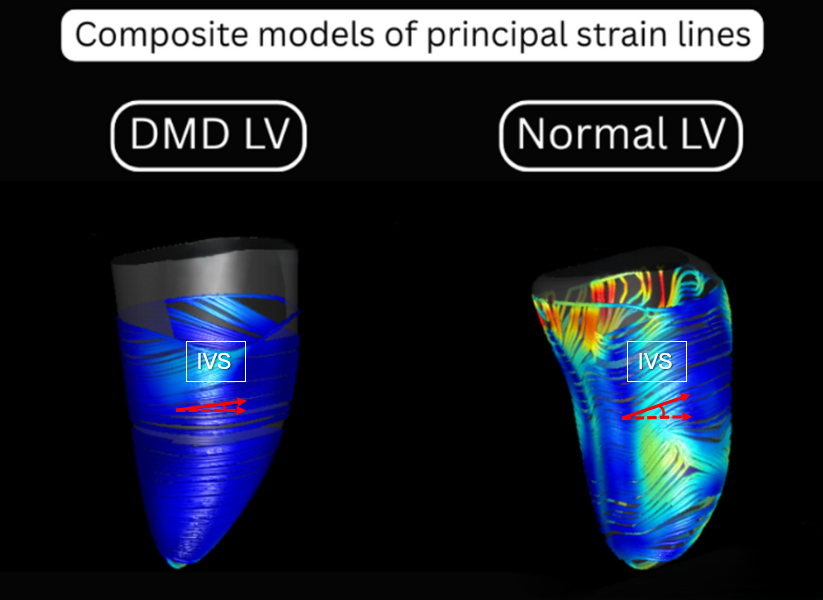
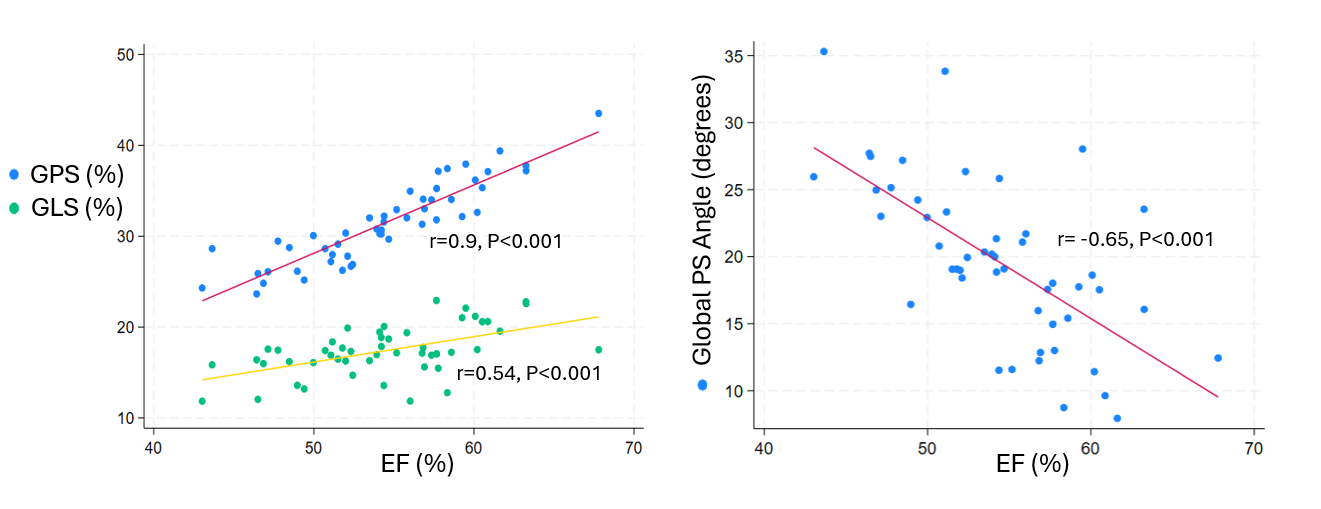
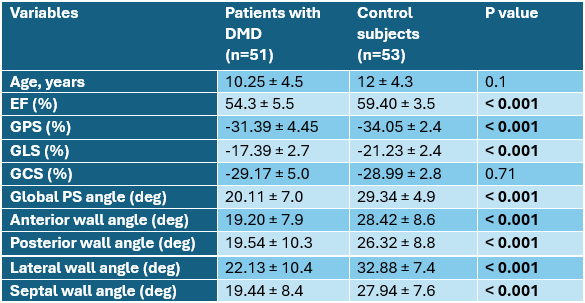
Results: In the DMD group, magnitudes of GPS and GLS were reduced compared to controls (Table 1). PS angles in all four walls (anterior, posterior, lateral, septal) had a more horizontal orientation compared to controls (Figure 1 and Table 1). GPS had the strongest correlation with EF (r= 0.91, p value < 0.001, Figure 2). Comparatively, GLS showed a weaker correlation with EF (r= 0.46, p<0.001, Figure 2). Global PS angle had a moderately strong inverse correlation with EF (r= -0.69, P < 0.001, Figure 2).
Conclusion: Principal strain analysis using 3D STE reveals alterations in myocardial fiber orientation in DMD patients, characterized by a more horizontal deformation pattern. Within the constraints of a cross-sectional study design, we speculate that these directional alterations in myofiber contraction may represent compensatory changes in the LV to preserve cardiac output, as evidenced by a moderately strong correlation between the PS angle and EF. These adaptations occur before progression to clinically significant cardiomyopathy. This technique may offer a valuable, noninvasive tool for early detection and monitoring of cardiac involvement in DMD patients.
Sivasubramanian, Dhiran
( Children's Hospital of Philadelphia
, Philadelphia
, Pennsylvania
, United States
)
Numata, Ryusuke
( Children's Hospital of Philadelphia
, Nagano
, Japan
)
Lin, Kimberly
( Childrens Hospital of Philadelphia
, Swarthmore
, Pennsylvania
, United States
)
Wang, Yan
( Children's Hospital of Philadelphia
, Philadelphia
, Pennsylvania
, United States
)
Pedrizzetti, Gianni
( University of Trieste
, Tireste
, Trieste
, Italy
)
Wittlieb-weber, Carol
( Children's Hospital of Philadelphia
, Philadelphia
, Pennsylvania
, United States
)
Banerjee, Anirban
( Children's Hospital of Philadelphia
, Philadelphia
, Pennsylvania
, United States
)
Author Disclosures:
Dhiran Sivasubramanian :DO NOT have relevant financial relationships
| Ryusuke Numata:DO NOT have relevant financial relationships
| Kimberly Lin:DO have relevant financial relationships
;
Consultant:Cytokinetics:Active (exists now)
| Yan Wang:DO NOT have relevant financial relationships
| Gianni Pedrizzetti:DO have relevant financial relationships
;
Consultant:Medis:Active (exists now)
| Carol Wittlieb-Weber:DO have relevant financial relationships
;
Consultant:Pfizer:Past (completed)
; Consultant:Sarepta:Past (completed)
| Anirban Banerjee:No Answer