Uptake of primary and secondary prevention against atherosclerotic disease in the Danish background population
Abstract Body (Do not enter title and authors here): Background Atherosclerotic cardiovascular disease (ASCVD) remains the leading cause of mortality worldwide. Primary and secondary prevention are crucial to reduce morbidity and mortality. Statins, acetylsalicylic acid (ASA), and/or adenosine diphosphate receptor inhibitors (ADPi) are recommended to all with established ASCVD for secondary prevention, and statins are often used in primary prevention. However, adherence and prescription patterns can vary significantly with age, potentially affecting outcomes. As part of a global research effort, we aimed to investigate the extent of clinical and silent atherosclerosis in individuals aged 18–70 years—an age group selected to optimize early preventive strategies.
Purpose To describe prescription patterns of ASA, ADPi, and statins for primary and secondary prevention across adult life, with a focus on disparities and potential adherence gaps by age.
Methods We analyzed a representative sample (matched on age, sex, and socioeconomic status) of individuals aged 18–70 years in December 2024, based on national registries. We identified those with or without ASCVD (defined via ICD-10 and procedure codes for ischemic heart disease, stroke, and peripheral artery disease) and recorded if they had filled at least one prescription for ASA, ADPi, or statins.
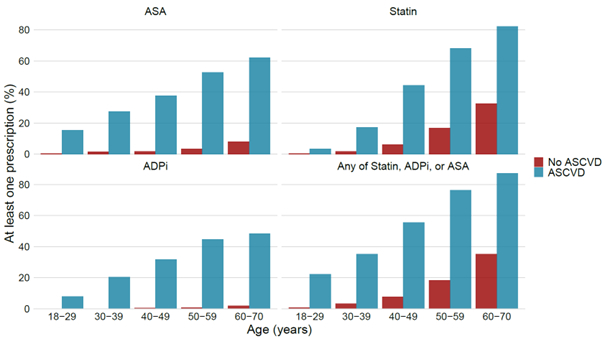
Results The sample included 160,000 individuals (50% female), median age 46 (range 18–70, IQR 33–58). ASCVD was found in 9,825 (6.1%), of whom 7,825 (79.6%) were on secondary prevention. Among 18–29-year-olds, only 20 (22.2%) with ASCVD had prescriptions, increasing to 5,310 (87.2%) in those aged 60–70, driven by ASA and statins. For primary prevention, 19,327 individuals (12.9%) without ASCVD had collected prescriptions—primarily statins. In the youngest group (18–29 years), only 216 (0.7%) had received treatment, increasing to 10,200 (35.0%) in the oldest group.
Conclusion This large, population-based study shows that young individuals with ASCVD have low adherence to recommended therapies. For primary prevention, use remained below 7.7% until age 50, rising to 35% in those aged 60–70. These findings underscore a significant potential for improved prevention of ASCVD, particularly among younger adults.
Kragh, Maja Valentin
(
Copenhagen University Hospital
, Copenhagen , Denmark )
Kofoed, Klaus
(
Rigshospitalet
, Copenhagen , Denmark )
Ibanez, Borja
(
CNIC
, Madrid , Spain )
Bundgaard, Henning
(
NATIONAL UNIVERSITY HOSPITAL
, Copenhagen , Denmark )
Author Disclosures:
Maja Valentin Kragh:DO NOT have relevant financial relationships
| Klaus Kofoed:No Answer
| Borja Ibanez:DO NOT have relevant financial relationships
| Henning Bundgaard:DO NOT have relevant financial relationships
| Rasmus Hasselbalch:DO have relevant financial relationships
;
Other (please indicate in the box next to the company name):Work on project funded by Novo Nordisk Foundation:Active (exists now)
| Carlos Nicolás Perez-Garcia:DO NOT have relevant financial relationships
| Joakim Kunkel:DO NOT have relevant financial relationships
| Ines Garcia-Lunar:DO NOT have relevant financial relationships
| Nikolaj Eldrup:No Answer
| Jose Fuster:DO NOT have relevant financial relationships
| Morten Bottcher:DO NOT have relevant financial relationships
| Kasper Iversen:No Answer