Risk assessment in primary prevention: plaque matters most
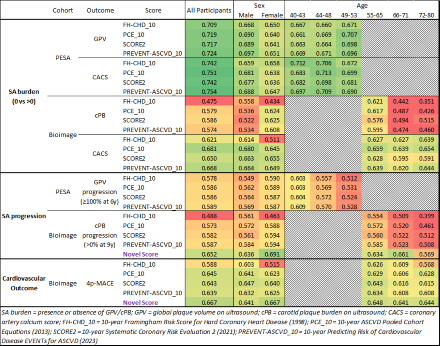
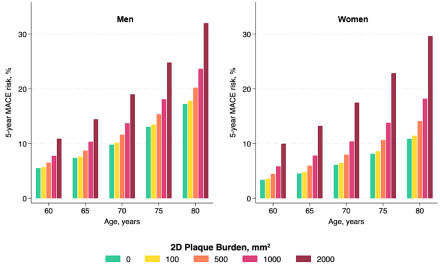
Abstract Body (Do not enter title and authors here): Background: Cardiovascular disease (CVD) risk stratification in primary prevention involves risk factor-based calculators. Subclinical atherosclerosis (SA) disease burden represents an individualized signature of cumulative risk factor exposure and may be undervalued in traditional assessment. Research Questions: How do risk calculators perform for predicting SA surrogates in healthy participants? Can a simplified risk score incorporating SA burden compete with conventional risk factor-based calculators? Methods: Asymptomatic participants in the Progression of Early Subclinical Atherosclerosis (PESA) and BioImage cohorts underwent assessment of ultrasound (US) plaque presence/progression and coronary artery calcium (CAC) presence, which were analyzed as binary surrogate outcomes of atherosclerosis. The performance of various calculators was compared using C-statistics in each cohort overall, by sex, and by age tertiles. A simplified novel risk score utilizing age, sex, and US plaque burden was developed in the BioImage cohort for predicting 5-year major adverse cardiovascular events (MACE; all-cause death, stroke, myocardial infarction, or coronary revascularization). Comparisons were drawn with established risk scores using C-statistics. Results: The cohorts had distinct characteristics (PESA n=3588, median age 46 years, 36% female; BioImage n=6011, median age 69 years, 57% female). All scores were moderately accurate for SA presence by US and CAC, though performance diminished with age (see Table). Scores were less accurate for predicting SA progression in either cohort. In the BioImage cohort, 473 MACE were observed at 5 years. Estimates of 5-year risk increased with age, with increasing baseline plaque burden, and with male sex (see Figure). Performance of the novel calculator using only age, sex, and plaque burden was significantly better than traditional risk factor-based scores (C-statistic 0.667, see Table). Conclusion: In two large cohorts of healthy participants with distinct age ranges, risk factor-based calculators predict SA surrogates with similar accuracy to their prediction of cardiovascular outcomes. A novel simplified score derived from 3 variables (age, sex, plaque burden) outperformed several contemporary risk factor-based calculators. Incorporating SA burden may improve a precision medicine approach to the primary prevention of CVD.
Skoza, Warren
(
CNIC
, Madrid , Spain )
Taylor, Dylan
(
CNIC
, Madrid , Spain )
De Cortes Oliva Pellicer, Belen
(
CNIC
, Madrid , Spain )
Pocock, Stuart
(
London School of Hygiene and Tropic
, London , United Kingdom )
Galan, Carlos
(
CNIC
, Madrid , Spain )
Devesa, Ana
(
CNIC
, Madrid , Spain )
Khan, Sadiya
(
Northwestern University
, Chicago , Illinois , United States )
Shapiro, Michael
(
Wake Forest Univ School of Medicine
, Winston Salem , North Carolina , United States )
Sanchez-gonzalez, Javier
(
Philips HealthCare
, Madrid , Spain )
Garcia-lunar, Ines
(
CNIC
, Madrid , Spain )
Garcia Alvarez, Ana
(
CNIC
, Madrid , Spain )
Fuster, Valentin
(
MOUNT SINAI HOSPITAL
, New York , New York , United States )
Ibanez, Borja
(
CNIC
, Madrid , Spain )
Author Disclosures:
Warren Skoza:DO NOT have relevant financial relationships
| Ines Garcia-Lunar:DO NOT have relevant financial relationships
| Ana Garcia Alvarez:No Answer
| Valentin Fuster:DO NOT have relevant financial relationships
| Borja Ibanez:DO NOT have relevant financial relationships
| Dylan Taylor:DO NOT have relevant financial relationships
| Belen de Cortes Oliva Pellicer:No Answer
| Stuart Pocock:No Answer
| Carlos Galan:No Answer
| Ana Devesa:No Answer
| Sadiya Khan:DO NOT have relevant financial relationships
| Michael Shapiro:DO have relevant financial relationships
;
Consultant:Ionis:Past (completed)
; Consultant:Arrowhead:Past (completed)
; Consultant:Regeneron:Past (completed)
; Researcher:New Amsterdam:Active (exists now)
; Researcher:Merck:Active (exists now)
; Researcher:Novartis:Active (exists now)
; Researcher:Esperion:Active (exists now)
; Researcher:Cleerly:Active (exists now)
; Researcher:Amgen:Active (exists now)
; Consultant:Novo Nordisk:Active (exists now)
; Consultant:Tourmaline:Active (exists now)
; Consultant:Merck:Active (exists now)
; Consultant:New Amsterdam:Past (completed)
; Consultant:Novartis:Active (exists now)
| Javier Sanchez-Gonzalez:No Answer