
Logo

American Heart Association

  23
  0


Final ID: MP1046

In Vitro Investigation of the Pathophysiological Mechanisms Underlying Severe Cardiomyopathic Phenotypes Associated with Noonan Syndrome with Multiple Lentigines

Abstract Body (Do not enter title and authors here): [Background]
RASopathy-associated cardiomyopathy (RAS-CMP) is thought to involve abnormalities in cardiomyocyte differentiation and maturation. In our previous work, we identified the presence of Ki-67-labeled cardiomyocytes in the hearts of patients with Noonan syndrome with multiple lentigines (NSML) and related forms of RAS-CMP. In this study, we employed a cellular model of NSML-associated cardiomyopathy (NSML-CMP) to investigate the molecular determinants of cardiomyocyte proliferative potential and to elucidate the contribution of these Ki-67-labeled cardiomyocytes to the pronounced myocardial thickening observed in NSML-CMP.
[Methods]
A NSML-causing, PTPN11 G464A pathogenic mutation was introduced to wild-type iPS cells by the CRISPR-Cas technique, and both mutant and wild-type iPS cells were differentiated into cardiomyocytes (iPSCMs) to generate a NSML-CMP model and its isogenic control. Phenotypic analyses were followed by profiling of the underlying aberrancies in mitogenic signaling.
[Results]
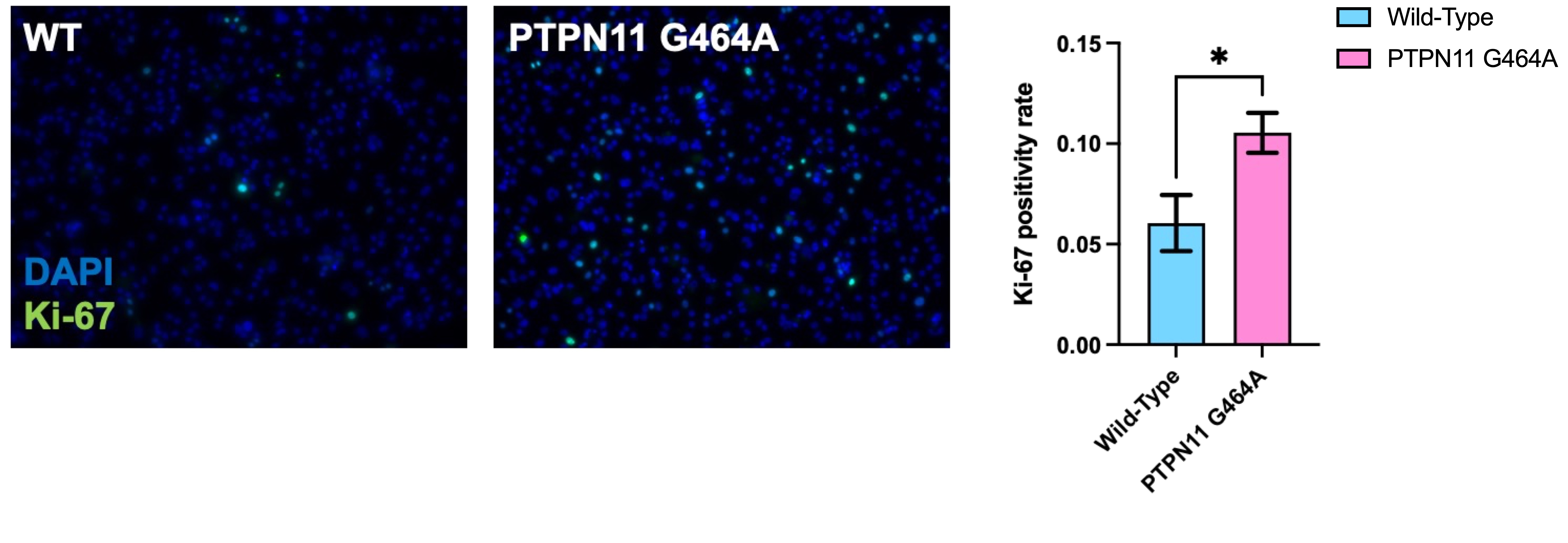
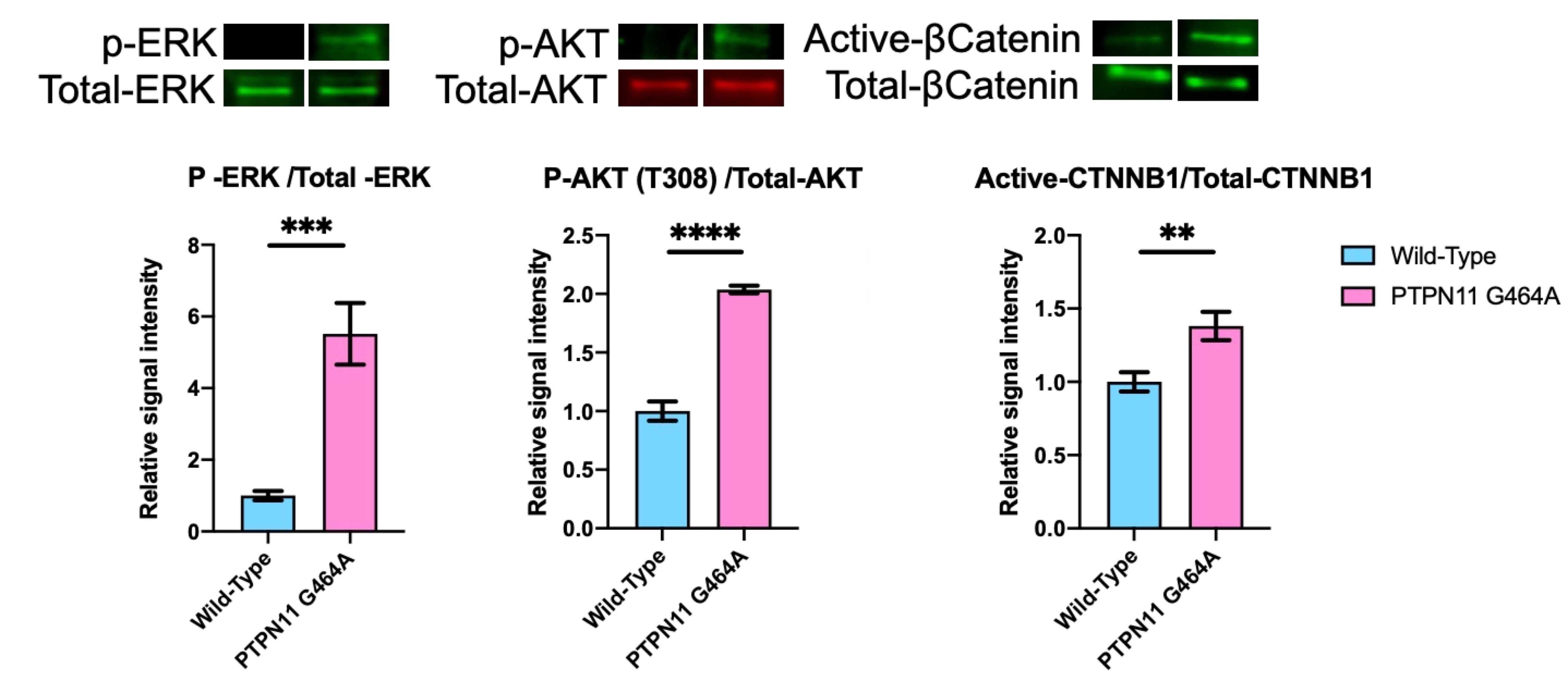
The PTPN11 G464A mutant iPSCMs recapitulated the increased Ki-67-labeling (p<0.01, Fig. 1) and accentuation in downstream Receptor tyrosine kinases(RTK)signaling (p<0.001), seen in cardiomyocytes of NSML-CMP and other related RAS-CMP forms. Pulldown experiments using recombinant PTPN11, as well as its mutant form, identified a candidate partner protein that may serve as a key linker between RTK signaling and other cooperating mitogenic pathways (Fig. 2).
[Discussion]
We have successfully established a cellular model of NSML-CMP that recapitulates key disease features. Aberrant RTK signaling, further amplified by interacting mitogenic networks, appears to drive the enhanced proliferative potential of cardiomyocytes and pronounced myocardial thickening observed in NSML-CMP. Pharmacological intervention and metabolic profiling are currently underway to achieve phenotypic reversal and to uncover novel druggable molecular abnormalities in NSML-CMP beyond mTORC inhibition.
  • Nakagama, Sachie  ( Osaka Metropolitan University , Osaka , Japan )
  • Nakagama, Shun  ( Osaka Metropolitan University , Osaka , Japan )
  • Yamasaki, Masataka  ( The University of Tokyo , Tokyo , Japan )
  • Ito, Masamichi  ( The University of Tokyo , Tokyo , Japan )
  • Kido, Yasutoshi  ( Osaka Metropolitan University , Osaka , Japan )
  • Nakagama, Yu  ( Osaka Metropolitan University , Osaka , Japan )
  • Author Disclosures:
    Sachie Nakagama: DO have relevant financial relationships ; Employee:QMD LLC:Active (exists now) | Shun Nakagama: DO NOT have relevant financial relationships | Masataka Yamasaki: DO NOT have relevant financial relationships | Masamichi Ito: DO NOT have relevant financial relationships | Yasutoshi Kido: No Answer | Yu Nakagama: DO NOT have relevant financial relationships
Meeting Info:

Scientific Sessions 2025

2025

New Orleans, Louisiana

Session Info:

Targeting the Thickened Heart: Advances in Hypertrophic Cardiomyopathy Therapy

Saturday, 11/08/2025 , 10:45AM - 12:00PM

Moderated Digital Poster Session

More abstracts on this topic:
A major uremic toxin indoxyl sulfate impairs macrophage efferocytosis and accelerates atherogenesis: a potential mechanism for cardiovascular risk in chronic kidney disease

Jha Prabhash, Kasai Taku, Vromman Amelie, Holden Rachel, Libby Peter, Tabas Ira, Singh Sasha, Aikawa Elena, Aikawa Masanori, Lupieri Adrien, Sonawane Abhijeet, Le Thanh-dat, Becker-greene Dakota, Chelvanambi Sarvesh, Turner Mandy, Nakamura Yuto, Passos Livia

12,13-diHOME Attenuates Pro-Arrhythmic Effect of High-Fat Diet

Buck Benjamin, Baer Lisa, Deschenes Isabelle, Chinthalapudi Krishna, Gallego-perez Daniel, Stanford Kristin, Hund Thomas, Areiza Natalia, Xu Xianyao, Elliott Austin, Wan Xiaoping, Nassal Drew, Lane Cemantha, Nirengi Shinsuke, James Natasha Maria

More abstracts from these authors:
You have to be authorized to contact abstract author. Please, Login
Not Available