
Logo

American Heart Association

  31
  0


Final ID: MP1999

Pacemaker Magnetic Resonance Imaging: Building Equity for Patients with Cardiovascular Implantable Electronic Devices

Abstract Body (Do not enter title and authors here): Background: More than 2 million people in the United States have cardiovascular implantable electronic devices (CIEDs), such as pacemakers or implantable cardioverter defibrillators. CIED patients often develop medical conditions that require magnetic resonance imaging (MRI) for diagnostic accuracy. Prior to 09/28/2021, MRI was not permitted for CIED patients at our safety-net hospital, stroke center, and trauma center. There are risks when unstable individuals must be transferred to other centers for imaging.
Hypothesis: MRI-conditional CIED patients can be scanned without harm at our safety-net hospital based on a guideline-directed policy that includes experienced MRI staff, ACLS-trained nurses, general cardiologists, and manufacturer representatives.
Goals: Pacemaker MRI available Monday to Friday, 8AM to 5PM. Included: Devices FDA-designated as safe under specific conditions (MRI-conditional). Excluded: Devices that are not MRI-conditional. No abandoned leads, epicardial leads, temporary transvenous systems. No device outside the thorax or at end of battery life.
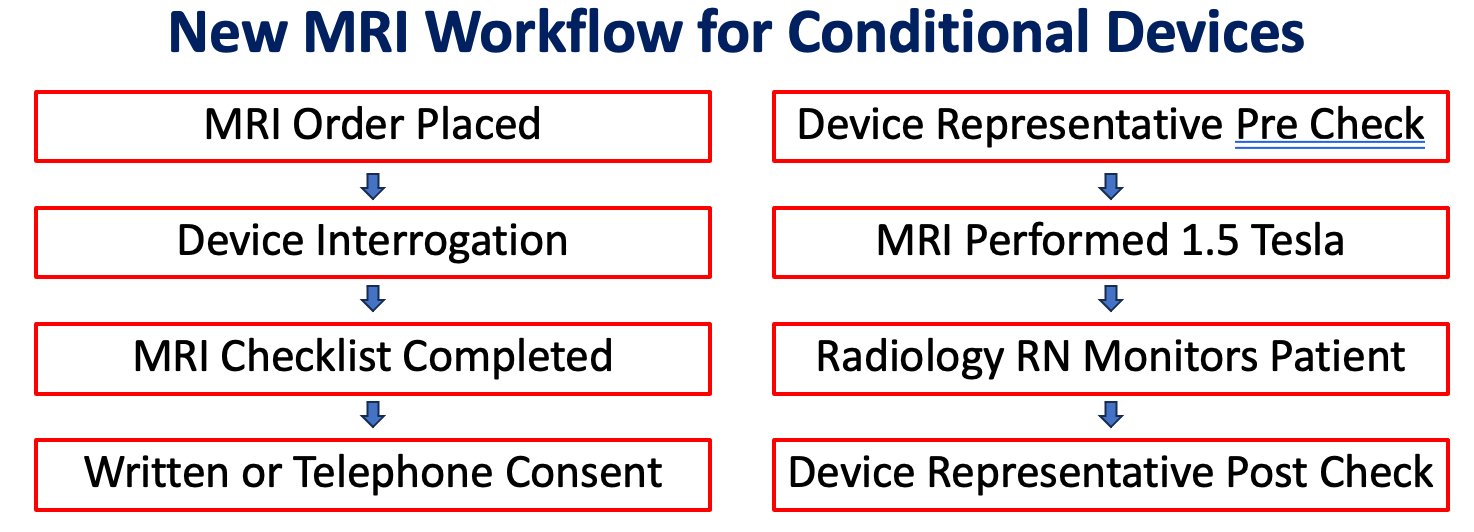
Approach: Graphic 1. Attending Radiologist confirms MRI is the most appropriate diagnostic modality available. Attending Cardiologist responds to questions about underlying condition(s) and device programming.
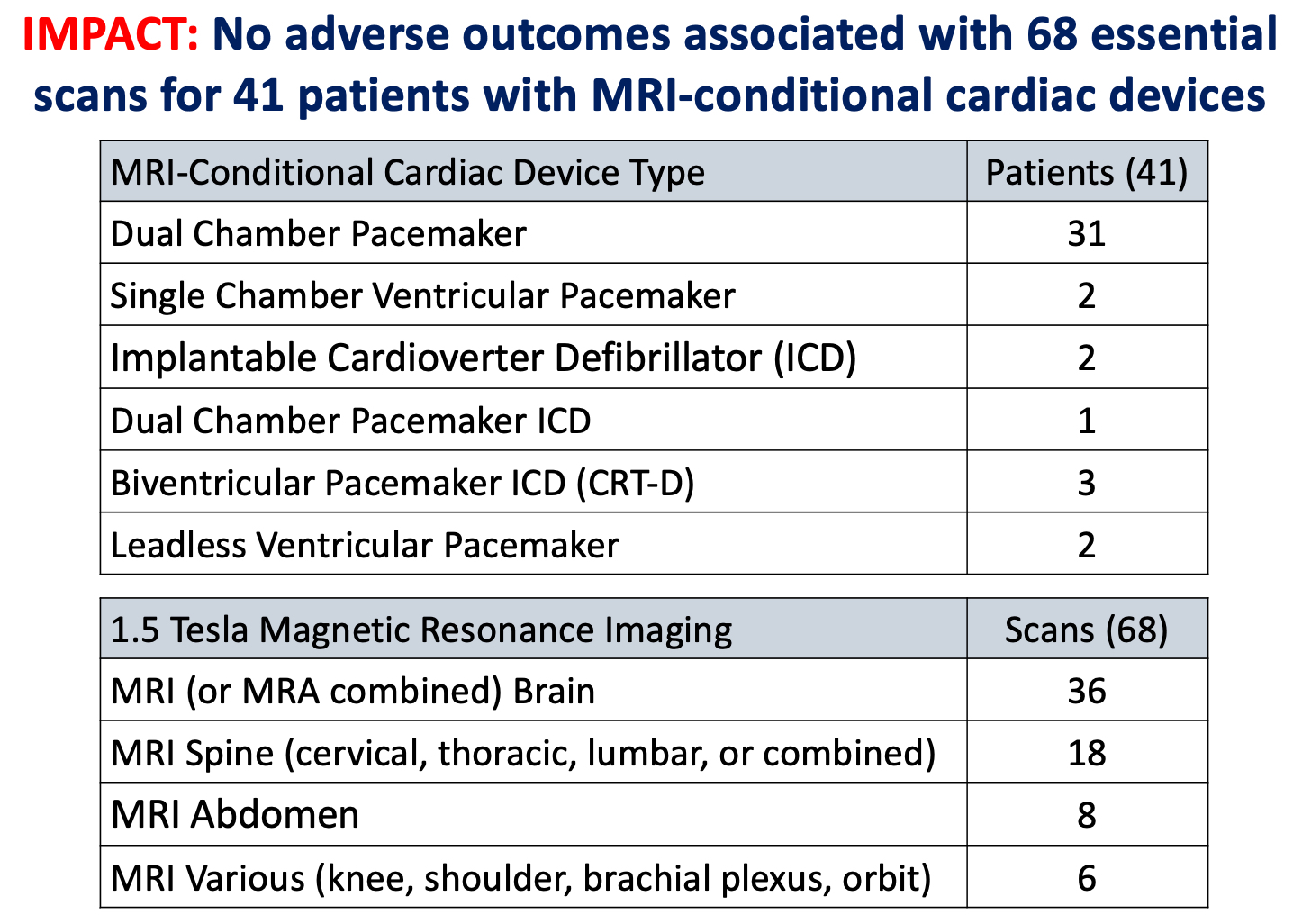
Results: Graphic 2. No adverse outcomes after 68 scans for 41 patients with MRI-conditional devices. No deaths, tissue injuries, pauses, ventricular arrhythmias, or significant changes in programmed parameters. Median age: 77 years. Outpatients: 25. Inpatients: 16. Representative Scenarios: Stroke, Trauma, Infection, Malignancy.
Conclusions: We developed a safe and sustainable MRI workflow at our safety-net hospital, stroke center, and trauma center. We are now engaging stakeholders from Critical Care, Nursing, Anesthesia, Cardiology, and other services to improve workflows for ICU patients with CIEDs. We will explore the feasibility of imaging individuals with MRI non-conditional devices.
  • Gray, Mary  ( UCSF San Francisco General Hospital , San Francisco , California , United States )
  • Win, Sithu  ( UCSF San Francisco General Hospital , San Francisco , California , United States )
  • Haas, Brian  ( UCSF San Francisco General Hospital , San Francisco , California , United States )
  • Wilson, Mark  ( UCSF San Francisco General Hospital , San Francisco , California , United States )
  • Author Disclosures:
    Mary Gray: DO NOT have relevant financial relationships | Sithu Win: No Answer | Brian Haas: DO have relevant financial relationships ; Ownership Interest:NeedleGPS:Active (exists now) | MARK WILSON: No Answer
Meeting Info:

Scientific Sessions 2025

2025

New Orleans, Louisiana

Session Info:

Moving the Needle: Expanding Capabilities in Multimodality Imaging

Monday, 11/10/2025 , 09:15AM - 10:30AM

Moderated Digital Poster Session

More abstracts on this topic:
Association of AHA PREVENT Risk Score with Cardiovascular Mortality Across Social Determinants of Health: A Nationwide Retrospective Cohort Study

Stephens Daniel, Parcha Vibhu, Mcclure Trevor, Cobbs Parker, Nordberg Megan, Clarkson Stephen

Analysis of Racial Disparities in the Training Path to Cardiology: Trends from 2012 to 2022

Gopal Jay, Rahafrooz Maryam, Chan Nathan, Gopal Devraj, Kepler Joshua, Ren Junling, Gopal Indulekha, Joseph Jacob

More abstracts from these authors:
Adiposity and Cardiac Function in South Asian Americans: Findings from the MASALA Study

Kanaya Alka, Nelson Lauren, Running Allison, Lin Feng, Kandula Namratha, Gadgil Meghana, Win Sithu, Shah Sanjiv

You have to be authorized to contact abstract author. Please, Login
Not Available