
Logo

American Heart Association

  31
  0


Final ID: MP2295

Influence of Heart Size and Sex on Cardiovascular Adaptations to 2 Years of Endurance Exercise Training in Sedentary Middle-Aged Adults

Abstract Body (Do not enter title and authors here): Background: Sedentary aging is linked to low cardiorespiratory fitness and poor cardiovascular health. People with smaller left ventricles, particularly females, are more likely to have low fitness levels, which is an important risk factor for developing heart failure. Endurance exercise training can reverse the effects of sedentary aging in middle age, but it remains to be determined whether the cardiovascular adaptations to training are influenced by initial heart size and sex.
Methods: Twenty-eight sedentary adults [15 females; age: 54±5 yr, peak oxygen uptake (VO2): 28.8±4.8 mL/min/kg] completed 2 years of endurance exercise training, with changes in left ventricular end-diastolic volume indexed to body surface area (LV EDVi) and cardiorespiratory fitness assessed following 10 months of progressive training and an additional 14 months of maintenance training.
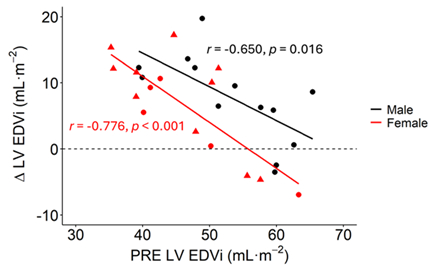
Results: Despite baseline sex differences in LV EDVi at rest (male: 53.3±8.4 vs. female: 46.3±8.4 mL/m2; main effect: p=0.004), both male (Δ = 7.7±6.6 mL/m2) and female (Δ = 6.6±7.5 mL/m2) participants experienced similar increases in EDVi with 2 years of training (main effect of time: p<0.001). Male (r=-0.650, p=0.016) and female (r=-0.776, p<0.001) participants with the smallest initial resting LV EDVi experienced the greatest increase in EDVi with training (Figure), suggesting the greatest cardiac remodeling occurred in individuals with the smallest LV on baseline testing. The increase in peak VO2 (sex × time: p<0.001) of female participants after 2 years (Δ = 0.26±0.14 L/min) was ~50% of the increase observed in male participants (Δ = 0.53±0.20 L/min), which was a consequence of smaller increases in peak stroke volume (sex × time interaction: p=0.013) and cardiac output (sex × time: p=0.005). The changes in arteriovenous O2 difference at peak exercise with training did not interact with the effect of sex (sex × time: p=0.129). Pre-training LV EDVi was not associated with the increase in peak VO2 with training (r=0.263, p=0.176).
Conclusion: Two years of structured endurance exercise training in middle age resulted in similar degrees of cardiac remodeling for both sexes; however, female participants still had blunted increases in cardiorespiratory fitness compared to male participants. Critically, the magnitude of improvement in cardiorespiratory fitness with endurance exercise training was not impaired in previously sedentary adults who had the smallest starting LV EDVi.
  • Hedge, Eric  ( University of Texas Southwestern Medical Center , Dallas , Texas , United States )
  • Howden, Erin  ( Baker Heart and Diabetes Institute , Melbourne , Victoria , Australia )
  • Lawley, Justin  ( University of Innsbruck , Innsbruck , Austria )
  • Cornwell, William  ( University of Colorado Anschutz Medical Campus , Aurora , Colorado , United States )
  • Levine, Benjamin  ( University of Texas Southwestern Medical Center , Dallas , Texas , United States )
  • Sarma, Satyam  ( University of Texas Southwestern Medical Center , Dallas , Texas , United States )
  • Author Disclosures:
    Eric Hedge: DO NOT have relevant financial relationships | Erin Howden: DO have relevant financial relationships ; Consultant:Race Oncology:Active (exists now) | Justin Lawley: No Answer | William Cornwell: DO NOT have relevant financial relationships | Benjamin Levine: DO NOT have relevant financial relationships
Meeting Info:

Scientific Sessions 2025

2025

New Orleans, Louisiana

Session Info:

Physical Activity as Medicine

Monday, 11/10/2025 , 12:15PM - 01:30PM

Moderated Digital Poster Session

More abstracts on this topic:
A-band titin-truncating variant promotes the development of arrhythmia-induced cardiomyopathy in a novel genetically-engineered porcine model

Lee Kwonjae, Del Rio Carlos, Mcnally Elizabeth, Pfenniger Anna, Bhatnagar Ashita, Glinton Kristofor, Burrell Amy, Ober Rebecca, Mcluckie Alicia, Bishop Brian, Rogers Christopher, Geist Gail

Relationship between hemodynamics and oxygen consumption in hypertrophic cardiomyopathy during maximal stress testing

Parrish Jonathan, Macgowan Guy, Jakovljevic Djordje, Charman Sarah, Blain Alasdair, Okwose Nduka, Fuller Amy, Alyahya Alaa, Russell Sophie, Eggett Christopher, Luke Peter, Bailey Kristian

More abstracts from these authors:
Autonomic Underpinnings of Long COVID

Cornwell William, Levine Benjamin

HFpEF in Space: The Influence of Weightlessness on Cardiac Filling Pressure in Obese Heart Failure with Preserved Ejection Fraction

Manferdelli Giorgio, Macnamara James, Hearon Christopher, Shah Aman, Tayon Kevin, Pandey Ambarish, Sarma Satyam, Levine Benjamin

You have to be authorized to contact abstract author. Please, Login
Not Available