One Size Doesn't Fit All: Age-Stratified Analysis of Digital Health Readiness and Patient Portal Use in US Adults with Cardiovascular Disease from 2024 Health Information National Trends Survey
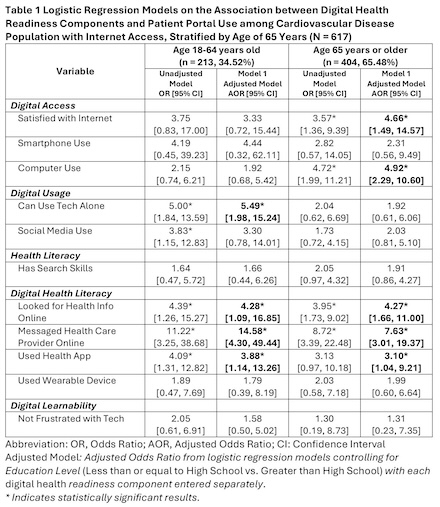
Abstract Body (Do not enter title and authors here): Background: Patient portals can support cardiovascular disease (CVD) management, but disparities in digital health readiness, especially among older adults, may limit their use. Understanding age-specific digital health readiness gaps is key to promoting equitable engagement. Research Questions: How is digital health readiness associated with patient portal use among US adults with CVD, and how do these associations vary by age group (18–64 vs. ≥65)? Methods: Cross-sectional analysis was done using the 2024 Health Information National Trends Survey 7 among those with self-reported CVD (heart attack, angina, or congestive heart failure) and internet access (used internet on any device). Digital health readiness domains include: 1) digital access (internet satisfaction, smartphone, computer use), 2) digital usage (can use tech alone, social media use), 3) digital literacy (search skills), 4) digital health literacy (looking up health info, messaging providers, app and wearable use), and 5) learnability (tech frustration). The outcome was self-reported patient portal use in the past year (Yes/No). Education was identified as a covariate based on bivariate analysis. Weighted logistic regressions were stratified by age, controlling for education. Results: A total of 644 adults (weighted N, 20.7 million) were included (mean(SD) age: 60(21) years; 66% ≥65 years, and 73% Non-Hispanic White adults). Overall, 70% reported using patient portals in the past year (75% of adults aged 18-64 and 66% of adults aged ≥65). In adults aged 18–64, patient portal use was associated with ability to use tech alone (Adjusted odds ratio [AOR] 5.5, 95%CI: 2.0–15.2), looking up health info (AOR 4.3, 95%CI: 1.1–16.9), messaging providers (AOR 14.6, 95%CI: 4.3–49.4), and health app use (AOR 3.9, 95%CI: 1.1–13.2). For adults aged ≥65 years, patient portal use was associated with computer use (AOR 4.9, 95%CI: 2.3–10.6), satisfaction with internet (AOR 4.7, 95%CI: 1.5–14.6), looking up health info (AOR 4.7, 95%CI: 1.7–11.0), messaging providers (AOR 7.6, 95%CI: 3.0–19.4), and health app use (AOR 3.1, 95%CI: 1.0–9.2). Conclusions: Digital health readiness was associated with patient portal use, but relevant domains differ by age. Adults 18-64 years may benefit from enhancing tech independence and communication features, while adults ≥65 years may require improved access and digital health literacy support. Age-specific interventions are needed to bridge the digital divide in CVD management.
Benjasirisan, Chitchanok
(
Johns Hopkins School of Nursing
, Baltimore , Maryland , United States )
Lim, Arum
(
Johns Hopkins School of Nursing
, Baltimore , Maryland , United States )
Chen, Yuling
(
Johns Hopkins School of Nursing
, Baltimore , Maryland , United States )
Kim, Soo Hyun
(
Johns Hopkins School of Nursing
, Baltimore , Maryland , United States )
Dennison Himmelfarb, Cheryl
(
Johns Hopkins School of Nursing
, Baltimore , Maryland , United States )
Koirala, Binu
(
Johns Hopkins School of Nursing
, Baltimore , Maryland , United States )
Author Disclosures:
Chitchanok Benjasirisan:DO NOT have relevant financial relationships
| Arum Lim:DO NOT have relevant financial relationships
| Yuling Chen:DO NOT have relevant financial relationships
| Soo Hyun Kim:DO NOT have relevant financial relationships
| Cheryl Dennison Himmelfarb:DO NOT have relevant financial relationships
| Binu Koirala:DO NOT have relevant financial relationships