
Logo

American Heart Association

  15
  0


Final ID: MP224

Self-Efficacy Partially Mediates the Association Between Shared Decision Making and Self-Reported Health Status Among US Adults and Those Living with Cardiometabolic Diseases

Abstract Body (Do not enter title and authors here): Background: Shared decision-making (SDM) is recommended to improve health outcomes among adults with cardiometabolic diseases (CMD). Prior studies have suggested that SDM may improve individuals’ self-efficacy. Yet, little is known about the associations between SDM, self-efficacy, and self-reported health status for US adults and those living with CMD.
Research question: What is the association between perceived SDM, self-efficacy, and self-reported health status among US adults and those living with CMD (hypertension and diabetes)?
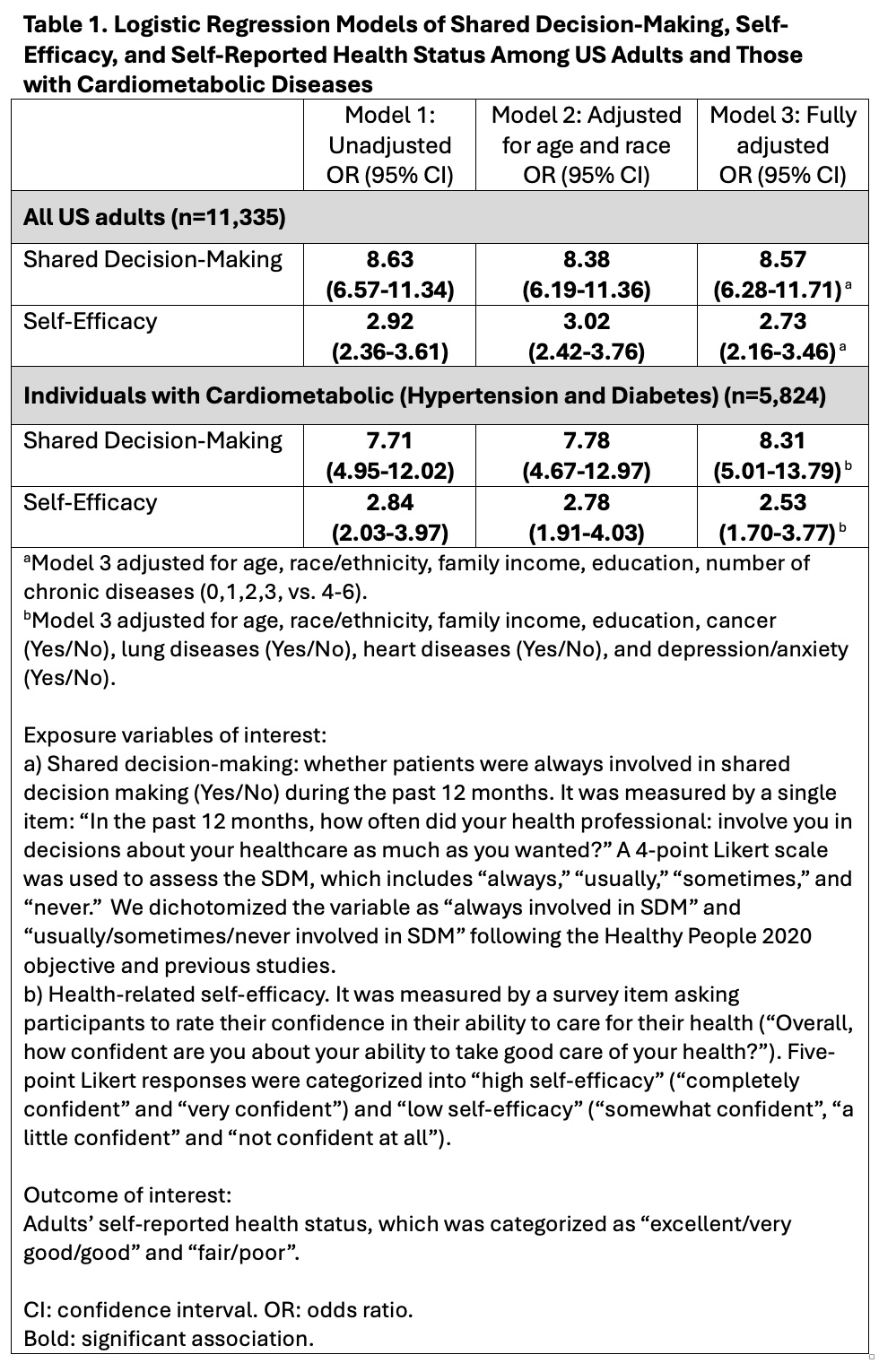
Methods: This cross-sectional study analyzed data from the 2022 and 2024 Health Information National Trends Survey conducted among US adults with CMD. The exposure variables were whether patients were involved in SDM (“always” and “usually/sometimes/never”) during past 12 months and health-related self-efficacy (high/low). The outcome was adults’ self-reported health status (“excellent/very good/good” and “fair/poor”). Three survey-weighted sequential multivariable logistic regression models were developed, including both exposure variables. The fully adjusted model included demographics and self-reported chronic diseases (see Table 1). Finally, causal mediation analyses were performed to examine whether self-efficacy mediates the association between SDM and health status.
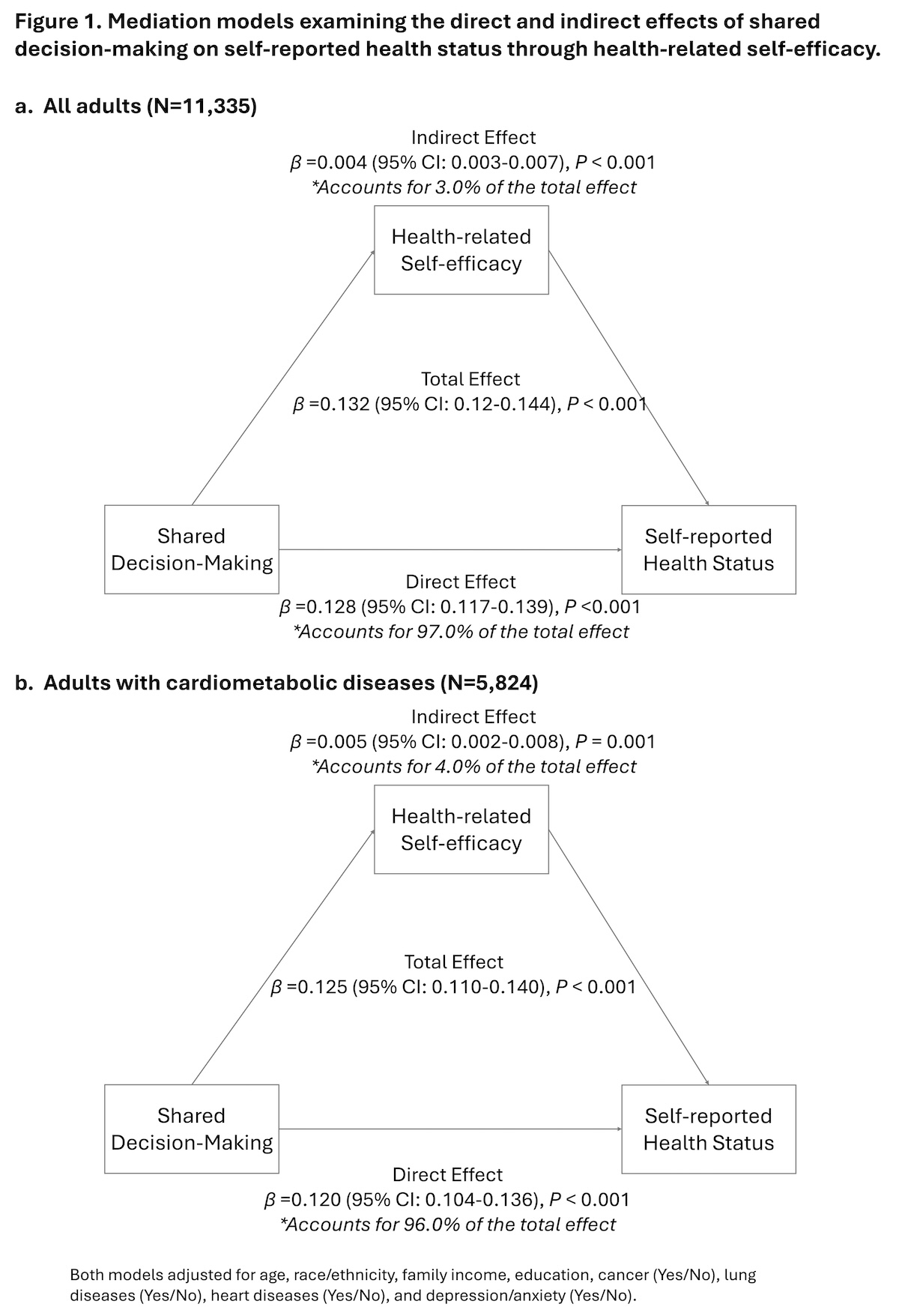
Results: A total of 11,335 US adults were included [mean (SD) age of 50.1 (17.5) years]. Overall, 51.7% of participants reported always being involved in SDM, and 68.6% reported high self-efficacy. The associations were similar in both direction and magnitude for the overall sample and among those with CMD (Table 1). Among adults with CMD, those who were always involved in SDM were 8.31 times (aOR: 8.31, 95% CI: 5.01-13.79) more likely to report better health status, and those with high self-efficacy were 2.53 times (aOR: 2.53, 95% CI: 1.70-3.77) more likely to report better health status. Causal mediation analysis (Fig.1 b) showed that self-efficacy mediated approximately 4% of the total effect of SDM on health status.
Conclusions: Both SDM and self-efficacy were significantly associated with better self-reported health status among US adults, and among those living with CMD. While self-efficacy partially mediated the relationship between SDM and health status, most of the effect was direct, highlighting the central role of SDM in promoting perceived health outcomes. Strategies that enhance adults’ engagement in SDM are important to improve health status.
  • Chen, Yuling  ( Johns Hopkins University School of Nursing , Baltimore , Maryland , United States )
  • Koirala, Binu  ( Johns Hopkins University School of Nursing , Baltimore , Maryland , United States )
  • Davidson, Patricia  ( University of New South Wales , Sydney , New South Wales , Australia )
  • Dennison Himmelfarb, Cheryl  ( Johns Hopkins University School of Nursing , Baltimore , Maryland , United States )
  • Author Disclosures:
    Yuling Chen: DO NOT have relevant financial relationships | Binu Koirala: DO NOT have relevant financial relationships | Patricia Davidson: No Answer | Cheryl Dennison Himmelfarb: DO NOT have relevant financial relationships
Meeting Info:

Scientific Sessions 2025

2025

New Orleans, Louisiana

Session Info:

Advancing Cardiovascular Health Through Engagement, Behavior, and Patient-Centered Interventions

Saturday, 11/08/2025 , 12:15PM - 01:25PM

Moderated Digital Poster Session

More abstracts on this topic:
Amusement Park Rides and Cardiac Devices: Heart Dropper or Heart Stopper?

Johnson Alexander, Kassab Mia, Kallas Dania, Franciosi Sonia, Bone Jeffrey, Sanatani Shubhayan

Effectively Communicating the Seriousness of High Cholesterol at Diagnosis to Improve Shared Decision-Making and Adherence: Findings from the Patient-Led “Insights from Patients Living with Elevated Cholesterol” (IPEC) Study

Johnson Neil, Kelly David, Oehrlein Elisabeth, Vandigo Joe, De Carvalho Fernanda, Gorre Celina, Hall Tanya, Hennessy Susan, Kazi Dhruv, Kotseva Kornelia, Petrie Patsy

More abstracts from these authors:
You have to be authorized to contact abstract author. Please, Login
Not Available