Sex Differences in Long-Term Outcomes Following Transcatheter Closure of Patent Foramen Ovale
Abstract Body (Do not enter title and authors here): Introduction Limited data suggest that closure of a patent foramen ovale (PFO) may be more effective in preventing stroke in men than in women. We aimed to assess sex-based differences in long-term outcomes following transcatheter PFO closure in a contemporary, large patient cohort.
Methods We conducted a retrospective cohort study using de-identified, aggregate patient data from the TriNetX research network, which includes data from 103 healthcare organizations and approximately 110 million patients, mostly in the US. We identified patients who underwent transcatheter PFO closure to prevent recurrent cerebrovascular events between January 2012 and January 2022. Patients were stratified by assigned female (F) or male (M) sex. The primary outcomes were the risk of TIA/stroke and all-cause mortality. Secondary outcomes included new-onset atrial fibrillation (AF), permanent pacemaker (PPM) implantation, and procedure-related hemorrhage. Covariates, including baseline demographics, comorbidities, and prescribed medications, were extensively matched by 1:1 propensity score matching.
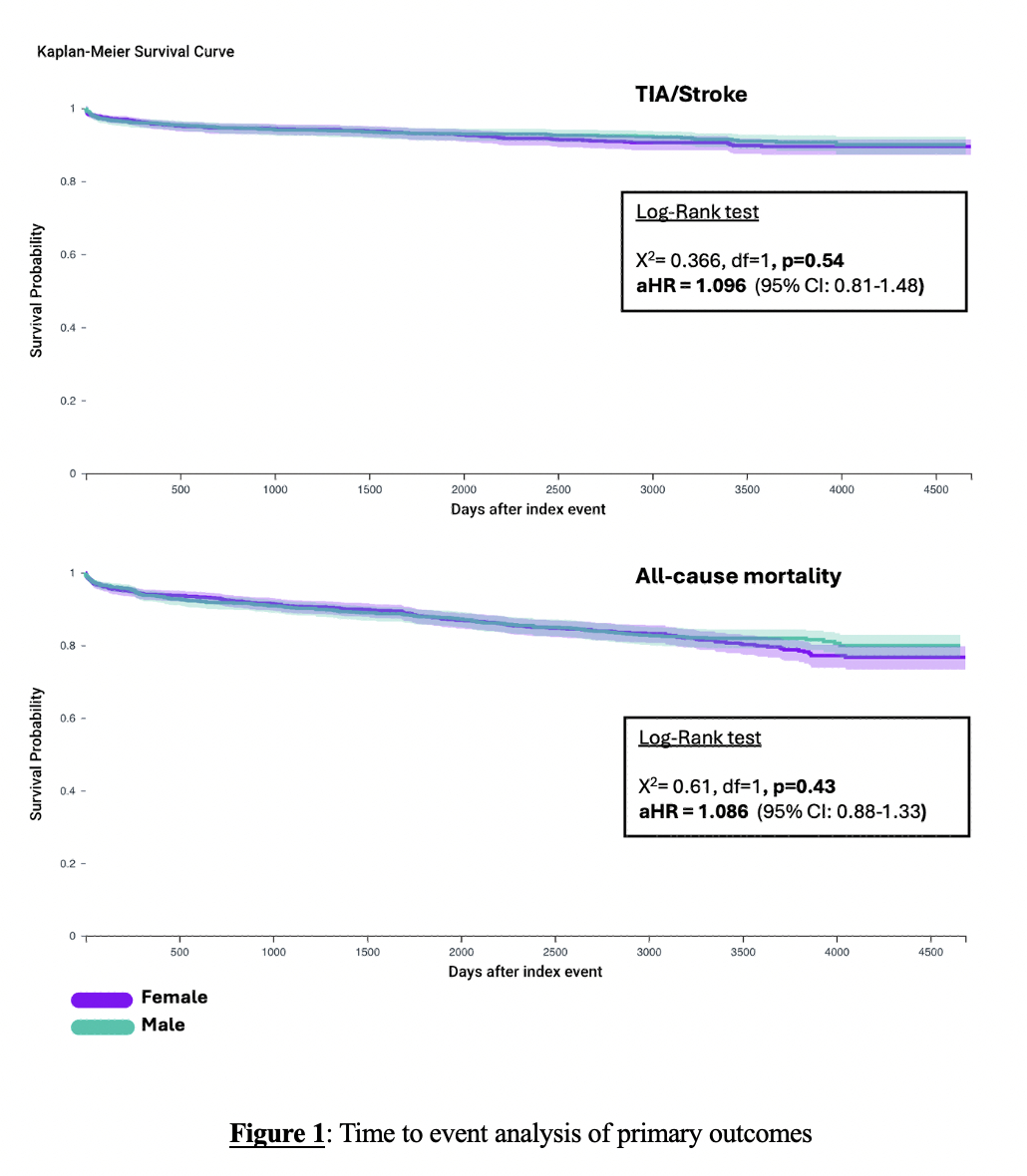
Results 3,016 patients (43.4% female) met inclusion criteria. Female patients were younger (29.4 ± 30 vs 35.2 ± 30.4 years) and had lower prevalence of cardiovascular risk factors in the unadjusted cohort. Subsequently, the matched cohort included 2,410 patients who underwent transcatheter PFO closure (1,205 per sex; mean age 28.3 ± 29 years; 65% White). After a median follow-up of 8.3 years, the risk of TIA/stroke did not differ significantly between the two sexes (F: 7.8% vs. M: 6.8%; OR: 1.14 [95% CI: 0.84–1.55]; P=0.39). Similarly, all-cause mortality was not significantly different (F: 15.9% vs. M: 13.9%; OR: 1.14 [95% CI: 0.94–1.38]; P=0.19). The incidence of new-onset AF and PPM implantation was also comparable (OR: 0.94 [95% CI: 0.74–1.20]; P=0.62 and OR: 1.18 [95% CI: 0.97–1.43]; P=0.09, respectively). Procedure-related hemorrhage rates were similar as well (OR: 0.82 [95% CI: 0.62–1.09]; P=0.17). Time-to-event analyses of the primary outcomes are shown in Figure 1.
Conclusions No sex-based differences in recurrent CVA, survival, new-onset AF, or need for PPM were observed following transcatheter closure of PFO, suggesting equal benefits for both sexes.
Kassab, Joseph
(
University of Texas Southwestern
, Dallas , Texas , United States )
Harb, Serge
(
CLEVELAND CLINIC
, Cleveland , Ohio , United States )
Author Disclosures:
Joseph Kassab:DO NOT have relevant financial relationships
| Serge Harb:No Answer