Equity in Transplantation: Evaluating Outcomes in Cancer-Associated Cardiomyopathy
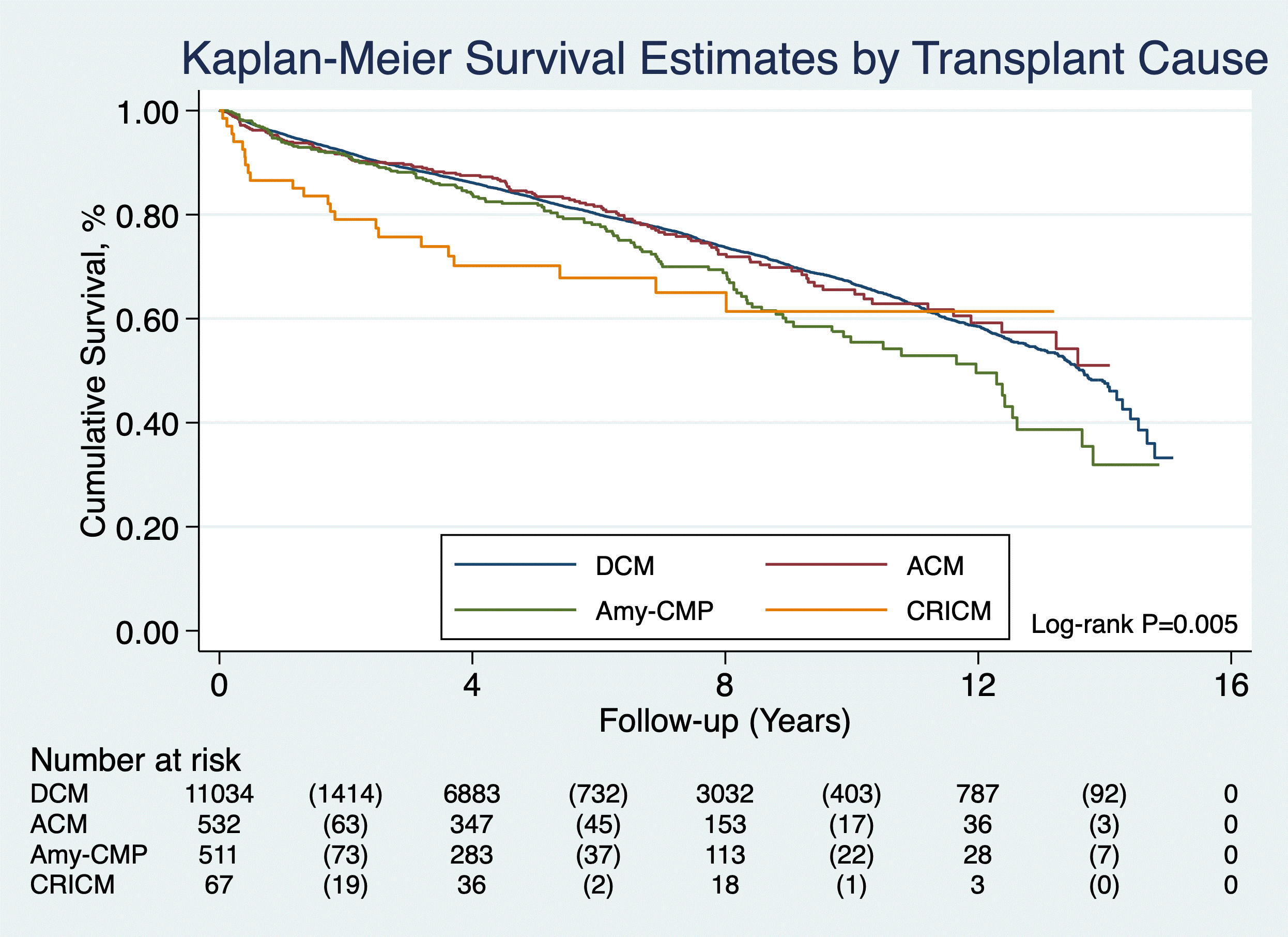
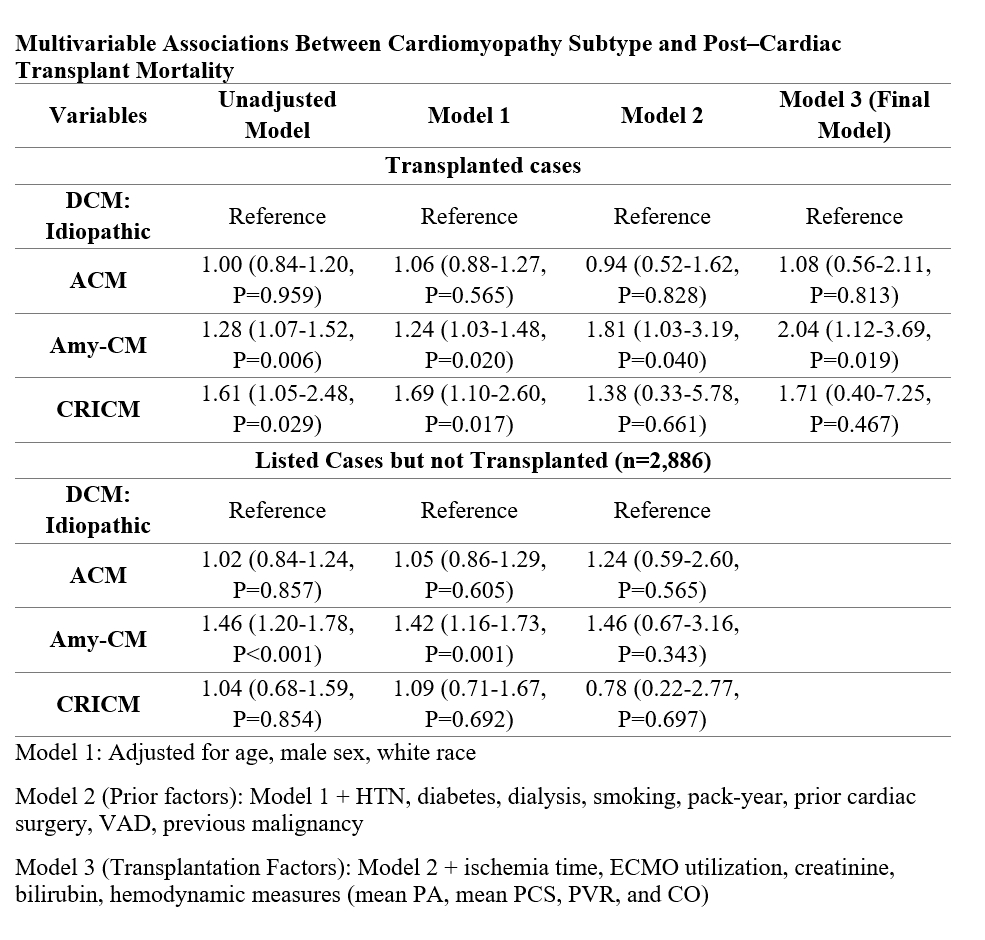
Abstract Body (Do not enter title and authors here): Background With improved cancer survival, therapy-related cardiomyopathies have become a leading cause of end-stage heart failure requiring heart transplantation (HT). However, post-transplant outcomes in this population remain poorly defined. We evaluated HT outcomes in three cardio-oncology subgroups—anthracycline-induced cardiomyopathy (ACM), amyloidosis-associated (AmyCM), and chemo-radiation–induced cardiomyopathy (CRICM)—compared to idiopathic dilated cardiomyopathy (DCM). Methods We conducted a retrospective study of adults (≥18 years) listed for HT in the U.S. between January 1, 2008, and January 1, 2021, using data from the Scientific Registry of Transplant Recipients. Patients with a primary diagnosis of DCM, ACM, Amy-CMP, or CRICM were included. The primary outcome was all-cause post-transplant mortality. Covariates included demographics, comorbidities, transplant status, and hemodynamic values. Cox proportional hazards models were used to assess the association between subtype and mortality, with three hierarchical models adjusting for clinical and transplant-related variables. Results Among 12,144 HT recipients, AmyCM patients were the oldest (median 64 years) and CRICM the youngest (52; p<0.001). Listing-to-transplant time was shortest for AmyCM (49 days) and longest for CRICM (136 days; p<0.001). CRICM had the longest ischemic time (202 min vs. 191 in DCM; p=0.21). Pulmonary vascular resistance was highest in AmyCM (2.3 WU; p<0.001). Post-transplant mortality was numerically higher in CRICM (32.8%) and AmyCM (27.2%) vs. DCM (23.9%; p=0.13). Graft survival exceeded 95% across all groups. Post-transplant malignancy was more common in all cardio-oncology subtypes than DCM (p<0.001). In fully adjusted models, AmyCM was independently associated with higher mortality (HR 2.04, 95% CI 1.12–3.69; p=0.019), while CRICM showed a non-significant trend (HR 1.71, 95% CI 0.40–7.25) (Figure 1). Time-stratified models showed CRICM was associated with higher 1-year mortality in unadjusted and adjusted analyses. At 5 years, AmyCM remained associated with increased mortality across models but without statistical significance (Figure 2). Conclusions AmyCM was independently associated with worse post-transplant survival. CRICM showed increased early (1-year) mortality, though this association attenuated with full adjustment. These findings highlight the need for tailored transplant strategies and post-transplant surveillance in cancer therapy–related cardiomyopathies.
Ali, Abdelrahman
(
UTMB
, Galveston , Texas , United States )
Elsayed, Omar
(
MCG at Augusta University
, Augusta , Georgia , United States )
Guha, Avirup
(
Augusta University
, Augusta , Georgia , United States )
Mansour, Shareef
(
University of Texas-Medical Branch
, Galveston , Texas , United States )
Hamouda, Hagar
(
Cleveland Clinic
, Cleveland , Ohio , United States )
Gaalema, Diann
(
University of Texas-Medical Branch
, Galveston , Texas , United States )
Skouri, Hadi
(
Sheikh Shakhbout Medical City
, Abu Dhabi , United Arab Emirates )
Jneid, Hani
(
UTMB
, Galveston , Texas , United States )
Chatila, Khaled
(
University of Texas-Medical Branch
, Galveston , Texas , United States )
Iliescu, Cezar
(
MD Anderson Cancer Center
, Houston , Texas , United States )
Deswal, Anita
(
UT MD Anderson Cancer Center
, Houston , Texas , United States )
Khalife, Wissam
(
University of Texas Medical Branch
, Friendswood , Texas , United States )
Author Disclosures:
Abdelrahman Ali:DO NOT have relevant financial relationships
| Cezar Iliescu:No Answer
| Anita Deswal:DO have relevant financial relationships
;
Consultant:Bayer:Active (exists now)
| Wissam Khalife:DO NOT have relevant financial relationships
| Omar Elsayed:DO NOT have relevant financial relationshipsShareef Mansour:No Answer
| Hagar Hamouda:DO NOT have relevant financial relationships
| Diann Gaalema:DO NOT have relevant financial relationships
| Hadi Skouri:No Answer
| Hani Jneid:DO NOT have relevant financial relationships
| Khaled Chatila:No Answer