
Logo

American Heart Association

  21
  0


Final ID: Mo3019

Impact of Mineralocorticoid Receptor Antagonists on Atrial Fibrillation Catheter Ablation Outcomes in Patients with HFpEF.

Abstract Body (Do not enter title and authors here): Background:
The effects of Mineralocorticoid receptor antagonist (MRAs) on atrial fibrillation (AFib) outcomes following catheter ablation in patients with heart failure with preserved ejection fraction (HFpEF) is not well described.

Objective:
This study sought to assess the impact of MRAs on AFib catheter ablation outcomes among patients with HFpEF.

Methods:
We conducted a retrospective cohort study using the TriNetX research network, we identified, patients ≥18 years of age with HFpEF who had undergone AF ablation up to December 1, 2024 by means of CPT and ICD-10 codes. Patients were stratified based on the baseline MRAs use. Propensity score matching was performed to balance baseline characteristics between MRA users and non-users. The primary outcome was the risk of re-do AF ablation after a blanking period of the index ablation.

Results:
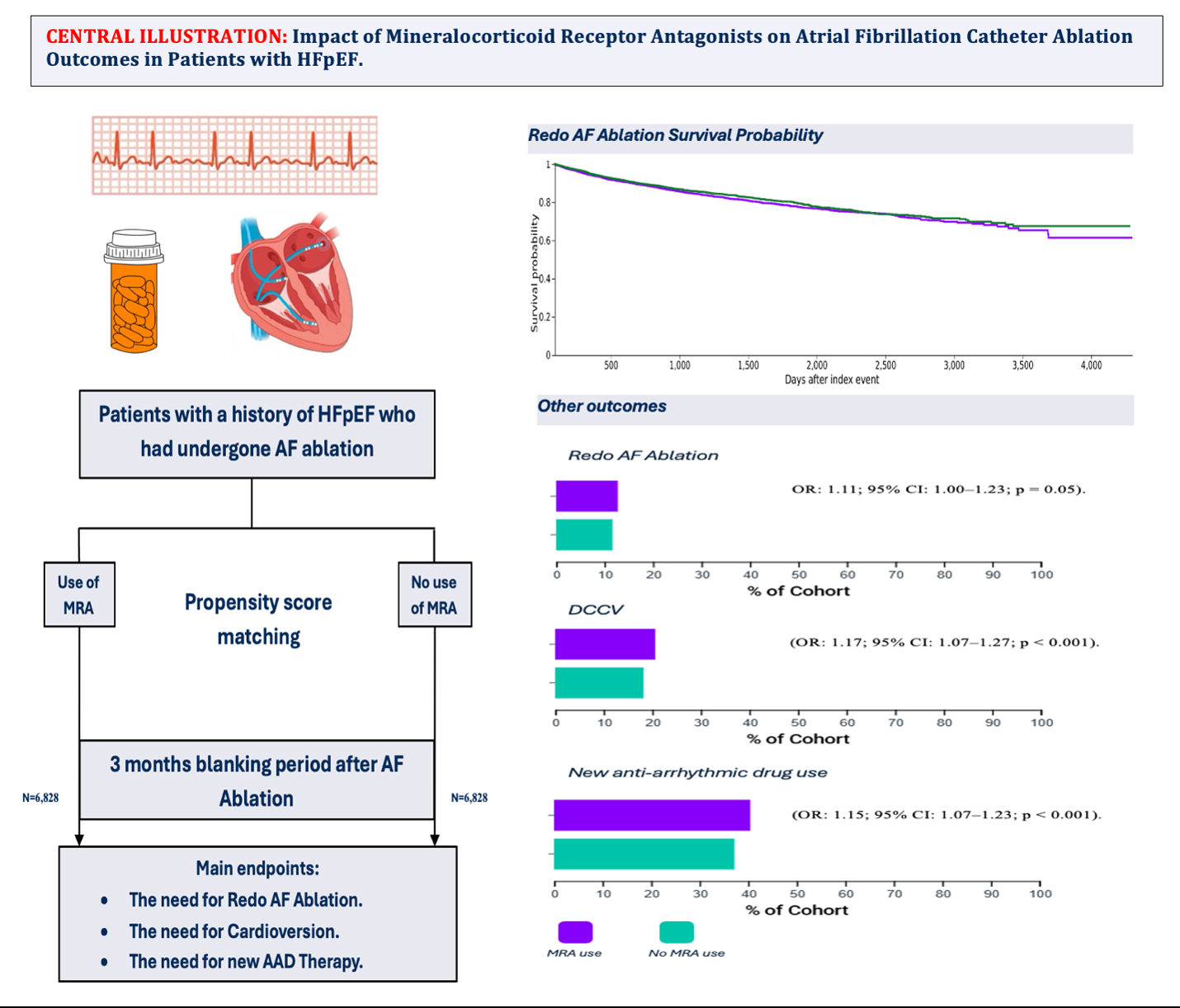
The study included 6,828 propensity-matched patients in each cohort. MRA use in patients with HFpEF undergoing AF ablation was associated with a non-significant trend toward a higher risk of redo AF ablation (OR: 1.11; 95% CI: 1.00–1.23; p = 0.05). This was accompanied by a modest yet statistically significant increase in rates of cardioversion (OR: 1.17; 95% CI: 1.07–1.27; p < 0.001) and new antiarrhythmic drug use (OR: 1.15; 95% CI: 1.07–1.23; p < 0.001). Additionally, MRA use in this group was not protective against acute HFpEF exacerbation and was linked to an increased odd of stroke.

Conclusion:
This retrospective analysis suggests that MRA use in patients with HFpEF undergoing AFib ablation may not be associated with a meaningful reduction in re-do ablation rates or improved event-free survival. Furthermore, MRA use was associated with a modestly higher burden of arrhythmia recurrence, as reflected by increased cardioversion rates and the need for new antiarrhythmic drug therapy. While our results suggest that MRAs may not confer a clear advantage in reducing arrhythmia recurrence or improving procedural outcomes, their clinical utility in this setting remains uncertain.
  • Alqudah, Qusai  ( University of Central Florida , Gainesville , Florida , United States )
  • Kc, Anil  ( University of Central Florida , Gainesville , Florida , United States )
  • Obeidat, Omar  ( University of Central Florida , Gainesville , Florida , United States )
  • Daise, Mohd  ( University of Central Florida , Gainesville , Florida , United States )
  • Rhabneh, Laith  ( Hackensack Meridian Ocean Medical Center , Brick , New Jersey , United States )
  • Awad, Ali  ( Detroit Medical Center , Detroit , Michigan , United States )
  • Mestarihi, Aseed  ( University of Central Florida , Gainesville , Florida , United States )
  • Rayyan, Abdallah  ( University of Central Florida , Gainesville , Florida , United States )
  • Al-ani, Hashim  ( University of Central Florida , Gainesville , Florida , United States )
  • Ismail, Mohamed  ( University of Central Florida , Gainesville , Florida , United States )
  • Author Disclosures:
    Qusai Alqudah: DO NOT have relevant financial relationships | ANIL KC: DO NOT have relevant financial relationships | Omar Obeidat: DO NOT have relevant financial relationships | Mohd Daise: DO NOT have relevant financial relationships | Laith Rhabneh: DO NOT have relevant financial relationships | Ali Awad: No Answer | Aseed Mestarihi: DO NOT have relevant financial relationships | Abdallah Rayyan: DO NOT have relevant financial relationships | Hashim Al-Ani: DO NOT have relevant financial relationships | Mohamed Ismail: No Answer
Meeting Info:

Scientific Sessions 2025

2025

New Orleans, Louisiana

Session Info:

Old Drugs, New Tricks: Evolving Pharmacotherapy for Arrhythmias

Monday, 11/10/2025 , 10:30AM - 11:30AM

Abstract Poster Board Session

More abstracts on this topic:
NGAL play a key role in the development of heart failure via fibrosis and inflammation pathway in rat chronic kidney failure model

Soulie Matthieu, Sanchez-bayuela Tania, Lima-posada Ixchel, Stephan Yohan, Palacios-ramirez Roberto, Nicol Lionel, Lopez-andres Natalia, Mulder Paul, Jaisser Frederic

A Beta Tubulin Mutation Suppresses Arrhythmias and Improves Connexin 43 Localization in Heart of Duchenne Muscular Dystrophy Mice

Zhou Delong, Liu Tong, Yehia Ghassan, Romanienko Peter, Rodney George, Wehrens Xander, Lampe Paul, Gourdie Robert, Xie Lai-hua, Fraidenraich Diego, Nouet Julie, Mesa Elam, Yegneshwaran Vasisht, Geukgeuzian Geovanni, Adibemma Ifeanyichukwu, Nandakumar Swetha, Ramirez Edwin, Li Hong

More abstracts from these authors:
Oral Anticoagulant Monotherapy vs Dual Antithrombotic Therapy in Patients with Atrial Fibrillation and Stable Coronary Artery Disease Following Percutaneous Coronary Intervention: Insights from a Real-World TriNetX Cohort Study

Mestarihi Aseed, Obeidat Omar, Alqudah Qusai, Rayyan Abdallah, Mansour Mohamad, Daise Mohd, Kc Anil

Evaluating the Risk of Cardiomyopathy in Breast Cancer Patients: A National Cohort Study

Obeidat Omar, Ismail Mohamed, Al-ani Hashim, Daise Mohd, Alqudah Qusai, Tarawneh Mohammad, Abughazaleh Saeed, Tong Ann

You have to be authorized to contact abstract author. Please, Login
Not Available