Hospital Admissions With Hypertensive Emergency Increased While Admissions With Asymptomatic Elevated Inpatient Blood Pressure Decreased From 2014-2024: A Nationwide Study
Abstract Body (Do not enter title and authors here): Introduction: Hypertension is common in acute care settings, and there is controversy on the best management depending on severity of elevation and the presence of end-organ damage, as inpatient treatment of high blood pressure without evidence of end-organ damage has been associated with harm.
Research Objective/Aims: To characterize trends in the number of inpatients meeting criteria for elevated inpatient blood pressure (SBP 130-179 with no end-organ damage), markedly elevated inpatient blood pressure (SBP >180 with no end-organ damage), and hypertensive emergency (SBP >180 with evidence of end-organ damage) according to current AHA criteria.
Methods: We used Epic Cosmos, a dataset of Epic health systems representing more than 299 million patients, to perform a retrospective study of all patients admitted to acute care hospitals from 2014-2024. We applied the criteria of the American Heart Association 2024 Management of Elevated Blood Pressure in the Acute Care Setting Scientific Statement as described in Figure 1. Trends in the proportion of inpatients meeting the criteria for elevated inpatient blood pressure, markedly elevated inpatient blood pressure, and hypertensive emergency were shown from 2014-2024. Average annual percent changes for each category were estimated using log-linear regression.
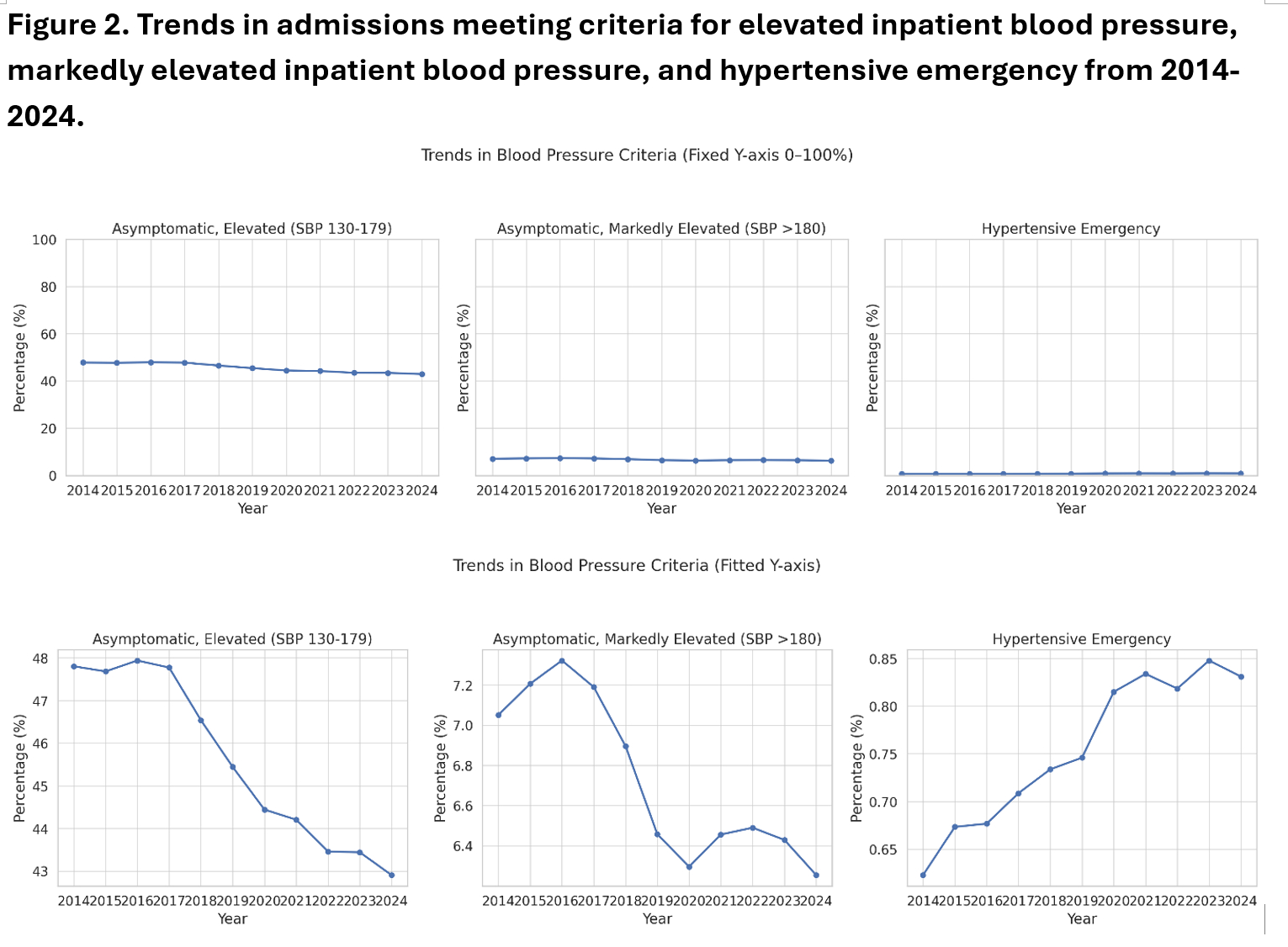
Results From 2014-2024, a total of 90,644,378 admissions to Epic Cosmos hospitals occurred. Of those, 40,809,813 (45.0%) had elevated inpatient blood pressure, 6,005,762 (6.63%) had markedly elevated inpatient blood pressure, and 704,882 (0.8%) met criteria for hypertensive emergency. Figure 2 shows trends in the rates of patients meeting the three criteria from 2014-2024. The proportion of admitted patients with elevated blood pressure decreased (AAPC -1.27%, 95% CI -1.53 to -1.02%, p <.001), as did the proportion of patients with markedly elevated inpatient blood pressure (AAPC -1.55%, 95% CI -2.21 to -0.90%, p<.001), while the proportion of admitted patients meeting criteria for hypertensive emergency increased (APC 3.1%, 95% CI 2.4- to 3.8%, p<.001).
Conclusions Despite decreasing rates from 2014-2024, elevated inpatient blood pressure remains common. Rates of admissions meeting hypertensive emergency criteria have, by contrast, been increasing, which could reflect greater risk factor burden for end-organ cardiovascular or renal manifestations or worsened control of severe hypertension in the general population.
Oladuja, Kemi
(
Duke University School of Medicine
, Durham , North Carolina , United States )
Obrien, Emily
(
Duke University
, Durham , North Carolina , United States )
Li, Fan
(
Duke University
, Durham , North Carolina , United States )
Mac Grory, Brian
(
Duke University School of Medicine
, Durham , North Carolina , United States )
Aymes, Shannon
(
University of North Carolina
, Durham , North Carolina , United States )
Lusk, Jay
(
University of North Carolina
, Durham , North Carolina , United States )
Author Disclosures:
Kemi Oladuja:No Answer
| Emily Obrien:DO NOT have relevant financial relationships
| Fan Li:DO NOT have relevant financial relationships
| Brian Mac Grory:No Answer
| Shannon Aymes:No Answer
| Jay Lusk:DO NOT have relevant financial relationships