
Logo

American Heart Association

  1
  0


Final ID: TU162

Association Between Perceived Risk of Hypertension and Healthcare Utilization among Black Adults with Elevated Blood Pressure or Untreated Stage 1 Hypertension: Findings from the RESTORE Network

Abstract Body: Introduction: Perceived risk of hypertension may influence health behaviors, but data are limited among Black adults, a population with a high prevalence of hypertension and low preventive healthcare engagement. We examined associations between perceived hypertension risk and healthcare use in Black adults with elevated blood pressure (BP) or untreated stage 1 hypertension.
Methods: Data were from two community-based trials in the AHA Health Equity Research Network on Hypertension Prevention (RESTORE), the EPIPHANY (Equity in Prevention and Progression of Hypertension by Addressing Barriers to Nutrition and Physical Activity) trial, which included Black adults from rural Alabama, and CLIP (Community-to-Clinic Linkage Implementation Program in Barbershops), which included Black men from New York City. All participants had systolic BP 120-139 mmHg and/or diastolic BP 80-89 mmHg. Perceived hypertension risk was assessed by asking participants what they thought their chances of developing hypertension were “below average”, “average”, or “above average” compared to adults of the same age and sex. Healthcare use outcomes were having: 1) a usual place of care and 2) a recent healthcare visit (in the last 12 months). We estimated prevalence ratios for associations between perceived risk and healthcare use, overall and by site and sex.
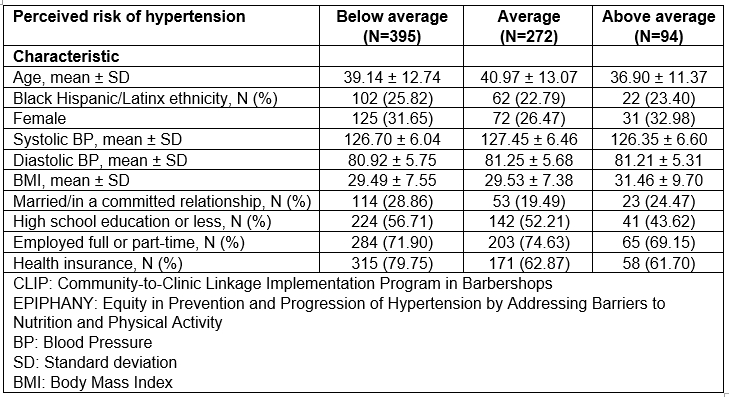
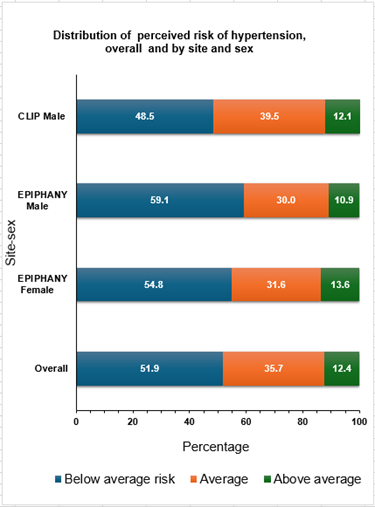
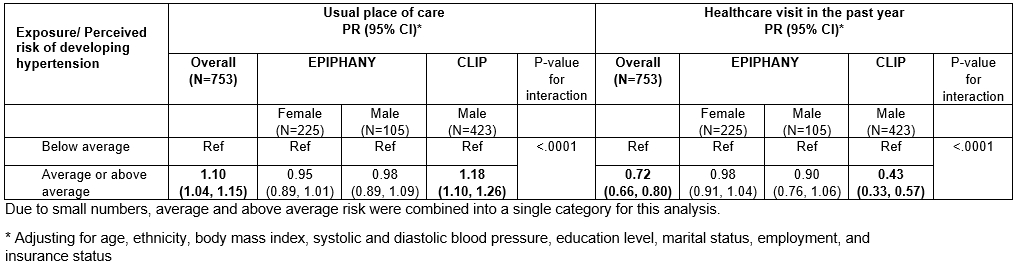
Results: The analysis included 761 participants (mean age 39.5 years, 30.0% women). Overall, 51.9% reported a “below average” hypertension risk (Figure 1). A higher proportion of participants with perceived “below average” risk than with higher perceived risk was insured and reported having a high school education or less (Table 1). In EPIPHANY participants, perceived risk was not associated with healthcare use. Among CLIP participants, those with “average” or “above average” risk were more likely to have a usual place of care than those with “below average” risk but were less likely to have had a recent healthcare visit (Table 2).
Conclusion: In the current study of Black adults with elevated BP or stage 1 hypertension, over half of participants perceived themselves to be at a “below average” risk for hypertension. Associations between perceived risk and healthcare use differed by site. Higher perceived hypertension risk among urban Black men was associated with having a usual place of care but with lower likelihood of having a recent healthcare visit, underscoring the need to convert risk awareness into ongoing preventive care.
  • Dubal, Medha  ( University of Alabama at Birmingham , Birmingham , Alabama , United States )
  • Levy, Phillip  ( WAYNE STATE UNIVERSITY , Detroit , Michigan , United States )
  • Hardy, Shakia  ( Univ of North Carolina Chapel Hill , Mebane , North Carolina , United States )
  • Ravenell, Joseph  ( NYU Grossman School of Medicine , New York , New York , United States )
  • Spruill, Tanya  ( NYU Grossman School of Medicine , New York , New York , United States )
  • Arabadjian, Milla  ( NYU Long Island School of Medicine , Mineola , New York , United States )
  • Foti, Kathryn  ( University of Alabama at Birmingham , Birmingham , Alabama , United States )
  • Poudel, Bharat  ( University of Alabama at Birmingham , Birmigham , Alabama , United States )
  • Christenson, Ashley  ( University of Alabama at Birmingham , Birmingham , Alabama , United States )
  • Wang, Zhixin  ( University of Alabama at Birmingham , Birmingham , Alabama , United States )
  • Green, Tanisha  ( NYU Grossman School of Medicine , New York , New York , United States )
  • Muntner, Paul  ( Perisphere real world evidence , Austin , Texas , United States )
  • Cluett, Jennifer  ( BIDMC-Harvard Medical School , Boston , Massachusetts , United States )
  • Commodore-mensah, Yvonne  ( Johns Hopkins University , Baltimore , Maryland , United States )
  • Author Disclosures:
Meeting Info:

EPI-Lifestyle Scientific Sessions 2026

2026

Boston, Massachusetts

Session Info:

Poster Session 1

Tuesday, 03/17/2026 , 05:00PM - 07:00PM

Poster Session

More abstracts on this topic:
A Focus for Improvement - Factors for Lab Adherence in a Pediatric Preventive Cardiology Program

Holsinger Hunter, Porterfield Ronna, Taylor Makenna, Dresbach Bethany, Seipel Brittany, Igwe Chukwuemeka, Alvarado Chance, Tran Andrew

A multi-state Causal Framework to Estimate the Effects of Treatment Regimes over the Course of Heart Disease

Ding Ming

More abstracts from these authors:
You have to be authorized to contact abstract author. Please, Login
Not Available