
Logo

American Heart Association

  33
  0


Final ID: MP1488

The Association between Non-High-Density Lipoprotein Cholesterol Level and Coronary Fatty Plaque Regression

Abstract Body (Do not enter title and authors here): Background: Regression of coronary fatty plaque, the type most prone to rupture and cause acute coronary syndromes, is associated with fewer cardiovascular events. A baseline non-HDL-C level ≤100 mg/dL predicted regression of fatty plaque at 30 months; however, to our knowledge, no data exist on the association between non-HDL-C level and percent of fatty plaque regression.
Research Question: Is there a target for coronary plaque regression and progression by non-HDL-C level?
Methods: Data from the Slowing HEART diSease with lifestyle and omega-3 fatty acids (HEARTS) trial, a randomized clinical trial, was analyzed. A total of 240 coronary artery disease (CAD) subjects on statin therapy were randomized to 3.36 g of omega-3 fatty acids daily for 30 months or none. Coronary plaque subtypes were quantitated with coronary computed tomographic angiography, and lipids and inflammatory markers were measured at baseline and 30-month follow-up. Significant interaction was found between hypertension and treatment arm in the prediction of plaque (p=0.008); thus, subjects were stratified by blood pressure status.
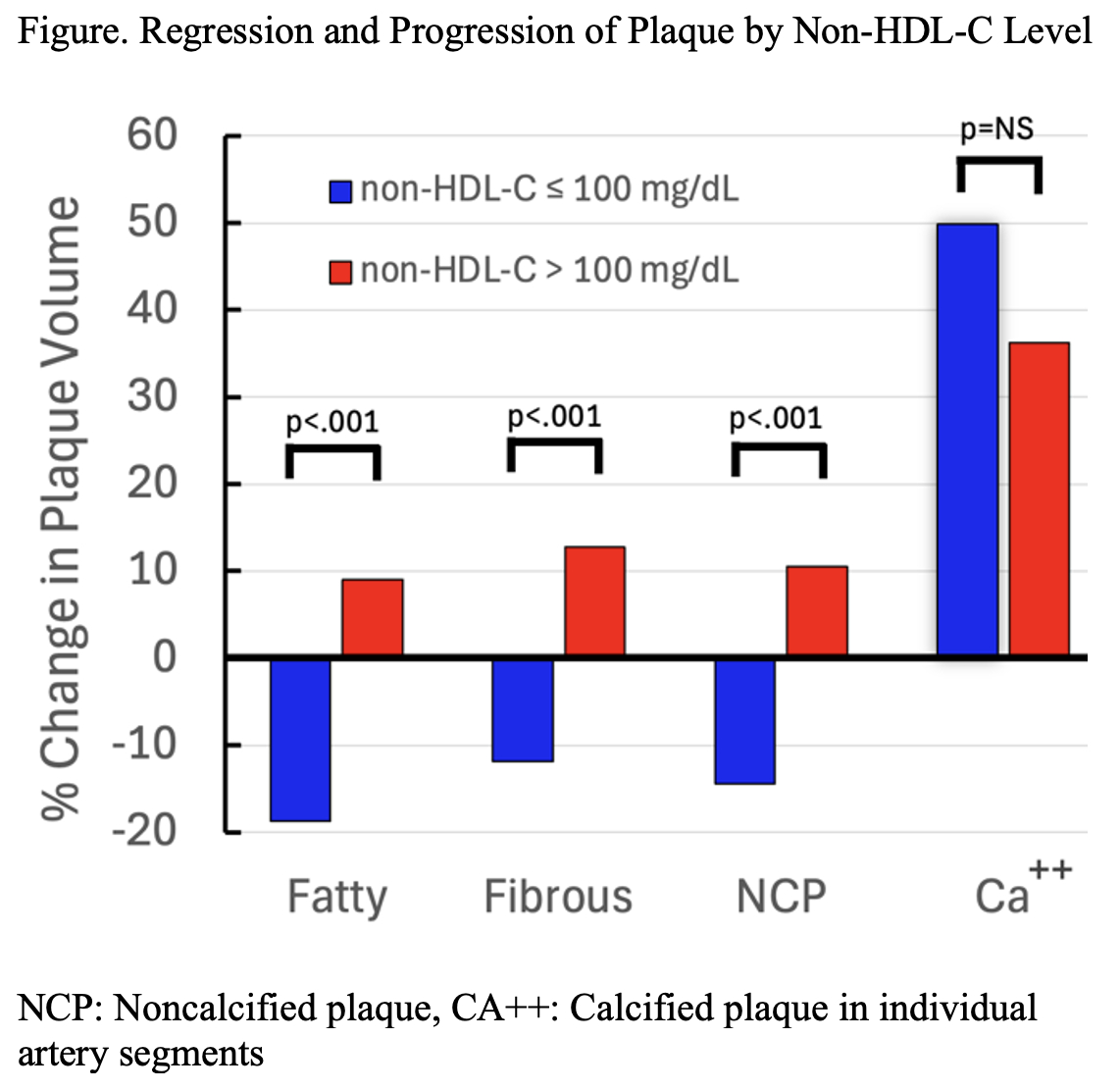
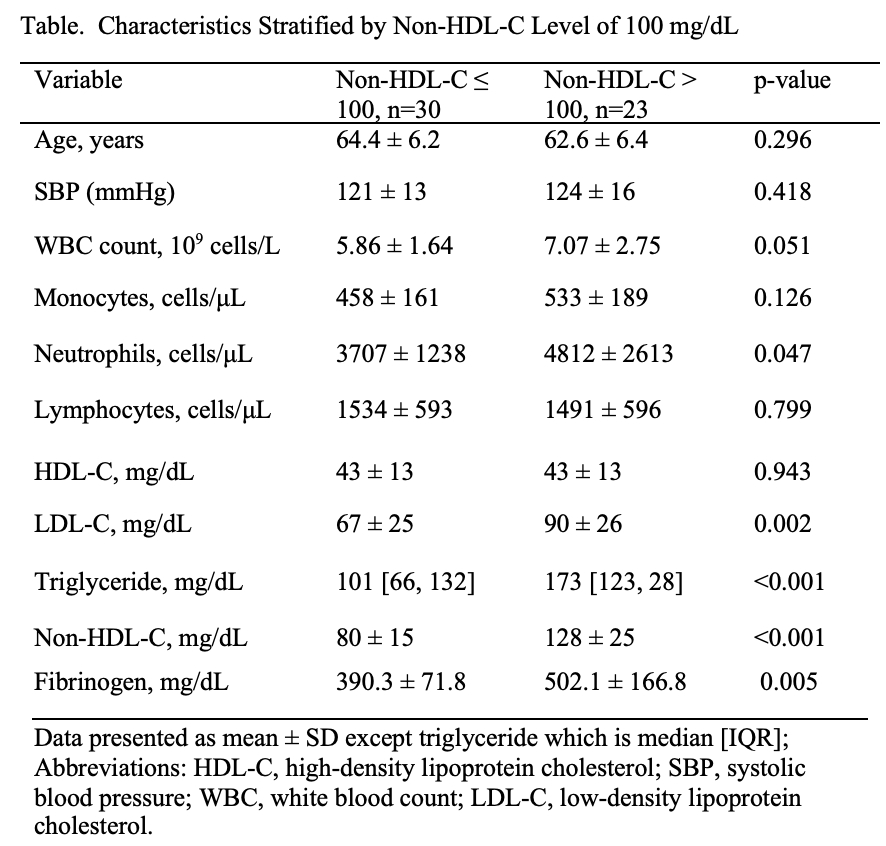
Results: Subjects (n=53) in whom non-HDL-C ≤100 mg/dL predicted plaque regression were in the control group; all had well-controlled hypertension. Median age was 63.6 years and 43 were male (81.1%). Those with non-HDL-C level ≤100 mg/dL had median fatty plaque regression of 18.8% [IQR: 6.9, 30.8] compared to median progression of 9.0% [7.3, 23.2] with non-HDL-C level >100 mg/dL (Figure). Those with non-HDL-C level >100 mg/dL had significantly higher levels of inflammatory markers: neutrophil count (p=0.047) and fibrinogen level (p=0.005) (Table). Mean LDL-C levels in the two non-HDL-C groups were 67±25 vs 90±26, respectively (p=0.002).
Conclusions: A non-HDL-C ≤100 mg/dL is a potential treatment target to achieve up to 18.8% fatty plaque regression in CAD subjects with well-controlled hypertension on statin therapy. The higher levels of inflammation in non-HDL-C >100 mg/dL suggest that inflammation may underlie the mechanism for plaque progression. The results also identify LDL-C levels at which regression and progression occur. Further study in this group, which appears to be the first report of plaque regression and progression by non-HDL-C and LDL-C levels, may identify mechanisms and reveal strategies to achieve regression of coronary plaque and prevent acute coronary syndromes.
  • Elajami, Tarec  ( Mount Sinai Medical Center , Coral Gables , Florida , United States )
  • Daher, Ralph  ( Cooper University Healthcare , Camden , New Jersey , United States )
  • Alfaddagh, Abdulhamied  ( The Johns Hopkins Hospital , Baltimore , Maryland , United States )
  • Welty, Francine  ( HARVARD MEDICAL SCHOOL , Brookline , Massachusetts , United States )
  • Author Disclosures:
    Tarec Elajami: DO NOT have relevant financial relationships | Ralph Daher: DO NOT have relevant financial relationships | Abdulhamied Alfaddagh: DO NOT have relevant financial relationships | Francine Welty: DO NOT have relevant financial relationships
Meeting Info:

Scientific Sessions 2025

2025

New Orleans, Louisiana

Session Info:

Targeteing Lipid-Associated Cardiovascular Disease Risk

Sunday, 11/09/2025 , 09:15AM - 10:30AM

Moderated Digital Poster Session

More abstracts on this topic:
A Novel Approach to Manage Hypercholesterolemia: The Veterans Affairs Lipid Optimization Reimagined Quality Improvement (VALOR-QI) Program

Djousse Luc, Leesch Tharen, Pena David, Gaziano Michael, Ward Rachel, Wellman Helen, Yel Nedim, Santos Abigail, Delgrande Jen, Fink Abigail, Colson Kristin, Pan Eddie

Co-localization of NCCT hypodensity and CTA spot sign to predict intracerebral hematoma expansion and severity: development and validation of the Black-&-White sign

Pensato Umberto, Banerjee Ankur, Kulkarni Girish, Menon Bijoy, Goyal Mayank, Hill Michael, Molina Carlos, Silva Yolanda, Boulanger Jean-martin, Gubitz Gord, Bhatia Rohit, Tanaka Koji, Srivastava Padma, Roy Jayanta, Dzialowski Imanuel, Kase Carlos, Kobayashi Adam, Rodriguez-luna David, Aviv Richard, Dowlatshahi Dar, Demchuk Andrew, Horn Mackenzie, Teleg Ericka, Al Sultan Abdulaziz, Kasickova Machova Linda, Ohara Tomoyuki, Ojha Piyush, Marzoughi Sina

More abstracts from these authors:
The Association between C-Reactive Protein-Triglyceride-Glucose Index and Cardiovascular Mortality in Patients with Metabolic Syndrome

Ghay Sahil, Elajami Mohamad, Abushamat Layla, Urina-jassir Daniela, Larralde Mark, Welty Francine, Mihos Christos, Elajami Tarec

Salivary Tumor Necrosis Factor-Alpha, Plasma Omega-3 Fatty Acid Index and Coronary Artery Plaque

Daher Ralph, Ahmad Bushra, Malik Abdulaziz, Alfaddagh Abdulhamied, Welty Francine

You have to be authorized to contact abstract author. Please, Login
Not Available