
Logo

American Heart Association

  25
  0


Final ID: MP2204

The Association between C-Reactive Protein-Triglyceride-Glucose Index and Cardiovascular Mortality in Patients with Metabolic Syndrome

Abstract Body (Do not enter title and authors here): Introduction: Metabolic syndrome is characterized by an interplay of risk factors mediated by a chronic state of inflammation and is strongly linked to increased cardiovascular (CV) mortality. C-Reactive Protein-Triglyceride-Glucose Index (CTI) has recently emerged as a marker for both insulin resistance and systemic inflammation, both of which are established contributors to cardiovascular disease.

Research Question: Does CTI predict CV mortality in patients with metabolic syndrome?

Methods: The NHANES database was used from 1999 to 2010, and data on mortality follow-up through December 31st, 2019 was analyzed. Patients with metabolic syndrome were identified by stratifying individuals aged ≥20 years meeting ≥3 of the 5 metabolic syndrome criteria. CTI was derived using the formula 0.412 × ln(CRP [mg/L]) + ln(Triglycerides [mg/dL] × Fasting Glucose [mg/dL])/2. The incidence of coronary heart disease (CHD) and CV mortality were assessed. CTI was tested as a continuous variable and by quartiles. A Kaplan-Meier survival analysis and multivariate Cox proportional hazards models were performed to assess the relationship between CTI and CV mortality.

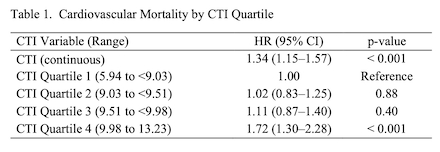
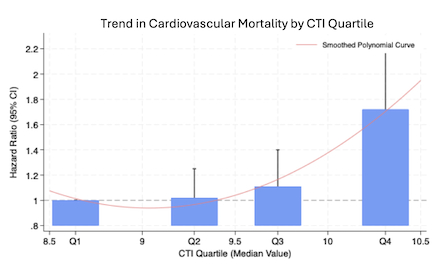
Results: A total of 10,421 patients with metabolic syndrome were identified. The mean age of the population was 57.0±17.2 years, of which 51.9% were female. The incidence of CHD was 13.0%. Kaplan-Meier survival analysis showed a significant difference in CV mortality across the 4 CTI quartiles (p<0.001) (Table 1). Notably, when CTI was modeled as a continuous variable, each one-unit increase in CTI was associated with a 34% higher CV mortality (HR = 1.34, 95% CI: 1.15–1.57, p<0.001). Cox regression analysis of CTI by quartiles showed a nonsignificant increase in CV mortality in quartile 2 (HR = 1.02, 95% CI: 0.83–1.25, p=0.88) and quartile 3 (HR = 1.11, 95% CI: 0.87–1.40, p=0.40) compared with the lowest quartile 1 (Figure 1). However, patients in quartile 4 had significantly higher CV mortality, with a hazard ratio of 1.72 (95% CI: 1.30–2.28, p<0.001).

Conclusion: CTI is a positive predictor of cardiovascular mortality in patients with metabolic syndrome. Our findings suggest that metabolic syndrome patients with higher insulin resistance and systemic inflammation have higher CV mortality. The current study underscores the need for further research into the clinical applicability of CTI as a strong quantitative measure of cardiovascular risk assessment.
  • Ghay, Sahil  ( Mount Sinai Medical Center , Miami Beach , Florida , United States )
  • Elajami, Mohamad  ( Hartford Hospital , Hartford , Connecticut , United States )
  • Abushamat, Layla  ( Baylor College of Medicine , Houston , Texas , United States )
  • Urina-jassir, Daniela  ( Mount Sinai Heart Institute , Miami Beach , Florida , United States )
  • Larralde, Mark  ( Mount Sinai Heart Institute , Miami Beach , Florida , United States )
  • Welty, Francine  ( Harvard Medical School , Brookline , Massachusetts , United States )
  • Mihos, Christos  ( Mount Sinai Heart Institute , Miami Beach , Florida , United States )
  • Elajami, Tarec  ( Mount Sinai Heart Institute , Miami Beach , Florida , United States )
  • Author Disclosures:
    Sahil Ghay: DO NOT have relevant financial relationships | Mohamad Elajami: No Answer | Layla Abushamat: No Answer | Daniela Urina-Jassir: No Answer | Mark Larralde: No Answer | Francine Welty: DO NOT have relevant financial relationships | Christos Mihos: No Answer | Tarec Elajami: DO NOT have relevant financial relationships
Meeting Info:

Scientific Sessions 2025

2025

New Orleans, Louisiana

Session Info:

Next-Generation Risk Prediction: Leveraging Biomarkers and Omics for Precision Health

Monday, 11/10/2025 , 01:45PM - 02:55PM

Moderated Digital Poster Session

More abstracts on this topic:
A Novel Role for Lipoprotein(a) in Potentiating Neutrophil Extracellular Trap Formation

Mouawad Sahar, Boffa Michael, Koschinsky Marlys

25-Year Decline in Aortic Aneurysm and Dissection Mortality in the U.S.: Impact of Endovascular Repair and Forecast to 2030

Ali Manzer, Umar Haddaya, Nazir Tahira, Nizam Muhammad, Steafo Lark, Sharif Ayesha, Jehangir Hanzala, Arham Muhammad, Hamza Anfal, Hassan Arbaz, Amjad Ans, Ali Iman, Zuha Zuha

More abstracts from these authors:
What’s the tipping point? When to initiate pharmacotherapy and can we ever stop?

Conroy Molly, Wadden Thomas, Kushner Robert, Jastreboff Ania, Almandoz Jaime, Abushamat Layla

The Association between Non-High-Density Lipoprotein Cholesterol Level and Coronary Fatty Plaque Regression

Elajami Tarec, Daher Ralph, Alfaddagh Abdulhamied, Welty Francine

You have to be authorized to contact abstract author. Please, Login
Not Available