Trends in Cardiovascular Mortality by Educational Attainment in the United States, 2010-2023
Abstract Body (Do not enter title and authors here): Background: Educational attainment is an important socioeconomic marker. Recent trends in cardiovascular (CV) mortality by educational attainment are unknown. This study examines CV mortality trends by educational attainment from 2010 to 2023 among US adults aged 25 years and older.
Methods: Mortality data from the National Center for Health Statistics were used to identify all CV deaths (ICD-10: I00-I99). Educational attainment from death certificates was categorized as high school or less, some college, and graduate/professional degree. Age-specific population estimates by education level were obtained from US Census data. Mortality rates were standardized to the 2010 Census population. Negative binomial models with year and education indicators were fit and the mean annual percent change (APC) was calculated. Piecewise linear models were fit to identify changes in trends over the study period. Estimates are presented with 95% confidence intervals.
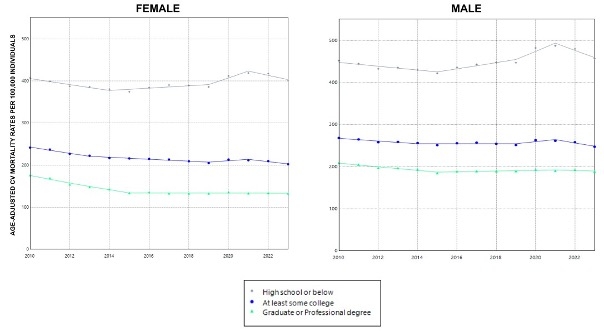
Results: Between 2010 and 2023, there were 10,552,366 CV deaths: 61.3% among adults with a high school education or less, 31.8% with some college, and 6.9% with a graduate/professional degree. Age-adjusted mortality was higher for the least educated compared to the other groups (Figure). The absolute difference in mortality rates between the highest and lowest educated groups was wider in 2023 than in 2010. Among men, the mean APC was 0.1% (0.08, 0.2) in the high school or less group, -0.6% (95% CI -0.7, -0.5) for some college, and -0.8% (-0.9, -0.7) for graduate/professional degrees. Among women, the mean APC was -0.1% (-0.2, -0.06), -1.4% (-1.4, -1.3), and -2.2% (-2.3, -2.0), respectively. For men in the high school or lower group, the APC in the 2019 to 2021 period was 4.2% (2.6%, 5.4%) and was -3.5% (-5.1, -1.5%) between 2021 and 2023, while for those with some college the APC was 1.9% (0.6%, 3.0%) in the 2019 to 2021 period and -3.0% (-4.7%, -1.2%) in the 2021 to 2023 period. Mortality rates were stable among the more than college group. Similar trends were noted among women.
Conclusions: Educational disparities in CV mortality widened from 2010 to 2023, with mortality rates among adults in the lowest education group stagnant or increasing, while declining in the higher educated groups. A sharp pandemic era increase in mortality in the least educated group had not fully returned to prior levels by 2023. These findings highlight the growing disparity in CV disease by educational attainment in the US.
Lin, John
(
University of Pennsylvania
, Philadelphia , Pennsylvania , United States )
Eberly, Lauren
(
University of Pennsylvania
, Philadelphia , Pennsylvania , United States )
Nathan, Ashwin
(
University of Pennsylvania
, Philadelphia , Pennsylvania , United States )
Khatana, Sameed
(
University of Pennsylvania
, Philadelphia , Pennsylvania , United States )
Author Disclosures:
John Lin:DO NOT have relevant financial relationships
| Lauren Eberly:DO NOT have relevant financial relationships
| Ashwin Nathan:No Answer
| Sameed Khatana:No Answer