
Logo

American Heart Association

  17
  0


Final ID: MP413

Energy Insecurity Associates with Increased Odds of Cardiovascular Disease Risk Factors and Burden: Data from the Behavioral Risk Factor Surveillance System, 2023

Abstract Body (Do not enter title and authors here): Introduction: Over a quarter of US households experience energy insecurity (EI) - the inability to meet household energy needs - and this number is expected to rise due to increasing global temperatures and energy demands. EI has been shown to impact health due to financial tradeoffs with healthcare, but limited evidence exists on how EI may contribute to cardiovascular disease (CVD) risk factors and burden.
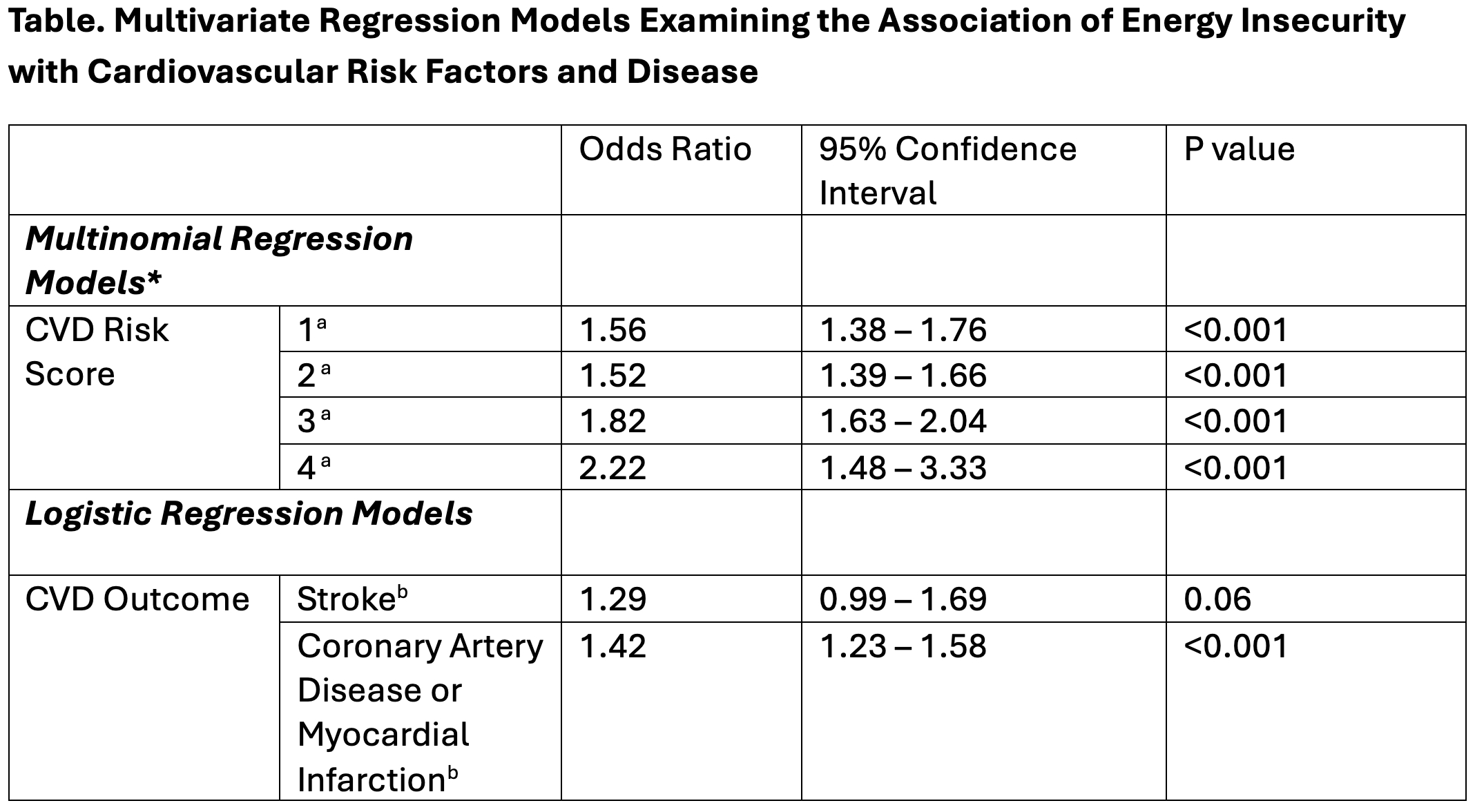
Methods: Using Behavioral Risk Factor Surveillance – a nationally representative survey – data from 2023, we examined the relationship between EI and CVD risk factors and outcomes among households with incomes at and below 200% of the federal poverty level. EI was defined as experiencing a threat of utility disconnection for electric, gas, oil or water in the past 12 months. CVD risk factors (high cholesterol, hypertension, diabetes and tobacco use) were assessed as a composite risk score (range 0 to 4) by counting the total number of conditions. We performed a complete case analysis and used weighted multinomial regression models to analyze the relationship between EI and CVD risk scores. Demographic and socioeconomic covariates were included in the model. We used logistic regression models to evaluate the relationship with CVD (coronary artery disease (CAD), myocardial infarction (MI) or stroke). CVD risk factors were also included as covariates in these models. Survey weights were used to account for the complex survey design.
Results: Within the study population (N= 53,389; 15.72% Black, 44.95% White and 28.38% Hispanic), those who reported EI (N=7,910) were found to be younger (median age: 42 (IQR 33.5) vs. 46 (IQR 31.6) years) and more likely to be female (62.5% vs. 56.7%), unemployed/unable to work (46.2% vs. 35.1%), and have public insurance (67.5% vs. 61.8%). In the adjusted model, EI was associated with significantly higher odds of reporting one or more CVD risk factors (Table) with OR of 2.22 (95% CI 1.48–3.33) for having all four risk factors. EI was also associated with higher odds of CAD or MI [1.42 (95% CI 1.23-1.58)]. There was a non-statistically significant higher odds of stroke [1.29 (95% CI 0.99-1.69)].
Conclusions: EI was associated with higher odds of CVD risk factors and burden among low-income adults. EI may be an important marker of increased risk of CVD, possibly due to financial tradeoffs, impaired healthcare access and management, or stress related physiologic pathways.
  • Ceasar, Joniqua  ( University of Pennsylvania , Philadelphia , Pennsylvania , United States )
  • Yang, Lin  ( University of Pennsylvania , Philadelphia , Pennsylvania , United States )
  • Wu, Jingyi  ( University of Pennsylvania , Philadelphia , Pennsylvania , United States )
  • Khatana, Sameed  ( UNIVERSITY OF PENNSYLVANIA , Philadelphia , Pennsylvania , United States )
  • Author Disclosures:
    Joniqua Ceasar: DO NOT have relevant financial relationships | Lin Yang: DO NOT have relevant financial relationships | Jingyi Wu: DO NOT have relevant financial relationships | Sameed Khatana: No Answer
Meeting Info:

Scientific Sessions 2025

2025

New Orleans, Louisiana

Session Info:

Geographic and Community-Level Determinants of Cardiovascular Risk: The Role of Place, Space, and Environment

Saturday, 11/08/2025 , 03:15PM - 04:15PM

Moderated Digital Poster Session

More abstracts on this topic:
Area-Based Social Risk Measures and In-Hospital Mortality: A Comparative Modeling Study in Coronary Artery Disease Patients

Gao Zihang, Jiang Tian, Hong Haoyun, Thomas Kathie, Hall Jennifer, Zhao Juan

Association of Serial Seattle Angina Questionnaire Assessments with Clinical Events in Chronic Coronary Disease: Insights from the ISCHEMIA Trial

O'keefe Evan, Hochman Judith, Spertus John, Jones Philip, Cho Yoon Joo, Saxon John, Boden William, Stone Gregg, Bangalore Sripal, Reynolds Harmony, Maron David

You have to be authorized to contact abstract author. Please, Login
Not Available