Ischemic ECG Changes Among Patients With Post-PCI Myocardial Injury Are Not Associated With Increased Long-Term All-Cause Mortality
Abstract Body (Do not enter title and authors here): Introduction Myocardial injury following elective percutaneous coronary intervention (PCI) is associated with reduced long-term survival. Ischemic changes on electrocardiogram (ECG) are an important component of the Universal Definition of Myocardial Infarction (MI), but their prognostic value in the setting of post-PCI myocardial injury remains uncertain.
Research Question What is the incremental prognostic value of new ischemic ECG changes, or any ischemic ECG findings post-PCI, in patients with post-PCI myocardial injury?
Methods Adults undergoing elective PCI between 2011 and 2020 without elevated pre-PCI cardiac biomarkers were included if they developed post-PCI myocardial injury, defined by peak CKMB concentration >99% of the upper reference limit. Baseline and post-PCI ECGs (within 24 hours) were reviewed for ischemic ECG findings (ST-segment abnormalities, T-wave abnormalities, and Q-waves), and compared to identify ischemic changes. Long-term mortality was determined from Social Security and National Death Index data. Relationships between ischemic ECG findings and long-term mortality were evaluated in Cox proportional hazards models adjusted for age, sex, and assay-normalized CKMB.
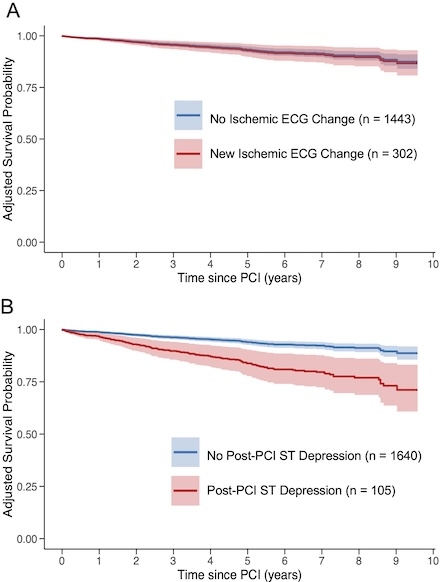
Results Among 1,745 patients with myocardial injury following elective PCI, 883 (50.6%) had ≥1 ischemic ECG finding post-PCI, and 302 (17.3%) had new ischemic ECG changes from baseline. Median follow-up was 5.2 years with 138 deaths (7.9%). New ischemic ECG changes compared to baseline (n=302) were not associated with increased long-term mortality after multivariable adjustment (7.0% vs. 8.1%, aHR 1.06, 95% CI 0.66–1.71; Figure 1A). When only post-PCI ECGs were considered, the presence of any ischemic finding (n=883) was also not associated with higher mortality (8.5% vs. 7.3%, aHR 1.37, 95% CI 0.98–1.92). In an analysis of ischemic findings on post-PCI ECGs, the presence of any ST-segment depressions (n=105) was associated with increased long-term mortality (16.8% vs. 7.0%, aHR 2.84, 95% CI 1.84–4.38; Figure 1B). Post-PCI ST-segment elevations demonstrated similar but non-significant trends limited by few events.
Conclusion Among patients with myocardial injury post-PCI, new ischemic ECG changes were not associated with increased mortality. Although the presence of post-PCI ST-segment depressions was associated with increased long-term mortality, other ischemic ECG abnormalities offered limited incremental prognostic value in patients with post-PCI myocardial injury.
Chakraborty, Ashish
(
NYU Grossman School of Medicine
, New York , New York , United States )
Laraja, Alexander
(
NYU Langone Health
, New York , New York , United States )
Talmor, Nina
(
NYU Langone Health
, New York , New York , United States )
Graves, Claire
(
Columbia University Medical Center
, New York , New York , United States )
Kozloff, Samuel
(
NYU Langone Health
, New York , New York , United States )
Major, Vincent
(
NYU Langone Health
, New York , New York , United States )
Xia, Yuhe
(
NYU Langone Health
, New York , New York , United States )
Shah, Binita
(
NYU Langone Health
, New York , New York , United States )
Babaev, Anvar
(
NYU Langone Health
, New York , New York , United States )
Razzouk, Louai
(
NYU Langone Health
, New York , New York , United States )
Rao, Sunil
(
NYU Langone Health
, New York , New York , United States )
Attubato, Michael
(
NYU Langone Health
, New York , New York , United States )
Feit, Frederick
(
NYU Langone Health
, New York , New York , United States )
Slater, James
(
NYU Langone Health
, New York , New York , United States )
Smilowitz, Nathaniel
(
NYU Langone Health
, New York , New York , United States )
Author Disclosures:
Ashish Chakraborty:DO NOT have relevant financial relationships
| Louai Razzouk:No Answer
| Sunil Rao:DO NOT have relevant financial relationships
| Michael Attubato:DO NOT have relevant financial relationships
| Frederick Feit:No Answer
| James Slater:No Answer
| Nathaniel Smilowitz:DO have relevant financial relationships
;
Consultant:Abbott Vascular:Active (exists now)
; Consultant:AngioInsight:Active (exists now)
; Consultant:Boston Scientific:Active (exists now)
| Alexander LaRaja:DO NOT have relevant financial relationships
| Nina Talmor:No Answer
| Claire Graves:No Answer
| samuel kozloff:No Answer
| Vincent Major:No Answer
| Yuhe Xia:DO NOT have relevant financial relationships
| Binita Shah:DO have relevant financial relationships
;
Researcher:Novo Nordisk:Active (exists now)
; Advisor:Philips Volcano:Active (exists now)
| Anvar Babaev:No Answer