Implanted Vagus Nerve Stimulators Show Reduced Risk of Developing Atrial Fibrillation and Supraventricular Tachycardia
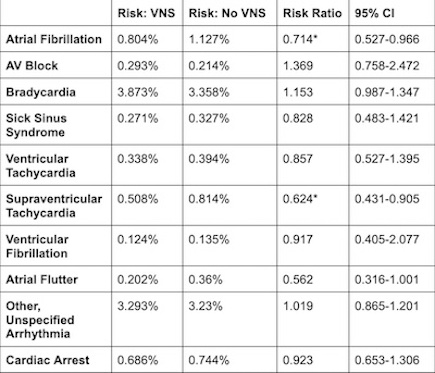
Abstract Body (Do not enter title and authors here): Introduction Implanted vagus nerve stimulators (VNS) have become an established therapy for treatment-resistant epilepsy and major depressive disorder (MDD), and the scope of its potential applications continues to grow, particularly in the realm of neuropsychiatric conditions. As the scope of VNS expands, understanding the potential cardiac effects of VNS is essential. While isolated case reports have raised concern for arrhythmias following VNS implantation, large-scale studies examining arrhythmia risk are limited. Research Question This study investigates whether VNS therapy alters the risk of developing cardiac arrhythmias in patients with epilepsy or MDD. Methods Using the TriNetX national database, we identified adult patients (≥18 years) with epilepsy or MDD diagnosed between January 1, 2005 and December 31, 2024. Two cohorts were created: one with VNS implantation and one without. Propensity score matching controlled for baseline differences, yielding 8,911 patients per group. We analyzed the absolute risk and risk ratios of ten arrhythmia-related outcomes, excluding pre-existing outcomes diagnosed prior to VNS implantation (VNS cohort) or diagnosis of epilepsy or MDD (no VNS cohort). Results Of the ten outcomes, two showed statistically significant reductions in risk among VNS patients. Atrial fibrillation occurred in 0.804% of VNS patients versus 1.127% without VNS (risk ratio [RR] 0.714, 95% CI: 0.527–0.966). Supraventricular tachycardia (SVT) occurred in 0.508% of VNS patients versus 0.814% without (RR 0.624, 95% CI: 0.431–0.905). Several other arrhythmias, including ventricular tachycardia (RR 0.857), ventricular fibrillation (RR 0.917), atrial flutter (RR 0.562), sick sinus syndrome (RR 0.828), and cardiac arrest (RR 0.923), were less common in the VNS group, though these findings were not statistically significant. Increased—but non-significant—risks were observed for atrioventricular block (RR 1.369), bradycardia (RR 1.153), and unspecified arrhythmias (RR 1.019). Conclusion In summary, VNS therapy does not appear to significantly increase the risk of new cardiac arrhythmias and may, in fact, confer a protective effect against atrial fibrillation and SVT. These findings support the electrophysiological safety of VNS in patients without prior arrhythmia and warrant further investigation into its potential role in arrhythmia prevention.
Williams, Ryan
(
University of Iowa
, Iowa City , Iowa , United States )
Howie, Cole
(
University of Iowa
, Iowa City , Iowa , United States )
Farjo, Peter
(
University of Iowa
, Iowa City , Iowa , United States )
Dominic, Paari
(
University of Iowa
, Iowa City , Iowa , United States )
Author Disclosures:
Ryan Williams:DO NOT have relevant financial relationships
| Cole Howie:No Answer
| Peter Farjo:DO NOT have relevant financial relationships
| Paari Dominic:DO have relevant financial relationships
;
Consultant:Boston Scientific:Active (exists now)
; Consultant:Biosense Webster:Active (exists now)