Rates of Atrial Fibrillation and Atrial Flutter in Non-diabetic Obese Adult Patients on Tirzepatide
Abstract Body (Do not enter title and authors here): Introduction Atrial fibrillation and atrial flutter are the most common types of cardiac arrhythmias and a leading cardiac cause of stroke. Obesity is one of the factors that has shown a causal role in atrial fibrillation through low-grade inflammation and greater epicardial fat thickness. Glucagon-Like Peptide 1 (GLP-1) medications have shown to have significant cardiovascular benefits not only in diabetic patients, but also in non-diabetic patients, through diabetes control, weight loss, and by reducing inflammation and oxidative stress. Does the use of Tirzepatide in non-diabetic obese adult patients, greater than 18 years of age, affect the risk of atrial arrhythmias?
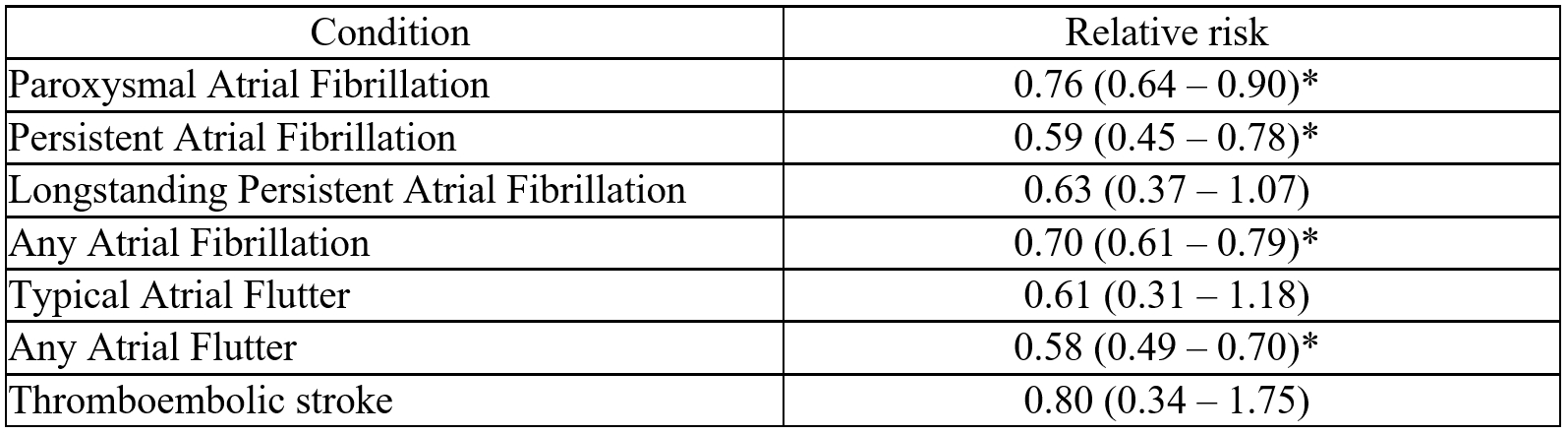
Methods Utilizing the TriNetX research database, a retrospective cohort study was done comparing non-diabetic obese adult patients greater than 18 years of age who are on Tirzepatide to those not on Tirzepatide. To reduce confounding, a total of 16,325 patients were selected in each cohort using propensity score matching. The outcomes measured were the number of patients who developed paroxysmal atrial fibrillation, persistent atrial fibrillation, longstanding persistent atrial fibrillation, any atrial fibrillation, typical atrial flutter, any atrial flutter, or thromboembolic strokes during a 12-month follow-up period.
Results The mean age of patients was 44 years and the mean body mass index (BMI) was 45 kg/m2. Seventy five percent of patients were white and 75% were females. There were no statistically significant differences in the baseline characteristics of the two cohorts. Non-diabetic obese adult patients greater than 18 years of age who are on Tirzepatide have statistically significant lower rates of developing paroxysmal atrial fibrillation, persistent atrial fibrillation, any atrial fibrillation, or any atrial flutter compared to patients who are not on Tirzepatide. There is no statistically significant difference in rates of longstanding persistent atrial fibrillation, typical atrial flutter, or thromboembolic stroke between the two cohorts. These results could potentially be explained by the weight loss and anti-inflammatory effects of GLP-1.
Conclusions Non-diabetic obese adult patients greater than 18 years of age who are on Tirzepatide have statistically significant lower rates of developing atrial fibrillation, atrial flutter, paroxysmal atrial fibrillation, or persistent atrial fibrillation compared to patients who are not on Tirzepatide.
Patel, Tusharbhai
(
Baylor College of Medicine
, Houston , Texas , United States )
Haloot, Justin
(
Baylor College of Medicine
, Houston , Texas , United States )
Giorgberidze, Irakli
(
Baylor College of Medicine
, Houston , Texas , United States )
Afshar, Hamid
(
Baylor College of Medicine
, Houston , Texas , United States )
Author Disclosures:
Tusharbhai Patel:DO NOT have relevant financial relationships
| Justin Haloot:DO NOT have relevant financial relationships
| Irakli Giorgberidze:No Answer
| Hamid Afshar:DO NOT have relevant financial relationships
Khan Muhammad Aslam, Haider Taimoor, Bhattarai Shraddha, Afzal Hafsa, Khan Bilal, Muhammad Anza, Shafique Nouman, Bhatia Hitesh, Aafreen Asna, Adil Abid Nawaz Khan, Akbar Usman, Khan Alamzaib, Haider Muhammad Adnan