
Logo

American Heart Association

  24
  0


Final ID: Mo3055

Accuracy of Angiographic Identification of Culprit Lesions in Women with MINOCA

Abstract Body (Do not enter title and authors here): Background:
Myocardial infarction with nonobstructive coronary arteries (MINOCA) accounts for 6-15% of myocardial infarctions and disproportionately affects women. Coronary culprit lesions in MINOCA occur in ~50% of cases and may be identified by multivessel optical coherence tomography (OCT). Identification of culprit lesions may guide pharmacologic therapy, but multivessel intravascular imaging remains infrequently utilized in MINOCA due to procedural complexity, time, risk, and uncertainty regarding culprit vessel.
Research Question:
How accurate are interventional cardiologists at identifying OCT-defined culprit lesion location on invasive coronary angiography in MINOCA patients?
Methods:
We conducted a retrospective substudy of women with MINOCA and a culprit lesion as identified by the OCT core laboratory in the AHA-funded Heart Attack Research Program (HARP). The OCT core laboratory identified the location of each culprit lesion on angiography. Separately, two interventional cardiologists blinded to the results of OCT independently reviewed invasive coronary angiography to identify the culprit vessel and segment, before and after review of electrocardiography (ECG) and echocardiography (echo). We assessed physician accuracy in determining culprit lesion location and the impact of ECG and echo on accuracy using chi-square tests.
Results:
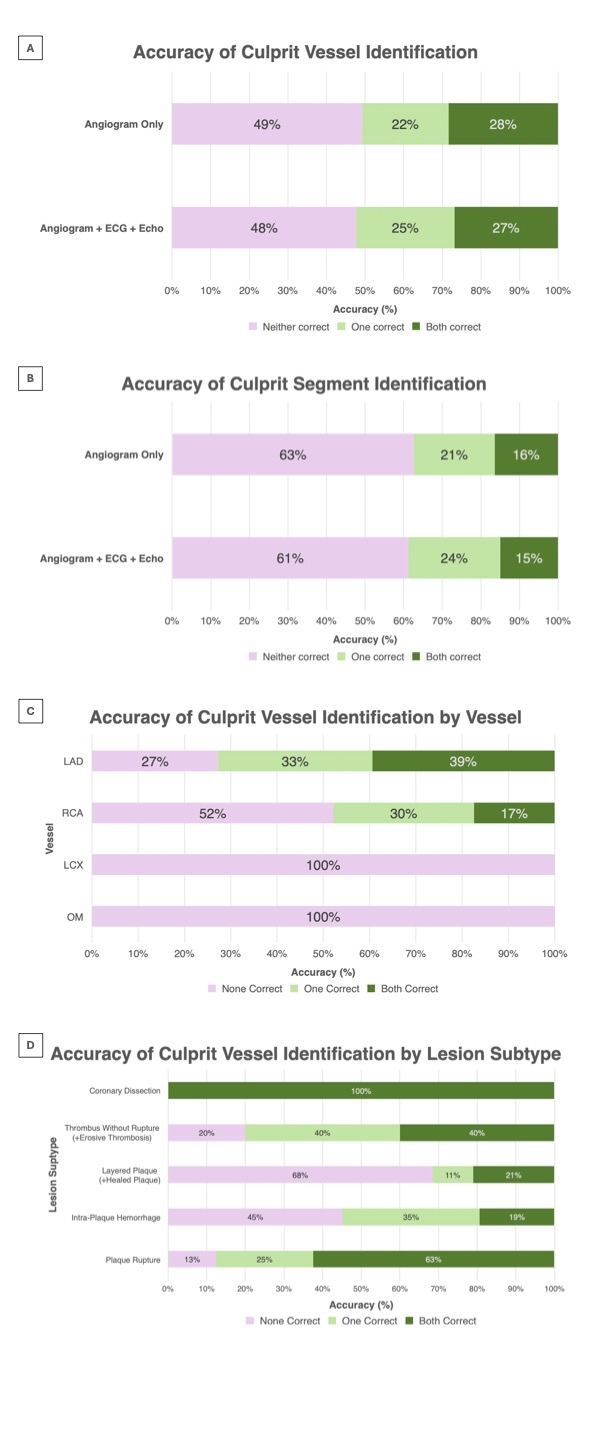
A total of 67 women with MINOCA and an OCT-defined culprit lesion were included in the analysis (median age 64, 97% NSTEMI). Culprit lesions were most often located in the LAD (49%) or RCA (33%). At least one interventional cardiologist correctly identified the culprit vessel in 52% (95% CI: 41–64%) of cases. Both were correct in only 27% (95% CI: 18–39%). The addition of ECG and echo did not improve accuracy of culprit lesion identification (P=0.98). Accuracy decreased further when interventional cardiologists were asked to identify the culprit coronary segment, with 39% (95% CI: 28–51%) correctly identified by ≥1 cardiologist. Accuracy of culprit lesion localization was highest for plaque rupture (88%). Accuracy was particularly poor for left circumflex culprits, which were missed by both cardiologists in all 11 cases.
Conclusion:
Angiographic identification of culprit lesions in women with MINOCA is challenging, even after consideration of ECG and echo data. These findings reinforce the utility of multivessel OCT to find culprit lesions in patients with MINOCA.
  • Shwayder, Elianna  ( New York University Grossman School of Medicine , New York , New York , United States )
  • Li, Vincent  ( New York University Grossman School of Medicine , New York , New York , United States )
  • Smilowitz, Nathaniel  ( New York University Langone Health , New York , New York , United States )
  • Serrano, Claudia  ( New York University Langone Health , New York , New York , United States )
  • Elbaum, Lindsay  ( New York University Langone Health , New York , New York , United States )
  • Shah, Binita  ( New York University Langone Health , New York , New York , United States )
  • Hochman, Judith  ( New York University Langone Health , New York , New York , United States )
  • Hausvater, Anais  ( New York University Langone Health , New York , New York , United States )
  • Reynolds, Harmony  ( New York University Langone Health , New York , New York , United States )
  • Author Disclosures:
    Elianna Shwayder: DO NOT have relevant financial relationships | Vincent Li: DO NOT have relevant financial relationships | Nathaniel Smilowitz: DO have relevant financial relationships ; Consultant:Abbott Vascular:Active (exists now) ; Consultant:AngioInsight:Active (exists now) ; Consultant:Boston Scientific:Active (exists now) | Claudia Serrano: No Answer | Lindsay Elbaum: No Answer | Binita Shah: DO have relevant financial relationships ; Researcher:Novo Nordisk:Active (exists now) ; Advisor:Philips Volcano:Active (exists now) | Judith Hochman: No Answer | Anais Hausvater: DO NOT have relevant financial relationships | Harmony Reynolds: No Answer
Meeting Info:

Scientific Sessions 2025

2025

New Orleans, Louisiana

Session Info:

AI, Advanced Imaging & Rapid Diagnostics in ACS

Monday, 11/10/2025 , 10:30AM - 11:30AM

Abstract Poster Board Session

More abstracts on this topic:
A Personal Risk Assessment Device in Patients with Chest Pain

Shvilkin Alexei, Zlatic Natasa, Atanasoski Vladimir, Grujovic Zdolsek Sanja, Popovic Maneski Lana, Miletic Marjan, Vukcevic Vladan

A novel small molecule synthesized based on a snail hibernation model induces hibernation in mouse fibroblasts and perfused hearts

Piao Jiyuan, Zhang Yongneng, Zhao Yuan Yuan, Hannington Patrick, Tabatabaei Dakhili Seyed Amirhossein, Ussher John, Sutendra Gopinath, Michelakis Evangelos

More abstracts from these authors:
Cell Signaling, Metabolic, and Inflammatory RNA Transcriptomic Pathways are Upregulated Among Patients with Coronary Microvascular Dysfunction and Ischemia with Non-Obstructive Coronary Arteries

Jerome Barbara, Berger Jeffrey, Smilowitz Nathaniel, Schlamp Florencia, Hausvater Anais, Joa Amanda, Serrano Claudia, Farid Ayman, Hochman Judith, Barrett Tessa, Reynolds Harmony

Discussion: Next Directions in Interventional Science

Shah Binita

You have to be authorized to contact abstract author. Please, Login
Not Available