
Logo

American Heart Association

  47
  0


Final ID: Su2056

Renal Function, Atrial Cardiopathy, and Their Joint Association with Mortality in the General Population

Abstract Body (Do not enter title and authors here): Background: Growing evidence suggests that left atrial dysfunction, or atrial cardiopathy, significantly increases mortality risk. Similarly, impaired renal function is a well-established predictor of mortality. However, the relationship between impaired renal function and atrial cardiopathy —and how their combined presence affects mortality risk—remains unexplored.
Methods: This analysis included 6,573 participants (mean age 57.0 ± 13.0 years; 50.5% women; 74.6% White) from NHANES-III who underwent electrocardiogram (ECG) recording. We excluded individuals with an estimated glomerular filtration rate (eGFR) <15 mL/min/1.73 m2 or major ECG abnormalities. The CKD-EPI equation was used to calculate eGFR. Atrial cardiopathy was defined from ECG tracings automatically processed at a central core facility as abnormal P-wave axis outside 0–75°, deep terminal negativity in V1 <100 µV, or prolonged P-wave duration in lead II >120 ms. Multivariable logistic regression assessed the cross-sectional association between impaired renal function (eGFR <45 vs. ≥45 mL/min/1.73 m2) and atrial cardiopathy. Cox proportional hazards models evaluated the individual and combined associations of eGFR and atrial cardiopathy with mortality.
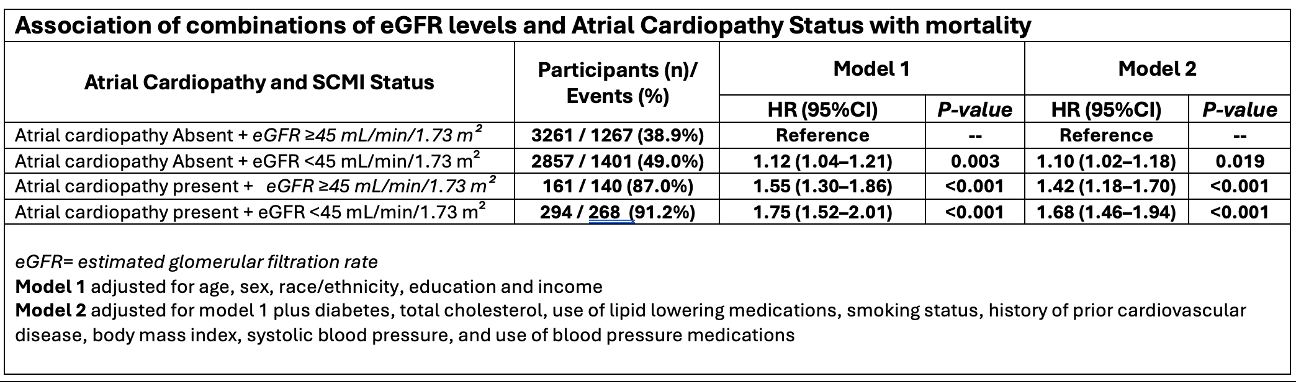
Results: About 47.9% (n=3151) of the participants had atrial cardiopathy at baseline. In multivariable logistic regression model adjusted for sociodemographic and cardiovascular risk factors, eGFR <45 (compared to ≥45) mL/min/1.73 m2 was associated with increased risk of atrial cardiopathy (OR (95% CI): 1.44(1.16–1.78)). During a median follow-up of 18.1 years, 3076 deaths occurred. Separate multivariable Cox proportional hazards models demonstrated that both atrial cardiopathy and eGFR <45 mL/min/1.73 m2 (compared to ≥45) were associated with an increased risk of mortality (HR (95% CI): 1.12(1.04-1.20) and 1.50(1.34-1.68), respectively). Compared to participants with eGFR ≥ 45 mL/min/1.73 m2 without atrial cardiopathy CM (reference group), those with coexistent eGFR <45 mL/min/1.73 m2 and atrial cardiopathy exhibited substantially higher risk of mortality, which was higher than either condition alone; interaction p-value = 0.011(Table).
Conclusions: Impaired renal function is associated with increased risk of atrial cardiopathy, and both conditions independently predict mortality, and their coexistence exhibits a synergistic effect, substantially amplifying mortality risk beyond their individual contributions.
  • Elbadawy, Menna  ( WAKE FOREST SCHOOL OF MEDICINE , Winston Salem , North Carolina , United States )
  • Soliman, Mai  ( WAKE FOREST SCHOOL OF MEDICINE , Winston Salem , North Carolina , United States )
  • Shatta, Ahmed  ( WAKE FOREST SCHOOL OF MEDICINE , Winston Salem , North Carolina , United States )
  • Mostafa, Mohamed  ( WAKE FOREST SCHOOL OF MEDICINE , Winston Salem , North Carolina , United States )
  • Attia, Mohamed  ( WAKE FOREST SCHOOL OF MEDICINE , Winston Salem , North Carolina , United States )
  • Kazibwe, Richard  ( WAKE FOREST SCHOOL OF MEDICINE , Winston Salem , North Carolina , United States )
  • Soliman, Elsayed  ( WAKE FOREST SCHOOL OF MEDICINE , Winston Salem , North Carolina , United States )
  • Author Disclosures:
    Menna Elbadawy: No Answer | Mai Soliman: DO NOT have relevant financial relationships | Ahmed Shatta: No Answer | Mohamed Mostafa: DO NOT have relevant financial relationships | Mohamed Attia: DO NOT have relevant financial relationships | Richard Kazibwe: DO NOT have relevant financial relationships | Elsayed Soliman: DO NOT have relevant financial relationships
Meeting Info:

Scientific Sessions 2025

2025

New Orleans, Louisiana

Session Info:

Metabolic Disease and Heart Failure: Mechanisms, Clinical Care and Population Outcomes

Sunday, 11/09/2025 , 11:30AM - 12:30PM

Abstract Poster Board Session

You have to be authorized to contact abstract author. Please, Login
Not Available