Scientific Sessions 2025
/
Aortic Disease
/
Sex-Based Differences in Short- and Long-Term Outcomes Following Aortic Dissection in Patients with Connective Tissue Disease
American Heart Association
127
0
Final ID: Su3145
Sex-Based Differences in Short- and Long-Term Outcomes Following Aortic Dissection in Patients with Connective Tissue Disease
Abstract Body (Do not enter title and authors here): Background: Connective tissue disorders (CTDs), including Ehlers-Danlos syndrome (EDS) and Marfan syndrome (MS), are known risk factors for aortic dissection (AD). Sex-based disparities in clinical outcomes among these patients remain underexplored, particularly in the context of short- and long-term complications. We aimed to evaluate these outcomes using a national database.
Methods: In this retrospective study, we queried the TriNetX global health research network to identify adults (≥18 years) with CTD (EDS and MS) who experienced type A AD. Baseline demographics (age, race), comorbidities, and medication use were collected. Propensity score matching (1:1) was applied based on age, race, major comorbidities, and medication use to generate balanced male and female cohorts. We compared short-term (30-day) and long-term outcomes, including all-cause mortality, neurological, respiratory, and vascular complications, acute kidney injury (AKI), rehospitalization, and infections. Risk ratios (RRs) with 95% confidence intervals (CIs) were calculated, with p < 0.05 considered statistically significant.
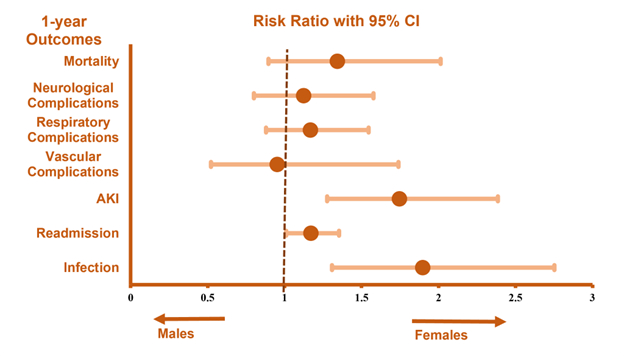
Results: A total of 1,588 CTD patients with type A AD were identified. After PSM, two well-balanced cohorts of 631 male and 631 female patients were obtained. The mean age was 52.6 ± 15.2 years; 68.5% were White and 13.8% were Black or African American. No significant sex-based differences were observed in all-cause mortality or in neurological, respiratory, or vascular complications at either time point. However, male patients had significantly higher rates of AKI (p < 0.001), rehospitalization (p = 0.035), and infections (p = 0.001) during both short- and long-term follow-up.
Conclusion: While overall mortality and major cardiovascular outcomes were similar between sexes, male patients with CTD and type A AD experienced higher rates of renal injury, infection, and rehospitalization. These findings underscore the need for enhanced post-discharge monitoring and supportive care in this high-risk group.
Shehzad, Mustafa
(
Hackensack University Medical Center
, Hackensack , New Jersey , United States )
Yousafzai, Osman
(
Hackensack University Medical Center
, Hackensack , New Jersey , United States )
Ahmad, Muhammad
(
Rawalpindi Medical University
, Rawalpindi , Pakistan )
Shehzad, Dawood
(
University of South Dakota
, Sioux Falls , South Dakota , United States )
Khan, Dawlat
(
University of South Dakota
, Sioux Falls , South Dakota , United States )
Chaudhry, Hammad
(
University of South Dakota
, Sioux Falls , South Dakota , United States )
Shabir Chaudhary, Sunia
(
Rawalpindi Medical University
, Rawalpindi , Pakistan )
Younis, Humna
(
Rawalpindi Medical University
, Rawalpindi , Pakistan )
Khan, Aoun Zaib
(
Metrohealth Medical Center
, Cleveland , Ohio , United States )
Ahmed, Mamoon
(
University of South Dakota
, Sioux Falls , South Dakota , United States )
Author Disclosures:
Mustafa Shehzad:DO NOT have relevant financial relationships
| Mamoon Ahmed:No Answer
| Osman Yousafzai:No Answer
| Muhammad Ahmad:DO NOT have relevant financial relationships
| Dawood Shehzad:DO NOT have relevant financial relationships
| Dawlat Khan:No Answer
| Hammad Chaudhry:DO NOT have relevant financial relationships
| Sunia Shabir chaudhary:No Answer
| Humna Younis:DO NOT have relevant financial relationships
| Aoun Zaib Khan:DO NOT have relevant financial relationships