
Coronary Artery Bypass Grafting Provides Better Long-Term Outcomes Compared To Percutaneous Coronary Intervention In Patients With Ischemic Heart Disease and Heart Failure with Ejection Fraction
Abstract Body (Do not enter title and authors here): Background The comparable long-term benefits of coronary artery bypass grafting (CABG) versus percutaneous coronary intervention (PCI) in patients with multivessel disease remains limited in underrepresented populations, particularly in patients with multivessel coronary artery disease and heart failure with severely reduced left ventricular ejection fraction (LVEF <35%).
Research Question Among patients with HF and LVEF < 35% which revascularization strategy (CABG or PCI) provides superior long-term clinical outcomes?
Methods: We conducted a systematic review and meta-analysis of observational studies involving patients with ischemic heart disease (IHD), HF and LVEF < 35% undergoing PCI or CABG with a minimum follow-up duration of five years. PubMed, Embase, and Cochrane databases were searched for studies published up to April 15, 2025. We computed hazard ratios (HR) from propensity score matched results. We used Cochrane Review Manager version 9.2.1 for statistical analysis. The primary endpoints of interest included all-cause mortality at 5 to 10 years, repeat revascularization, and all-cause mortality at 10 or more years.
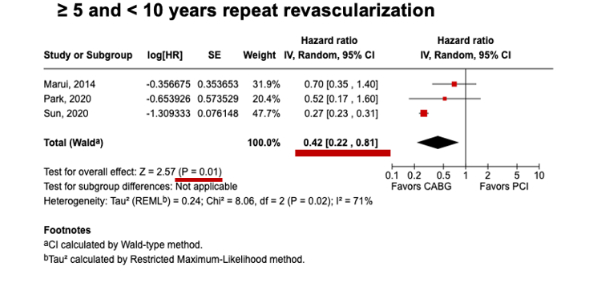
Results We included 8 studies with 12,697 patients (6,187 PCI vs 6,510 CABG). Median follow-up duration ranged from 3.8 to 5.2 years, with the longest reported follow-up up to 13 years. The cumulative, propensity adjusted, incidence of all-cause mortality was significantly lower in the CABG group compared to PCI in 5 to 10 years of follow-up (HR 0.61; 95% CI 0.54-0.69; p<0.001) and ≥ 10 years (HR 0.63; 95% CI 0.53-0.74; p<0.001). Additionally, CABG was associated with a reduced need for repeat revascularization in the 5 to 10 year time frame, with a HR of 0.42 (95% CI 0.22-0.81; p=0.01).
Conclusion In this systematic review and meta-analysis of patients with IHD and an ejection fraction ≤ 35% undergoing revascularization, CABG was associated with a reduction in all-cause mortality at ≥ 5 and ≥ 10 years of follow-up, as compared to PCI.
Lopes, Rodolfo
( Memorial Healthcare System
, Pembroke Pines
, Florida
, United States
)
Bortoletto Mussolini, Maria Carolina
( Faculdade de Medicina de Araraquara
, Descalvado
, Brazil
)
Itaya, Eduardo Dan
( University of Connecticut
, Farmington
, Connecticut
, United States
)
Chierici Pereira, Lucas
( Jefferson Einstein Hospital
, Philadelphia
, Pennsylvania
, United States
)
Vergara, Carlos
( Mayo Clinic
, Jacksonville
, Florida
, United States
)
Colombo, Rosario
( Jackson Memorial Hospital
, Miami Shores
, Florida
, United States
)
Author Disclosures:
Rodolfo Lopes:DO NOT have relevant financial relationships
| Maria Carolina Bortoletto Mussolini:DO NOT have relevant financial relationships
| Fernanda Luz:DO NOT have relevant financial relationships
| Eduardo Dan Itaya:DO NOT have relevant financial relationships
| Lucas Chierici Pereira:DO NOT have relevant financial relationships
| Carlos Vergara:DO NOT have relevant financial relationships
| Rosario Colombo:No Answer