Hybrid Devices Rank First in Vascular Closure Outcomes After Transfemoral TAVR Access: A Bayesian Network Meta-Analysis of Randomized Controlled Trials
Abstract Body (Do not enter title and authors here): Background
Transfemoral transcatheter aortic valve replacement (TAVR) is an established approach for treatment of symptomatic severe aortic stenosis. Various vascular closure devices (VCDs) have been used to for hemostasis; however, comparative outcome data remains limited.
Objective
To compare the safety and efficacy of plug, suture, and hybrid (suture and plug) based vascular closure devices in patients undergoing transfemoral TAVR.
Methods
A systematic search of PubMed, Embase, and the Cochrane Library was performed from inception until February 17th, 2025, for randomized controlled trials involving vascular closure devices in patients undergoing transfemoral TAVR. This study is registered in PROSPERO. We conducted a Bayesian network meta-analysis to synthesize the network evidence plot, surface under the cumulative ranking curve (SUCRA), and forest plot for efficacy and safety (in-hospital and 30-day complications) outcomes. Data analysis was performed using the “BUGSnet” package in R. The risk of bias for each study was assessed using RoB 2.0.
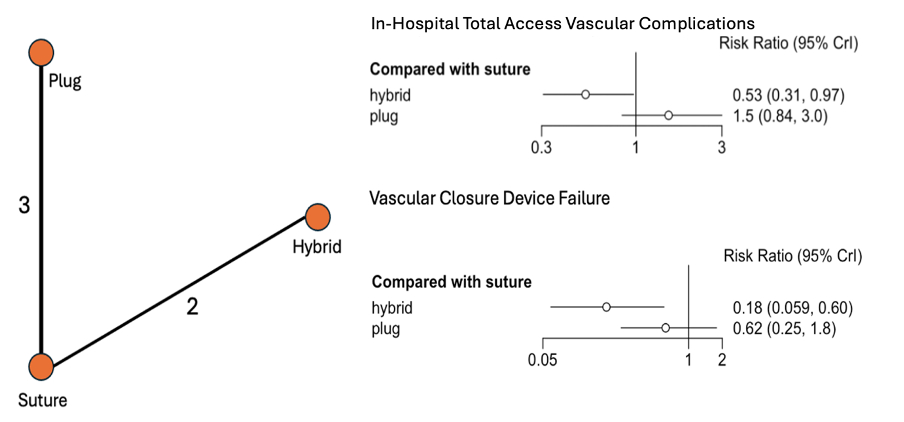
Results A total of 1,683 patients, involving 3 different closure techniques—plug (MANTATM), hybrids (ProGlideTM/ProStylesTM or Perclose-ProGlideTM and Angio-Seal®) and suture-only (ProGlideTM, Prostar XLTM, ProStylesTM)—were included in the final analysis. Hybrid closure techniques were associated with the lowest risk of total composite (major and minor) access-site vascular complications (relative risk (RR): 0.53; 95% credible interval (CrI): 0.31–0.97) and VCD failure (RR: 0.18; 95% CrI: 0.059–0.60) among all strategies. No other differences were identified in number of bleeding events, need for transfusion, number of emergency procedures, or 30-day mortality. Based on rank probabilities and SUCRA values, the hybrid approach was ranked first, followed by suture-based and plug-based devices.
Conclusion Hybrid-based closure of TAVR vascular access was associated with the most favorable safety and efficacy profile, with significantly lower rates of access-site complications and VCD failure. These findings support hybrid closure as the preferred strategy following transfemoral TAVR.
Lopes, Rodolfo
(
Memorial Healthcare System
, Pembroke Pines , Florida , United States )
Nursabur, Bistamy
(
Padjadjaran University
, Bandung , Indonesia )
Talavera, Juan Armando
(
Mount Sinai Medical Center
, Miami , Florida , United States )
Nudelman, Brian
(
Memorial Healthcare System
, Pembroke Pines , Florida , United States )
Itaya, Eduardo Dan
(
University of Connecticut School of Medicine
, Farmington , Connecticut , United States )
Park, Kyeeun
(
Memorial Healthcare System
, Pembroke Pines , Florida , United States )
Khalili, Houman
(
Florida Atlantic University
, Boca Raton , Florida , United States )
Author Disclosures:
Rodolfo Lopes:DO NOT have relevant financial relationships
| Bistamy Nursabur:No Answer
| Juan Armando Talavera:DO NOT have relevant financial relationships
| Brian Nudelman:DO NOT have relevant financial relationships
| Eduardo Dan Itaya:DO NOT have relevant financial relationships
| Kyeeun Park:No Answer
| HOUMAN KHALILI:No Answer