Consumer Wearables Heart Rate Metrics and Ventricular Arrythmia Risk in Heart Failure: An All of Us Cohort Analysis
Abstract Body (Do not enter title and authors here): Background Consumer activity trackers generate continuous heart rate (HR) and step counts that could complement clinical predictors of ventricular tachycardia/ventricular fibrillation (VT/VF) in heart-failure (HF) populations. Whether these signals confer incremental prognostic information remains unclear.
Methods We analyzed participants in the Fitbit Bring-Your-Own-Device cohort of the All of Us Research Program who carried an ICD-10 HF diagnosis on or before their first Fitbit record (2010-2022). Wearable metrics were calculated for every person-day and summarized per participant as: mean HR, HR pooled coefficient of variation (HR-CV), mean daily steps, step coefficient of variation (Steps-CV), and the daily HR-per-step ratio (dHRPS). Incident VT/VF was defined by I49.0* or I47.2* codes occurring after wearable initiation. Separate Cox proportional-hazards models for each wearable metric were adjusted for age, sex, and any VT/VF recorded before wearable use.
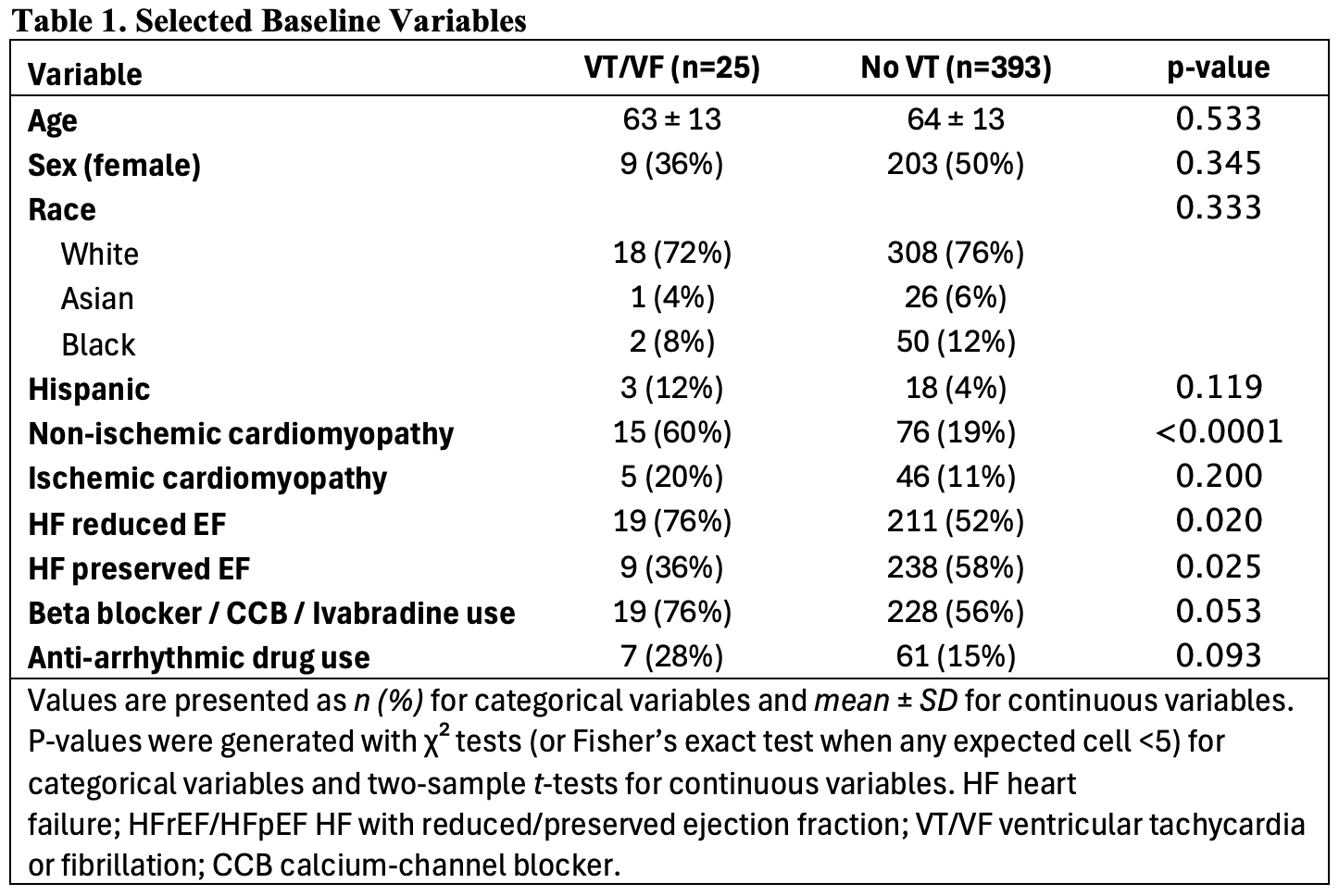
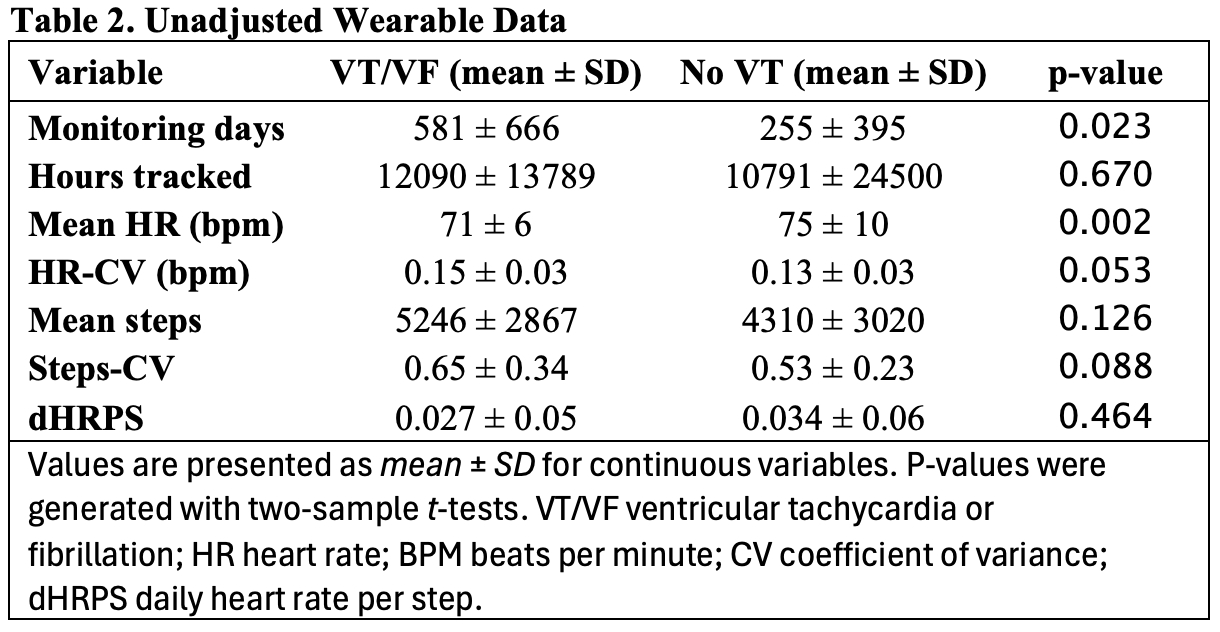
Results The analysis included 418 HF participants (mean age 64 ± 13y; 50% female) who contributed a median of 2,055 (IQR 1241–8430) monitoring hours. Over a median 87 (IQR 51–584) days of follow-up, 25 individuals (6%) experienced VT/VF. Non-ischemic cardiomyopathy and HFrEF were more commonly diagnosed at baseline in those with VT/VF (Table 1). Compared with those without VT/VF, affected participants displayed a lower mean HR (71 vs. 75 beats per minute, p = 0.002), while HR-CV, daily steps, Steps-CV and dHRPS were similar (Table 2).
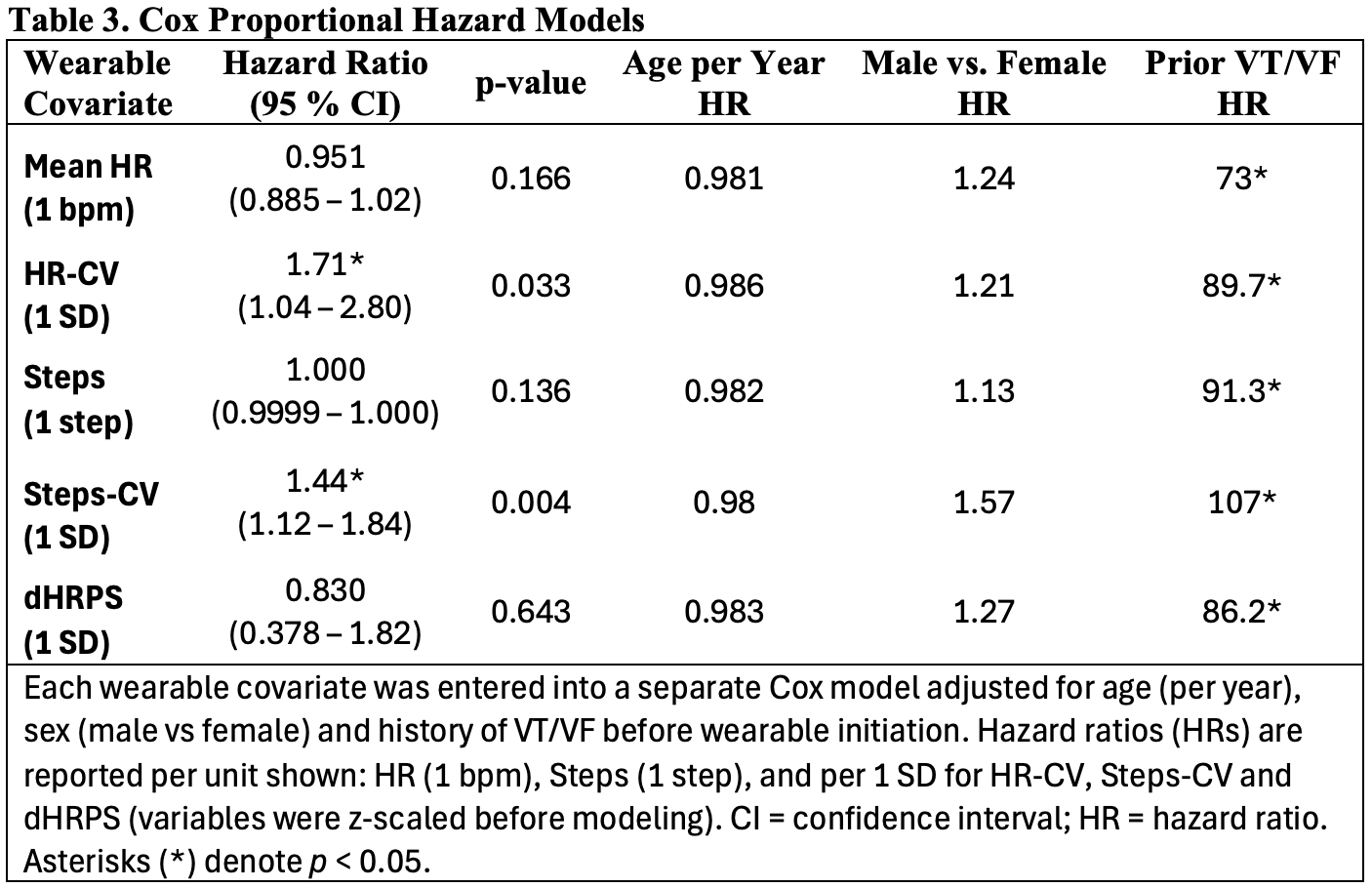
In multivariate models, HR-CV was independently associated with VT/VF (hazard ratio [H.R.] 1.71, p = 0.033) as was Steps-CV (H.R. 1.44, p = 0.004). Mean HR (p = 0.17), mean steps (p = 0.14) and dHRPS (p = 0.64) were not significant (Table 3). Prior VT/VF remained the strongest predictor across models (H.R. range 72–107, all p < 1×10⁻⁸).
Conclusions Among HF patients in the All of Us cohort, greater day-to-day variability in HR and step counts captured by consumer wearables was modestly associated with subsequent VT/VF after adjustment for age, sex and prior arrhythmia, whereas average HR and activity was not. Although these findings suggest that instability in physiologic rhythms may signal elevated arrhythmic risk, effect sizes were small relative to established clinical factors and may have limited clinical utility. Larger studies integrating device data with conventional risk markers are needed before wearables can be recommended for VT/VF risk stratification in HF.
Mallery, Quinn
(
Loyola University Medical Center
, Maywood , Illinois , United States )
Azari, Zubeen
(
Loyola University Medical Center
, Maywood , Illinois , United States )
Vasaiwala, Smit
(
Loyola University Medical Center
, Maywood , Illinois , United States )
Author Disclosures:
Quinn Mallery:DO NOT have relevant financial relationships
| Zubeen Azari:DO NOT have relevant financial relationships
| Smit Vasaiwala:No Answer