Logo

American Heart Association

  19
  0


Final ID: MP2136

Echocardiographic Assessment of Shock Using Right Ventricular–Pulmonary Artery Uncoupling in Acute Pulmonary Embolism

Abstract Body (Do not enter title and authors here):
Introduction:
Right ventricular–pulmonary arterial (RV–PA) coupling refers to the relationship between right ventricular contractility and its afterload. This relationship can be noninvasively estimated using tricuspid annular plane systolic excursion (TAPSE) to pulmonary arterial systolic pressure (PASP) ratio. A study by Yurditsy et al. demonstrated that in patients with acute pulmonary embolism (APE) undergoing mechanical thrombectomy, the TAPSE/PASP ratio was a strong predictor of normotensive shock. By using noninvasive echocardiographic measurements to assess hemodynamics, this approach may offer valuable insights for enhanced PE risk stratification.
Research Question/Hypothesis:
We predict that the TAPSE/PASP ratio will strongly predict shock in patients with APE.
Methods:
This retrospective analysis examined 83 patients with low-risk, intermediate-risk, or high-risk APE who had complete invasive hemodynamic results and echocardiograms at a large quaternary care academic medical center. The patients were stratified into shock (CI <2.2) versus no-shock (CI >2.2) groups based on right heart catheterization measurements. Univariate testing was performed between the two shock groups with Student’s t-test for continuous variables and chi-squared testing for categorical variables. Receiver operating characteristic curves were constructed for both the TAPSE/PASP ratio and TAPSE alone to predict shock—with AUCs and 95% confidence intervals estimated by DeLong’s method, optimal thresholds identified via the Youden index, and a DeLong test applied to compare the difference in AUCs.
Results/Data:
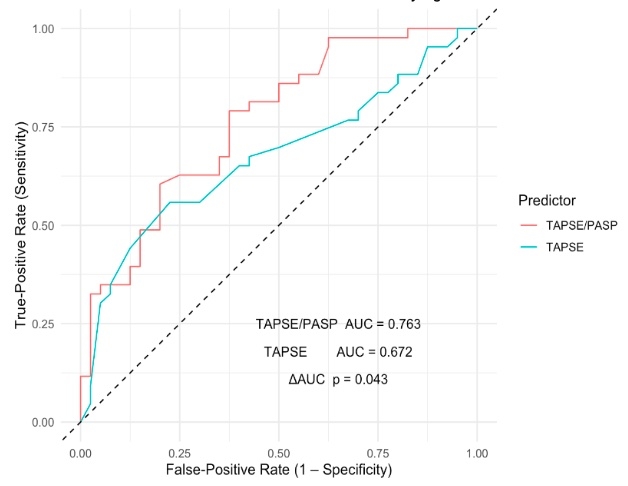
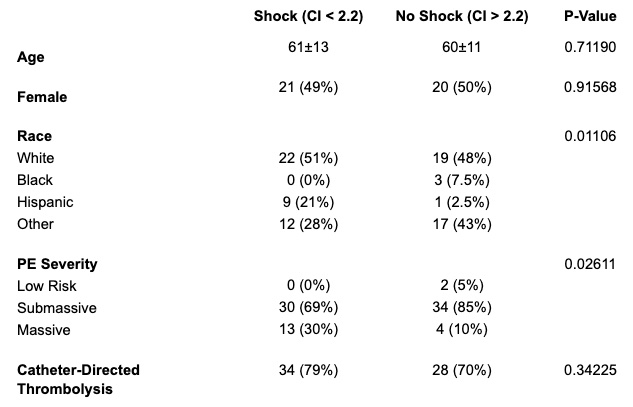
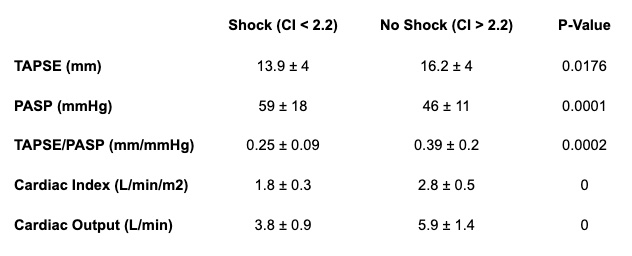
Invasive hemodynamics identified 43 (52%) of our patients with cardiogenic shock. The age, gender, and race were evenly distributed among the shock and no-shock groups (Table 1). Patients classified in the shock group had a significantly lower TAPSE/PASP ratio compared to the no-shock group (Table 2). The TAPSE/PASP ratio yielded an area under the curve (AUC) of 0.76, with a sensitivity of 0.79, specificity of 0.63, positive predictive value of 0.69, and negative predictive value of 0.74. Notably, the TAPSE/PASP ratio had a significantly higher AUC for predicting shock compared to TAPSE alone (p=0.043) (Figure 1).

Conclusion:
In conclusion, the TAPSE/PASP ratio can be a useful non-invasive measurement in predicting shock in patients presenting with APE. The measurement can be used to quickly assess hemodynamics to further risk-stratify patients with an APE.
  • Greathouse, Frances  ( Loyola University Medical Center , Forest Park , Illinois , United States )
  • Mallery, Quinn  ( Loyola University Medical Center , Maywood , Illinois , United States )
  • Choi, Myoung Hyun  ( Loyola University Medical Center , Forest Park , Illinois , United States )
  • Koura, Simran  ( Loyola University Medical Center , Apex , North Carolina , United States )
  • Gadhoke, Neel  ( Loyola University Medical Center , Forest Park , Illinois , United States )
  • Sharma, Aishwarya  ( Loyola University Medical Center , Forest Park , Illinois , United States )
  • Darki, Amir  ( Loyola University Medical Center , Apex , North Carolina , United States )
  • Author Disclosures:
    Frances Greathouse: DO NOT have relevant financial relationships | Quinn Mallery: DO NOT have relevant financial relationships | Myoung Hyun Choi: No Answer | Simran Koura: DO NOT have relevant financial relationships | Neel Gadhoke: DO NOT have relevant financial relationships | Aishwarya Sharma: DO NOT have relevant financial relationships | Amir Darki: No Answer
Meeting Info:

Scientific Sessions 2025

2025

New Orleans, Louisiana

Session Info:

Echoes of Progress: Innovation, Automation and Disease Specific Insights

Monday, 11/10/2025 , 12:15PM - 01:30PM

Moderated Digital Poster Session

More abstracts on this topic:
Adverse Events and Outcomes Among Patients with Temporary Mechanical Circulatory Support Devices Placed at Referring Versus Hub Cardiogenic Shock Centers

Patel Zachary, Silkowski Molly, Dodson Kaylen, Bull Lindsey, Gregoski Mathew, Tedford Ryan, Mcmurray Jeffrey, Witer Lucas, Kilic Arman, Houston Brian, Carnicelli Anthony, Ospina Meg, Mittelstaedt Roxanne, Peller Jacob, Samani Stephanie, Marchell Charlotte, Ohlrich Kelly, Gunn Brady, Varrone Michael

A Diagnosis Dilemma of Positional Hypoxia: Scoliosis-Mediated Platypnea-Orthodeoxia Syndrome

Ademuwagun Christianah, Arjoon Roy, Seth Paula, Chang Gene, Ibe Oby

More abstracts from these authors:
Comparison of Right Ventricular Dysfunction Following Catheter-Directed, Half-Dose, and Full-Dose Thrombolysis for Acute Pulmonary Embolism

Koura Simran, Shah Parth, Sutherland David, Kumar Amudha, Wroblewski Igor, Darki Amir, Mallery Quinn, Clarke Jacob, Greathouse Frances, Choi Myoung Hyun, Riya Fnu, Bruno Elizabeth, Arora Punit, Malas Waddah

Atrial Fibrillation Linked to Right Ventricular Dysfunction in Patients with Acute Pulmonary Embolism

Mallery Quinn, Shah Parth, Sutherland David, Kumar Amudha, Wroblewski Igor, Darki Amir, Gupta Riya, Clarke Jacob, Greathouse Frances, Choi Myoung Hyun, Koura Simran, Bruno Elizabeth, Arora Punit, Malas Waddah
You have to be authorized to contact abstract author. Please, Login
Not Available