
Logo

American Heart Association

  18
  0


Final ID: MP689

Endo-Epicardial Ablation for Recurrent Scar-Mediated Ventricular Tachycardia: A Case Report

Abstract Body (Do not enter title and authors here): Introduction: Endo-epicardial ablation is used for a wide variety of cardiac arrhythmias including idiopathic and scar-related ventricular tachycardias (VT). Patients who have extensive scar tissue or adhesions from prior cardiac surgeries might not be candidates for percutaneous access and require collaboration with cardiothoracic surgery prior to ablation.
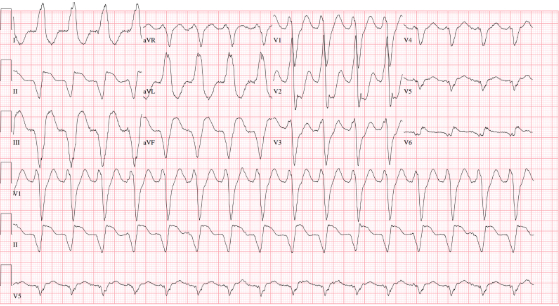
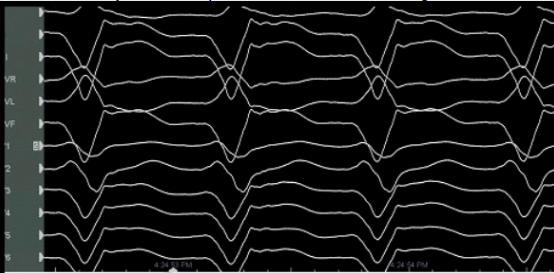
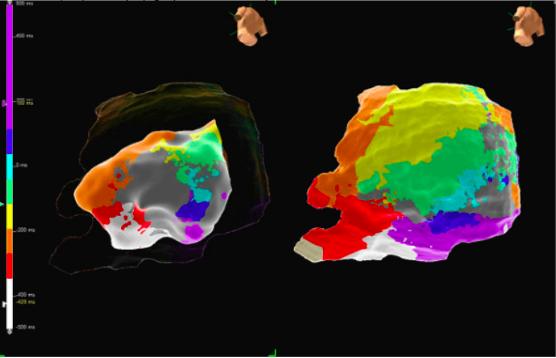
Case: A 61-year-old male with history of CAD (3-vessel CABG in 2005 and four subsequent PCIs), HFrEF with LBBB (status post CRT-D), and recurrent VT (with four endocardial VT ablations) presented with palpitations and an episode of syncope. ECG and device interrogation confirmed recurrent slow VT (figure 1). He was treated with manual ATP via device interrogation and started on a lidocaine infusion. He was euvolemic and labs were unremarkable. Left heart catheterization three months prior showed a patent LIMA-LAD graft, occluded OM vein graft, severe proximal LAD in-stent restenosis treated with PCI, and no additional revascularization targets. The decision was made to pursue endocardial and epicardial ablation due to prior treatment failure. The procedure was performed in the EP lab with transesophageal echocardiography for hemodynamic monitoring. Preemptive common femoral artery and vein sheaths were inserted for ECMO backup. A left thoracotomy was performed with subsequent lysis of pericardial adhesions. Intraoperatively he was in stable VT (figure 2). Epicardial mapping was performed with an HD GRID-X catheter (Abbott Medical) followed by LV endocardial activation mapping. This demonstrated a central channel in the inferior wall (Figure 3). Epicardial entrainment was performed which confirmed localization within the critical isthmus of the reentry circuit. Radiofrequency (RF) ablation was performed resulting in VT termination, with additional epicardial cryoablation performed afterwards. Endocardial RF ablation was performed targeting low amplitude fractionated EGMs opposing the epicardial ablation site. Following ablation, VT was non-inducible with programmed stimulation down to 400/200/200/200 ms. He was discharged on post-operative day 4 without complications or recurrence.
Discussion: We present a case of recurrent VT, refractory to endocardial ablation, in the setting of extensive cardiac surgical history. Collaboration between electrophysiology and cardiothoracic surgery regarding options for epicardial ablation in this high-risk patient population is necessary to ensure optimal outcomes.
  • Sweeney, Daniel  ( Loyola University Medical Center , Chicago , Illinois , United States )
  • Mallery, Quinn  ( Loyola University Medical Center , Maywood , Illinois , United States )
  • Vasaiwala, Smit  ( Loyola University Chicago , Maywood , Illinois , United States )
  • Author Disclosures:
    Daniel Sweeney: DO NOT have relevant financial relationships | Quinn Mallery: DO NOT have relevant financial relationships | Smit Vasaiwala: No Answer
Meeting Info:

Scientific Sessions 2025

2025

New Orleans, Louisiana

Session Info:

Out of Sync: Puzzling Cases in Electrophysiology

Saturday, 11/08/2025 , 03:15PM - 04:30PM

Moderated Digital Poster Session

More abstracts on this topic:
Changes in Cardiopulmonary Exercise Performance Following Atrial Fibrillation Ablation

Wattanachayakul Phuuwadith, Srikulmontri Thitiphan, Marotta Riley, Kulthamrongsri Narathorn, Lorlowhakarn Koravich, Kewcharoen Jakrin, Kittipibul Veraprapas, Amanullah Aman, Mainigi Sumeet

A Retrospective Analysis of Papillary Muscle PVC Ablations and Postprocedural Outcomes

Gulati Arvind, Praveen Niharika, Poddar Aastha, Futela Pragyat, Quelal Karol, Thomas Varghese Ben, Deshmukh Abhishek, Kowlgi Gurukripa

More abstracts from these authors:
You have to be authorized to contact abstract author. Please, Login
Not Available