
Logo

American Heart Association

  24
  0


Final ID: MP942

Proteomics analysis identifies sub-phenotypes amongst clinically similar patients with Idiopathic Pulmonary Arterial Hypertension

Abstract Body (Do not enter title and authors here): Background:
Patients with idiopathic pulmonary arterial hypertension (IPAH), a progressive pulmonary vasculopathy, may be clinically similar, yet have different responses to therapy and outcomes. Understanding proteomic profiles that distinguish amongst clinically similar patients could improve disease classification to better target treatment.
Research Question:
Can proteomic profiling identify molecular sub-phenotypes amongst otherwise clinically similar patients with IPAH?
Methods:
A cross-sectional, prevalent cohort of patients with IPAH (N=120, 60 survivors/60 non-survivors) was selected from the PAH Biobank to have similar clinical, genetic hemodynamic and risk profiles. Plasma protein levels of 11,000 proteins (SomaScan 11K Platform) were assayed. The top 10% of proteins with highest variance were used for spectral clustering. Survival by cluster was evaluated by Kaplan-Meier analysis and Cox proportional hazards model, adjusted for enrollment age and sex. Clinical differences between clusters were assessed with Chi-squared, Kruskal-Wallis and Fisher’s exact tests. Pathway analysis identified major proteomic pathways differentiating each cluster.
Results:
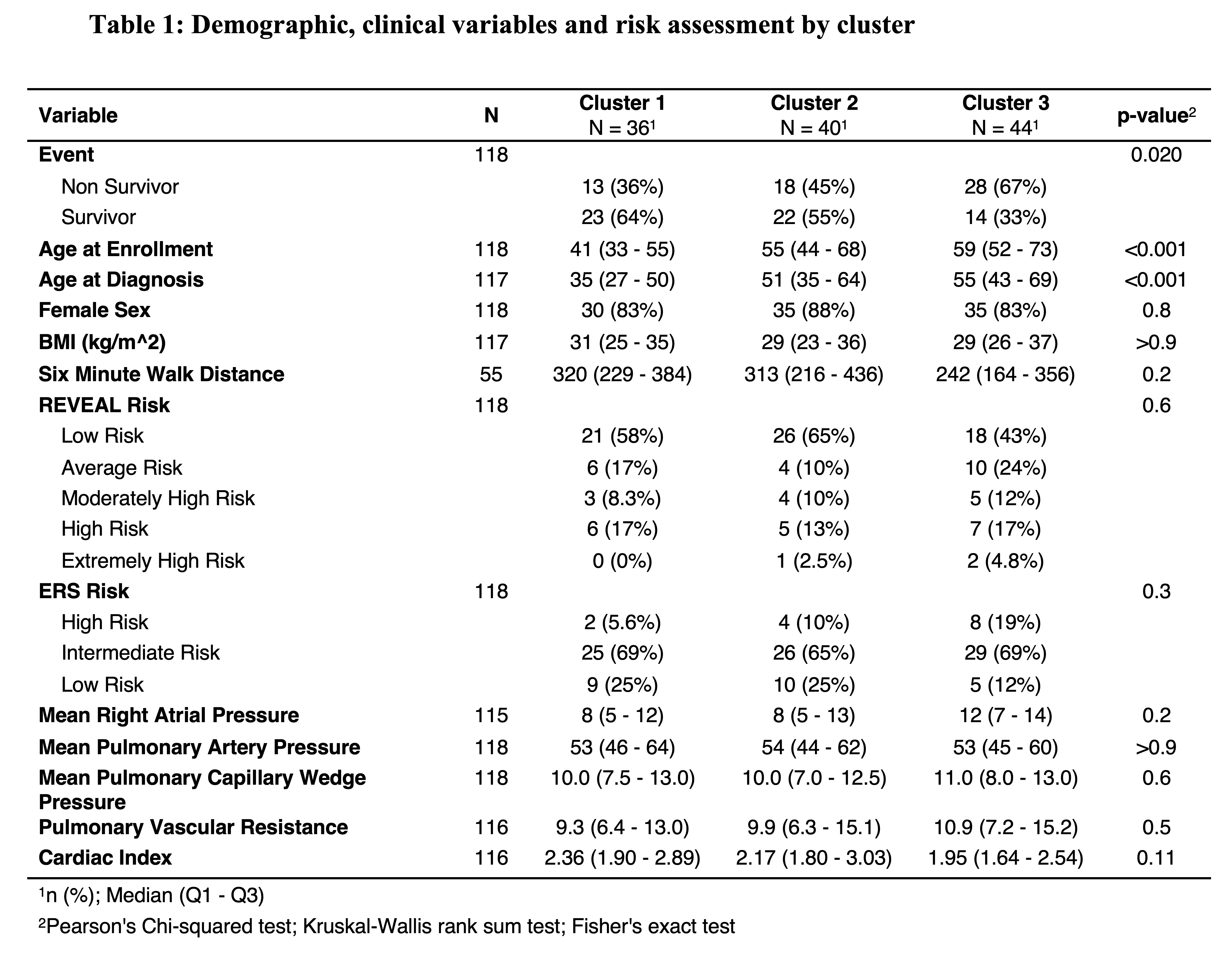
Spectral clustering identified 3 clusters, with 36%, 45% and 68% events over 5-years in clusters 1, 2 and 3 respectively (Figure 1, p=0.0025). The adjusted hazard ratio for death was 1.40 and 2.78 in clusters 2, 3 comparing to cluster 1. Subjects in cluster 3 were older than cluster 1 and 2. Medications, six-minute walk test and hemodynamics were similar across clusters and most subjects were intermediate risk (ERS criteria) and low or average risk (REVEAL 2.0)(Table 1).Differentially expressed proteins showed enrichment of Vascular Endothelial Growth Factor (VEGF) signaling (p=9.30E-04) between clusters 1 and 2, the Wnt signaling between clusters 1 and 3 (p=0.0014), and Neurotrophin signaling (p=4.82E-09) and VEGF signaling (p=5.93E-09) between clusters 2 and 3.
Conclusions:
This study identified differential expression of 3 pathways across clusters of similar IPAH patients with differences in outcomes not predicted by clinical risk assessment. All three of these pathways, Wnt, VEGF and Neurotrophin, have been implicated in pulmonary vascular and right ventricular dysfunction and may identify patients at higher risk or at different stages of the IPAH disease process. Understanding the proteome may identify molecular phenotypes of IPAH associated with outcomes but missed by clinical classification.
  • Ruan, Peifeng  ( University of Texas Southwestern , Dallas , Texas , United States )
  • Manlhiot, Cedric  ( THE HOSPITAL FOR SICK CHILDREN , Toronto , Ontario , Canada )
  • Austin, Eric  ( VANDERBILT UNIVERSITY MEDICAL CTR , Nashville , Tennessee , United States )
  • Nichols, Bill  ( Cincinnati Childrens Medical Center , Cincinnati , Ohio , United States )
  • Everett, Allen  ( Johns Hopkins University , Glenwood , Maryland , United States )
  • Griffiths, Megan  ( University of Texas Southwestern , Dallas , Texas , United States )
  • Author Disclosures:
    Peifeng Ruan: DO NOT have relevant financial relationships | Cedric Manlhiot: DO NOT have relevant financial relationships | Eric Austin: DO have relevant financial relationships ; Advisor:Merck, Inc:Past (completed) | Bill Nichols: No Answer | Allen Everett: DO NOT have relevant financial relationships | Megan Griffiths: DO NOT have relevant financial relationships
Meeting Info:

Scientific Sessions 2025

2025

New Orleans, Louisiana

Session Info:

Decoding the Molecular Basis of Disease: Using OMICS to Understand Pulmonary Vascular Disease

Saturday, 11/08/2025 , 10:45AM - 12:00PM

Moderated Digital Poster Session

More abstracts on this topic:
Comprehensive Single-Cell Atlas of the Human Lung in Pulmonary Arterial Hypertension

Hong Jason, Wong Brenda, Brownstein Adam, Graves Tammy, Aldred Micheala, Dai Zhiyu, Yang Xia, Eghbali Mansoureh

Genome Wide Association Study Identifies Loci Associated with Pulmonary Pressure

Agrawal Vineet, Sun Yan, Brittain Evan, Hui Qin, Garry Jonah, Kundu Suman, West James, Mosley Jonathan, Kepler Joshua, Freiberg Matthew, Joseph Jacob

More abstracts from these authors:
Role of Cellular Communication Network Protein Family in Pulmonary Arterial Hypertension

Byrd Carly, Austin Eric, Hassoun Paul, Everett Allen, Schramm Jennifer, Yang Jun, Griffiths Megan, Damico Rachel, Simpson Catherine, Kolb Todd, Nichols Bill, Ivy Dunbar

Using High-throughput Proteome-wide Analysis to Discover Clinical Biomarkers of Pediatric Pulmonary Arterial Hypertension

Ng Qimin, Ivy Dunbar, Chinni Bhargava, Manlhiot Cedric, Nichols Bill, Barnes Allan, Griffiths Megan, Yang Jun, Everett Allen

You have to be authorized to contact abstract author. Please, Login
Not Available