Logo

American Heart Association

  27
  0


Final ID: MP2461

Advanced Mapping Techniques for Atrioventricular Nodal Reentrant Tachycardia in Pediatric Patients: Do They Make a Difference?

Abstract Body (Do not enter title and authors here): Introduction: Catheter ablation for atrioventricular nodal reentrant tachycardia (AVNRT) traditionally used a combination of anatomic and signal morphology mapping. Newer advanced mapping techniques (AMTs) for AVNRT include propagation mapping to identify the collision point of atrial wavefronts and voltage mapping to identify a low-voltage bridge. Due to very good outcomes of AVNRT ablation in general, assessment of the true value of AMTs is challenging.
Hypothesis: AMTs improve procedural outcomes in pediatric patients and are viewed as valuable (both accurate and helpful).
Aims: To describe outcomes for AVNRT ablations in pediatric patients with and without use of AMTs and to assess intraprocedural views on their value.
Methods: Single-center retrospective study. Our center began almost exclusively using AMTs in AVNRT ablations in 2020, with both propagation and voltage mapping performed in these cases (AMT group: 2020-2024). A control group included the same number of the most-recent, consecutive, non-AMT procedures (2017-2022). Procedural outcomes were compared. In addition, the accuracy of AMT (whether combined pre-ablation AMTs correctly predicted the successful ablation location) and perceived helpfulness of AMT (as documented by the electrophysiologist at the time of the procedure) were assessed.
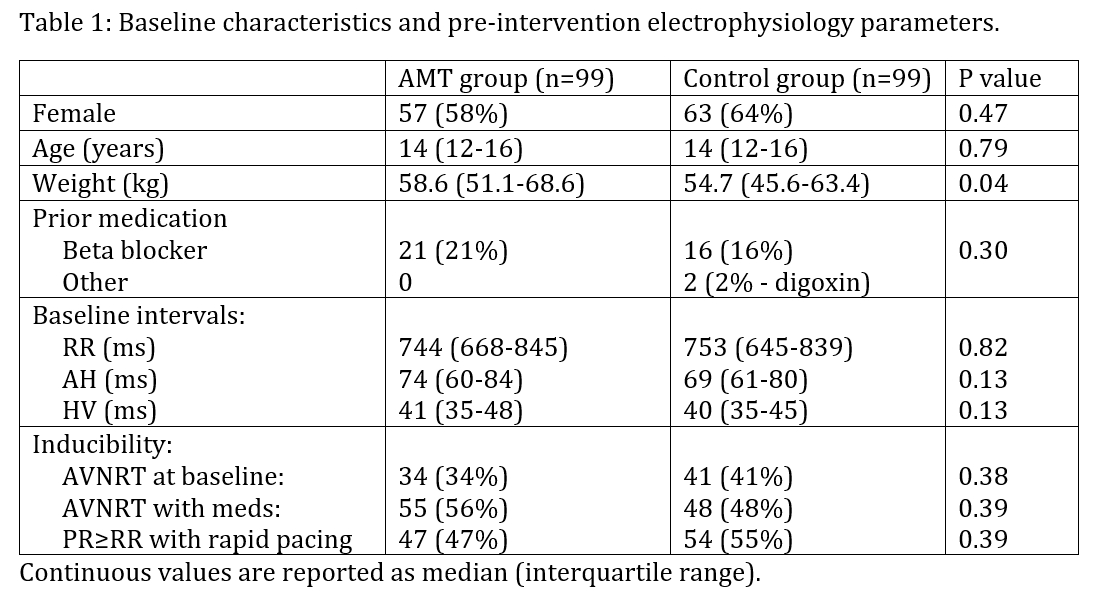
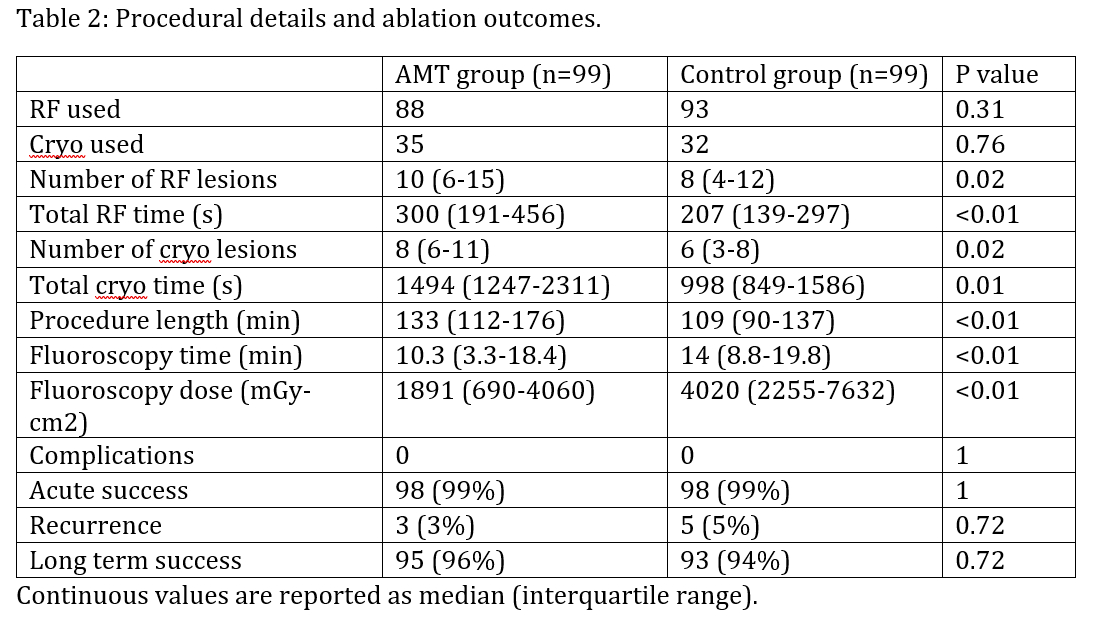
Results: 99 AMT procedures and 99 controls were compared. Table 1 shows baseline characteristics while Table 2 shows procedural outcomes. There were no statistically significant differences in success rates or recurrences. Both the number and total time of RF and cryoablation lesions were greater in the AMT group. Median fluoroscopy time (9.9 v 13.8 min) and dose (1914 vs 4073 mGy-cm2) were lower in AMT procedures, but procedures lasted longer (133 v 109 min). AMTs were accurate in 52% of cases. When accurate, degree of helpfulness of AMT was categorized into three categories: 1.) helped identify the correct ablation location not suggested by traditional techniques in 23%; 2.) helpful but identified the same location as from traditional mapping in 17%, and 3.) unclear helpfulness in 11%.
Conclusion: Only 52% of AMT localizations were viewed as accurate, but 23% were viewed as clearly helpful beyond traditional mapping techniques. AMTs correlated with reduced fluoroscopy but longer procedure times. The total number of ablation lesions and ablation times were higher in the AMT group and suggests that AMTs may adversely influence initial ablation locations.
  • Uniat, Jonathan  ( CHILDRENS HOSPITAL LOS ANGELES , Los Angeles , California , United States )
  • Hill, Allison  ( Children's Hospital Los Angeles , Los Angeles , California , United States )
  • Shwayder, Mark  ( CHILDRENS HOSPITAL LOS ANGELES , Los Angeles , California , United States )
  • Silka, Michael  ( Children's Hospital Los Angeles , Los Angeles , California , United States )
  • Bar-cohen, Yaniv  ( CHILDREN'S HOSPITAL LOS ANGELES , Los Angeles , California , United States )
  • Author Disclosures:
    Jonathan Uniat: DO NOT have relevant financial relationships | Allison Hill: DO NOT have relevant financial relationships | Mark Shwayder: DO NOT have relevant financial relationships | Michael Silka: DO NOT have relevant financial relationships | Yaniv Bar-Cohen: DO NOT have relevant financial relationships
Meeting Info:

Scientific Sessions 2025

2025

New Orleans, Louisiana

Session Info:

Treatment of Arrhythmias: Ablation and Device Therapy

Monday, 11/10/2025 , 09:15AM - 10:25AM

Moderated Digital Poster Session

More abstracts on this topic:
Ablation for Atrial Fibrillation: A Comprehensive Meta-Analysis of Randomized Controlled Trials with Reconstructed Time-to-Event Data

Mi Jiaqi, Katapadi Aashish, Darden Douglas, Uppalapati Sree Varuntej, Kabra Aanya, Katapadi Aashika

Cavo-Tricuspid Isthmus Ablation in Atrial Flutter with Uncorrected Ebstein’s Anomaly: A Scoping Review

Jain Shubhika, Goyal Samarth, Ramesh Prerana, Momin Elina, Vyas Rahul

You have to be authorized to contact abstract author. Please, Login
Not Available