Artificial Intelligence-Enabled Electrocardiogram for the Detection of Elevated Filling Pressure in Hypertrophic Cardiomyopathy and Cardiac Amyloidosis
Abstract Body (Do not enter title and authors here): Introduction Diastolic dysfunction is a hallmark of heart failure with preserved ejection fraction, yet echocardiographic grading is challenging in patients with hypertrophic or amyloid cardiomyopathies due to variable structural and functional remodeling. Consequently, there is a need for additional diagnostic tools to identify patients at increased risk of diastolic dysfunction and enhanced filling pressure.
Research question What is the accuracy of an artificial intelligence (AI)-enabled electrocardiogram (ECG) model to predict diastolic dysfunction in hypertrophic and amyloid cardiomyopathy?
Methods We included patients with diverse phenotypes of hypertrophic cardiomyopathy (HCM) and cardiac amyloidosis and validated Mayo Clinic's AI-enabled ECG model to grade diastolic function (normal: grade 0/1; abnormal: grade 2/3). Echocardiographic analysis of systolic (LVEF) and diastolic function was performed within 14 days of ECG recording. Diastolic function was graded based on E/e’ (>14), left atrial volume index (>34 mL/m2), pulmonary venous atrial reversal flow duration (≥30 ms), and peak tricuspid regurgitation velocity (>2.8 m/s). Filling pressure was considered increased if ≥3 parameters were abnormal, inconclusive if 2 were abnomal, and normal if ≥3 were normal. Echocardiograms with severe mitral regurgitation were excluded.
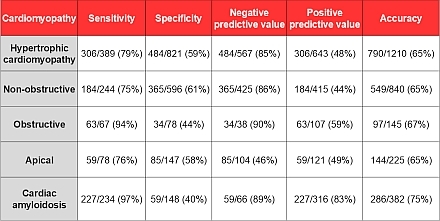
Results We identified and matched 840 ECGs from non-obstructive HCM patients (n=125, age 58±19y, 70% male), 145 ECGs from obstructive HCM patients (n=29, age 56±18y, 66% male), 225 ECGs from apical HCM patients (n=33, age 66±14y, 61% male), and 382 ECGs from cardiac amyloidosis patients (n=49, age 70±13y, 57% male). The AI-enabled ECG model predicted diastolic dysfunction with an accuracy of 65% (non-obstructive HCM), 67% (obstructive HCM), 65% (apical HCM), and 75% (cardiac amyloidosis), with sensitivities of 94% and 97% for obstructive HCM and cardiac amyloidosis, respectively, and high positive and negative predictive values for cardiac amyloidosis. Systolic dysfunction (LVEF≤40%) was more common in cardiac amyloidosis (29%) than in all HCM patients (5%).
Conclusion The AI-enabled ECG model demonstrates moderate accuracy but high sensitivity for detecting diastolic dysfunction and increased filling pressure, especially in obstructive HCM and cardiac amyloidosis. The AI-enabled ECG is a useful, widely scalable, and low cost tool to identify patients at increased risk for diastolic dysfunction.
Van Lerberghe, Robin
(
UZ Leuven
, Leuven , Belgium )
Vandenberk, Bert
(
UZ Leuven
, Leuven , Belgium )
Jacobs, Johanna
(
Mayo Clinic and UZ Leuven
, Leuven , Belgium )
Servaes, Veerle
(
UZ Leuven
, Leuven , Belgium )
Robyns, Tomas
(
UZ Leuven
, Leuven , Belgium )
Van Aelst, Lucas
(
UZ Leuven
, Leuven , Belgium )
Mangold, Kathryn
(
Mayo Clinic
, Rochester , Minnesota , United States )
Attia, Zachi
(
Mayo Clinic
, Rochester , Minnesota , United States )
Oh, Jae
(
Mayo Clinic
, Rochester , Minnesota , United States )
Grogan, Martha
(
Mayo Clinic
, Rochester , Minnesota , United States )
Friedman, Paul
(
Mayo Clinic
, Rochester , Minnesota , United States )
Herrmann, Joerg
(
Mayo Clinic
, Rochester , Minnesota , United States )
Janssens, Stefan
(
UZ Leuven
, Leuven , Belgium )
Author Disclosures:
Robin Van Lerberghe:DO NOT have relevant financial relationships
| Martha Grogan:DO have relevant financial relationships
;
Research Funding (PI or named investigator):BridgeBio:Active (exists now)
; Consultant:AstraZeneca:Active (exists now)
; Research Funding (PI or named investigator):Intellia:Active (exists now)
; Research Funding (PI or named investigator):NovoNordisk:Active (exists now)
; Consultant:NovoNordisk:Active (exists now)
; Consultant:Janssen:Active (exists now)
; Research Funding (PI or named investigator):Alnylam:Active (exists now)
; Research Funding (PI or named investigator):AstraZeneca:Active (exists now)
| Paul Friedman:DO have relevant financial relationships
;
Other (please indicate in the box next to the company name):Anumana:Active (exists now)
; Other (please indicate in the box next to the company name):Eko Health:Active (exists now)
; Other (please indicate in the box next to the company name):AliveCor:Active (exists now)
| Joerg Herrmann:DO NOT have relevant financial relationships
| Stefan Janssens:DO NOT have relevant financial relationships
| Bert Vandenberk:DO NOT have relevant financial relationships
| Johanna Jacobs:DO NOT have relevant financial relationships
| Veerle Servaes:No Answer
| Tomas Robyns:DO NOT have relevant financial relationships
| Lucas Van Aelst:DO NOT have relevant financial relationships
| Kathryn Mangold:No Answer
| Zachi Attia:No Answer
| Jae Oh:DO have relevant financial relationships
;
Royalties/Patent Beneficiary:Anumana:Active (exists now)
; Consultant:Medtronic:Active (exists now)