Etomidate Is Associated with Lower Odds of Early-Onset Hypotension and Hypoxemia but Not Cardiac Arrest Compared to Ketamine in Endotracheal Intubation: A Meta-Analysis of Their Comparative Hemodynamic Outcomes
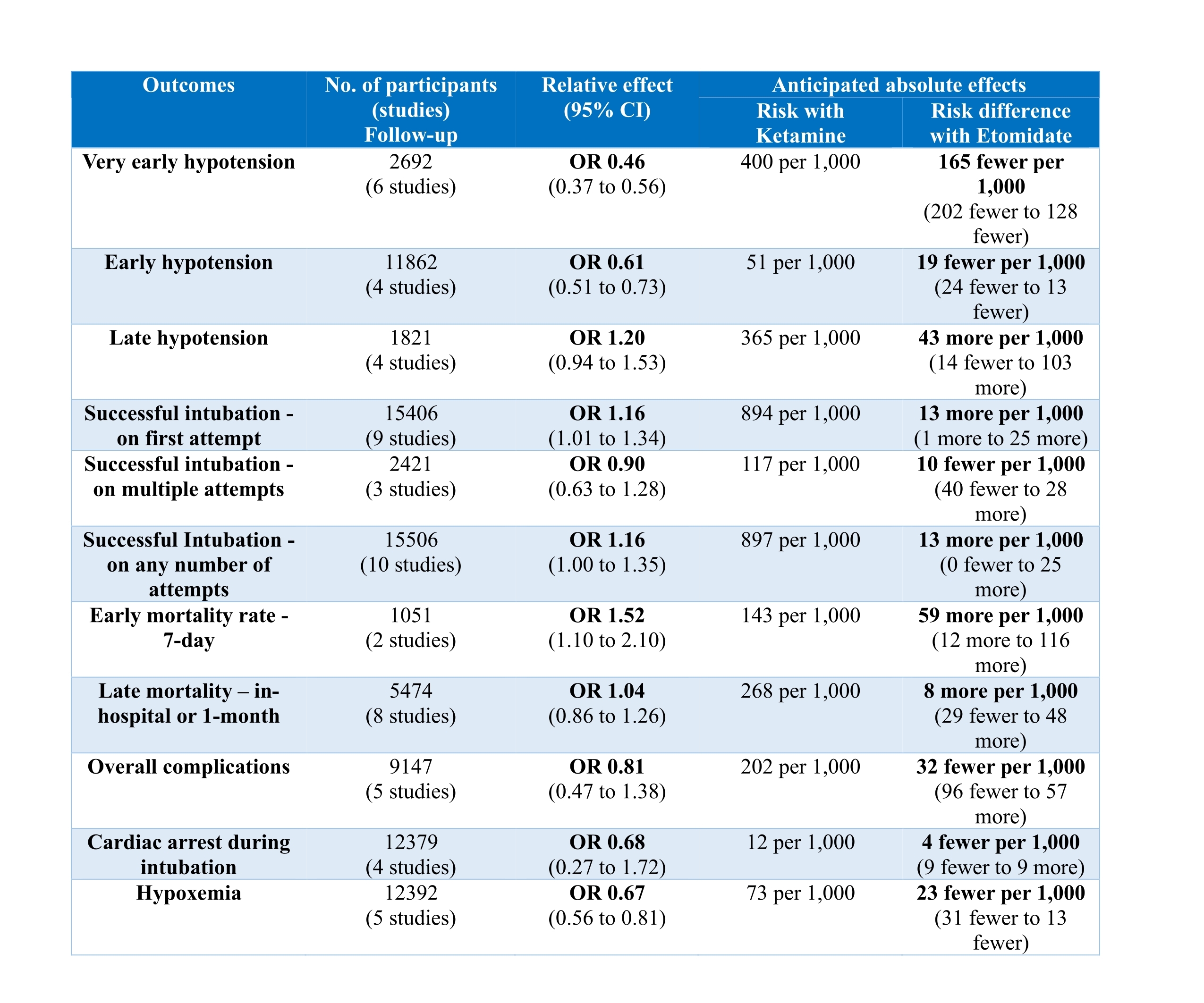
Abstract Body (Do not enter title and authors here): Introduction: Etomidate and ketamine are both widely used in endotracheal intubation (ETI), a critical procedure in emergency and intensive care settings often associated with hemodynamic instability. Recent studies have yielded conflicting evidence regarding their safety profiles, particularly in the context of post-intubation events. Research Questions: Is there a difference between etomidate and ketamine in terms of hemodynamic outcomes? How do these agents compare with respect to key clinical measures such as intubation success, hypoxemia, cardiac arrest, mortality, and overall complication rates? Methods: PubMed, Embase, Cochrane, ClinicalTrials.gov, and WHO ICTRP were searched. All analyses were conducted in RevMan Web using a fixed- or random-effects model depending upon the observed heterogeneity. Results: Four trials and 15 cohort studies met the eligibility criteria. Compared with ketamine, etomidate was associated with significantly lower odds of very early-onset (within first 30min; OR:0.46; 95%-CI:0.37–0.56) and early-onset hypotension (within first 2h; OR:0.61; 95%-CI:0.51–0.73). However, no significant difference was observed in the odds of late-onset hypotension (within first 24h; OR:1.20;95%-CI: 0.94–1.53). In terms of safety, etomidate demonstrated significantly lower odds of hypoxemia (OR:0.67; 95%-CI:0.56–0.81), whereas no significant advantage was seen in the prevention of cardiac arrest (OR:0.68; 95%-CI:0.27–1.72) and overall complications (OR:0.81; 95%-CI:0.39–1.66). Etomidate had marginally higher odds of successful intubation (OR:1.16; 95%-CI:1.00–1.35), slightly higher odds of mortality within 7 days (OR:1.52; 95%CI:1.10– 2.10), but similar odds of mortality in the hospital or within 1 month (OR:1.04; 95%-CI:0.86–1.26). Conclusion: Etomidate offers an early hemodynamic advantage over ketamine, with significantly lower odds of hypotension, but this benefit does not extend into the later post-intubation period (within 24 hours). Etomidate is also associated with higher odds of successful intubation and lower odds of hypoxemia, further suggesting etomidate superiority early on. Nevertheless, neither agent shows superiority in preventing cardiac arrest or complications overall, and the marginally higher odds of 7-day mortality with etomidate point toward other potential risk factors associated with etomidate use. These findings warrant further comparisons between the two drugs in randomized studies.
Maqsood, Musab
(
King Edward Medical University
, Lahore , Pakistan )
Shabbir, Muhammad Asad
(
Gujranwala Medical College
, Gujranwala Medical College , Pakistan )
Rashid, Mohsin
(
King Edward Medical University
, Lahore , Pakistan )
Iqbal, Talha
(
King Edward Medical University
, Lahore , Pakistan )
Arshad, Hafiz Muhammad Ehsan
(
King Edward Medical University
, Lahore , Pakistan )
Babar, Anas
(
King Edward Medical University
, Lahore , Pakistan )
Shahid, Abdullah
(
Khawaja Muhammad Safdar Medical College
, Sialkot , Pakistan )
Raza, Muhammad Zain
(
King Edward Medical University
, Lahore , Pakistan )
Shahid, Aymon
(
King Edward Medical University
, Lahore , Pakistan )
Nadeem, Ali Ahmad
(
King Edward Medical University, LHR
, Lahore , Pakistan )
Ashraf Zia, Aiza
(
King Edward Medical University
, Lahore , Pakistan )
Author Disclosures:
Musab Maqsood:DO NOT have relevant financial relationships
| Ali Ahmad Nadeem:DO NOT have relevant financial relationships
| Aiza Ashraf Zia:No Answer
| Muhammad Asad Shabbir:DO NOT have relevant financial relationships
| Mohsin Rashid:DO NOT have relevant financial relationships
| Talha Iqbal:No Answer
| Hafiz Muhammad Ehsan Arshad:DO NOT have relevant financial relationships
| Anas Babar:DO NOT have relevant financial relationships
| Abdullah Shahid:DO NOT have relevant financial relationships
| Muhammad Zain Raza:No Answer
| Aymon Shahid:DO NOT have relevant financial relationships