
Logo

American Heart Association

  15
  0


Final ID: 4366340

Use of 3D Virtual Modeling to Guide Mitral Valve Partial Heart Transplantation in a Pediatric Patient with a Mechanical Mitral Valve

Abstract Body (Do not enter title and authors here): Background:
Mitral valve (MV) partial heart transplantation (PHT) is an exceptionally rare and technically demanding procedure, with only one prior case reported using a living donor valve. This case represents the first known MV PHT to replace a mechanical prosthesis. In patients with prior valve replacement, distorted cardiac geometry and absent subvalvular structures pose significant challenges to donor valve implantation. Precise placement and tensioning of donor chordae necessitate accurate spatial measurements that conventional imaging cannot reliably provide. 3D virtual modeling offers a patient-specific solution to quantify anatomic relationships and support high-precision surgical planning for these complex and unprecedented interventions.
Methods:
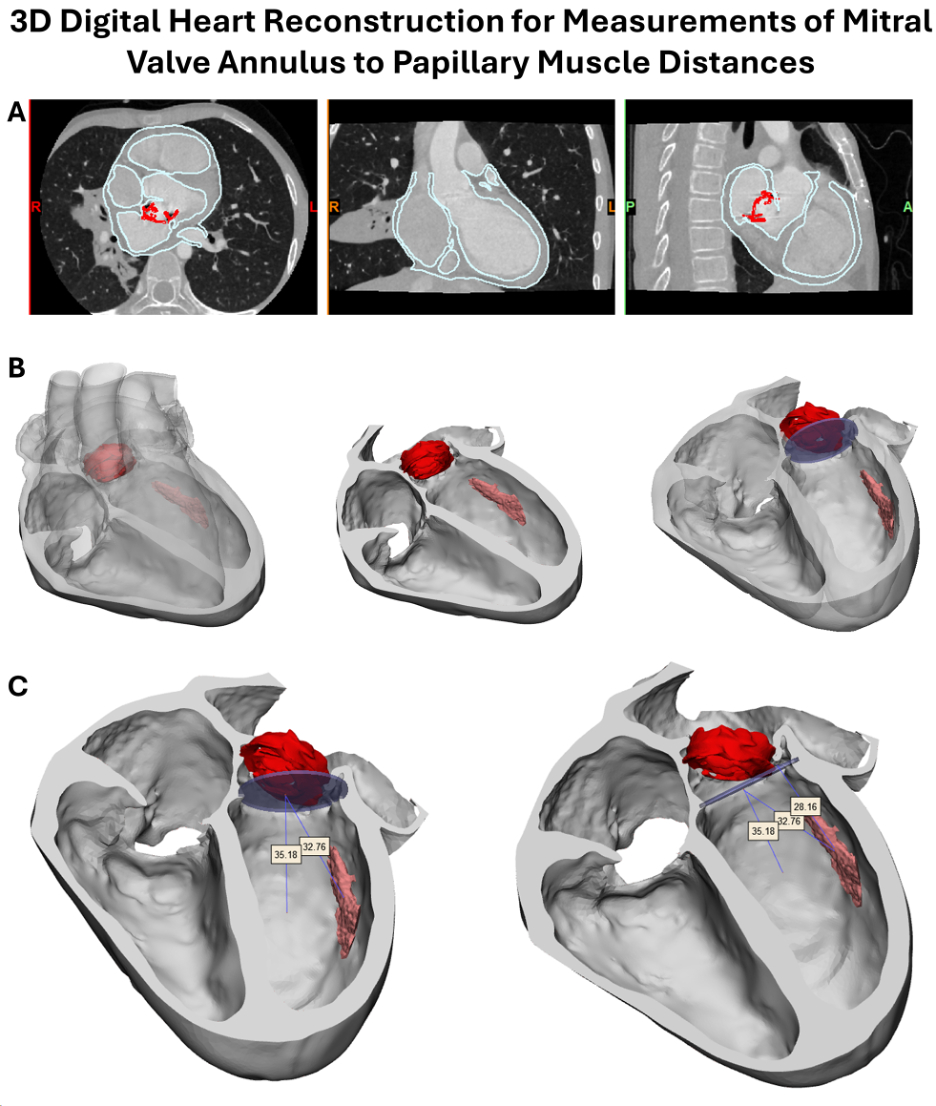
A 12-year-old male with a history of VSD closure and supra-annular 21 mm mechanical MV replacement at age 2 presented with severe prosthetic valve stenosis and was evaluated for MV PHT. ECG-gated contrast-enhanced cardiac CT scans were acquired in both systole and diastole (Fig 1A). 3D digital hearts (DHs) were reconstructed for each phase to include the ventricular myocardium, mechanical valve, and remnant anterolateral papillary muscle (PM) (Fig 1B). The resulting DHs enabled direct measurement from the native annular plane to the PM, providing a critical spatial reference to guide intraoperative donor chordae placement.
Results:
The DHs revealed annular-to-PM distances ranging from 25 to 35 mm (Fig 1C). These measurements informed the placement of pledgeted sutures for donor chordae attachment on the LV free wall, ensuring physiologic leaflet tensioning. The DHs also clarified spatial constraints posed by the prior valve and altered LV geometry, assisting surgical decision-making beyond what static imaging allowed. The patient underwent successful MV PHT with serial follow-up echocardiography showing stable MV function with mild regurgitation and preserved biventricular function.
Conclusion:
This case highlights the critical role of 3D virtual modeling in the planning of MV PHT, enabling precise intraoperative chordal placement in the absence of native subvalvular anatomy. Patient-specific DHs allowed accurate quantification of complex spatial relationships that were otherwise inaccessible, enhancing surgical confidence and procedural precision. Integration of DHs into preoperative workflows may broaden the feasibility of complex reconstructive valve strategies in pediatric and reoperative populations.
  • O'hara, Ryan  ( Children's National Hospital , Washington DC , Maryland , United States )
  • Aydin, Muhammed Ikbal  ( Children's National Hospital , Washington DC , Maryland , United States )
  • Kollar, Sarah  ( Children's National Hospital , Washington DC , Maryland , United States )
  • Clauss, Sarah  ( Children's National Hospital , Washington DC , Maryland , United States )
  • Udine, Michelle  ( Children's National Hospital , Washington DC , Maryland , United States )
  • D'udekem, Yves  ( Children's National Hospital , Washington DC , Maryland , United States )
  • Loke, Yue-hin  ( Children's National Hospital , Washington DC , Maryland , United States )
  • Author Disclosures:
    Ryan O'Hara: DO NOT have relevant financial relationships | Muhammed Ikbal Aydin: No Answer | Sarah Kollar: DO NOT have relevant financial relationships | Sarah Clauss: DO NOT have relevant financial relationships | Michelle Udine: No Answer | YVES D'UDEKEM: DO have relevant financial relationships ; Consultant:Bayer Pharmaceuticals:Active (exists now) | Yue-Hin Loke: DO NOT have relevant financial relationships
Meeting Info:

Scientific Sessions 2025

2025

New Orleans, Louisiana

Session Info:

From Molecules to Mechanics: Top Translational Advances in Valvular Heart Disease

Saturday, 11/08/2025 , 09:45AM - 11:00AM

Abstract Oral Session

More abstracts on this topic:
18F-NaF and 18F-FDG and calcification predict the development of abdominal aortic aneurysms and is attenuated by drug therapy

Nakahara Takehiro, Miyazawa Raita, Iwabuchi Yu, Tonda Kai, Narula Nupoor, Strauss Harry, Narula Jagat, Jinzaki Masahiro

A Case of Caseous Mitral Annular Calcification and the Utility of Multimodality Cardiac Imaging

Nguyen Amanda, English Carter, Ghasemiesfe Ahmadreza, Venugopal Sandhya

More abstracts from these authors:
Shape Variations in Right Ventricular 3D Geometry are associated with adverse outcomes in Hypoplastic Left Heart Syndrome Patients: A Fontan Outcomes Registry using CMR Examination (FORCE) Study

Loke Yue-hin, Balaras Elias, D'udekem Yves, Alsaied Tarek, Olivieri Laura, Truong Uyen, Capuano Francesco, O'hara Ryan, Contento Jacqueline, Marella Nicole, Anantuni Lekha, Gaviria Susana, Kollar Sarah, Vegulla Ravi, Mehta Rittal

Determining the Physiologic Effect of the Cavopulmonary Connection on Caval Flows Using 4D Flow MRI

Suresh Kumar Vasupradha, Kollar Sarah, Loke Yue-hin, Vegulla Ravi

You have to be authorized to contact abstract author. Please, Login
Not Available