
Logo

American Heart Association

  14
  0


Final ID: MP1228

ECMO Combined with Thrombectomy Yields Superior Outcomes in Acute High-Risk Pulmonary Embolism

Abstract Body (Do not enter title and authors here): Background:
Extracorporeal membrane oxygenation (ECMO) is used as a rescue therapy in patients with severe high-risk pulmonary embolism (PE), but data on optimal management and especially on mid- and long-term outcomes remain limited.

Hypothesis:
We hypothesized that ECMO combined with thrombectomy would lead to better short- and long-term outcomes than ECMO with thrombolysis or ECMO alone.

Methods:
We retrospectively reviewed the medical records of patients with high-risk PE who received ECMO at a single institution between January 2016 and July 2024. Patients were categorized into three groups based on the type of adjunctive reperfusion therapy received: those who underwent thrombectomy, including surgical and percutaneous mechanical thrombectomy; those who received thrombolysis, including systemic thrombolysis and catheter-directed thrombolysis; and those who were managed with ECMO alone without reperfusion therapy. We compared patient characteristics and clinical outcomes across these groups.

Results:
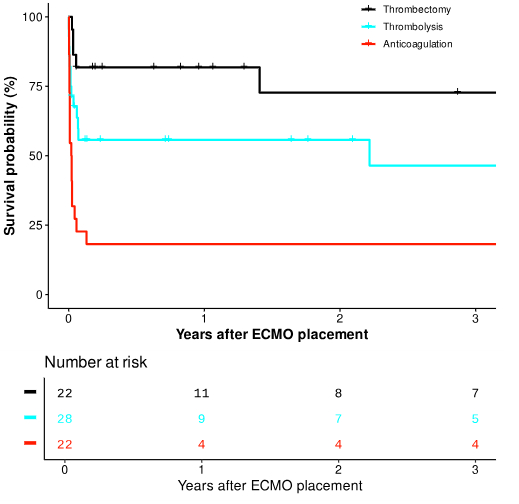
A total of 72 patients with high-risk PE underwent ECMO during the study period, with a median age of 52.5 years (95% CI: 42.0–65.3). Of these, 22 patients received ECMO with thrombectomy (5 surgical, 17 percutaneous), 28 patients received ECMO with thrombolysis (13 systemic, 15 catheter-directed), and 22 patients received ECMO alone. There were no significant demographic differences among the groups. The incidence of cardiac arrest was similar: ECMO alone (72.7%), thrombolysis (67.9%), and thrombectomy (77.3%) (P=0.76). The median duration of ECMO support was 5 days (95% CI: 4–6 days), with no significant difference among the three groups (P = 0.2). Successful weaning from ECMO was achieved in 100% of the thrombectomy group, 60.7% of the thrombolysis group, and 36.4% of the ECMO-alone group (P<0.01). Survival to hospital discharge was highest in the ECMO with thrombectomy group (81.8%), compared to 57.1% in the thrombolysis group and 18.1% in the ECMO alone group (P<0.01). There were no significant differences in in-hospital complications among the groups. The 1- and 3-year survival rates were 81.8%, and 72.7% in the ECMO with thrombectomy group; 55.7%, and 46.4% in the ECMO with thrombolysis group; and 18.2%, and 18.2% in the ECMO alone group (P <0.001).

Conclusion:
ECMO without reperfusion therapy was associated with poor outcomes, whereas ECMO with thrombectomy provided the best short- and long-term survival, followed by thrombolysis.
  • Fujimoto, Ryo  ( University of Pennsylvania , Philadelphia , Pennsylvania , United States )
  • Pugliese, Steven  ( University of Pennsylvania , Philadelphia , Pennsylvania , United States )
  • Bermudez, Christian  ( University of Pennsylvania , Philadelphia , Pennsylvania , United States )
  • Gregorio, Paulo  ( University of Pennsylvania , Philadelphia , Pennsylvania , United States )
  • Richards, Tomas  ( University of Pennsylvania , Philadelphia , Pennsylvania , United States )
  • Olia, Salim  ( University of Pennsylvania , Philadelphia , Pennsylvania , United States )
  • Mazur, Zane  ( University of Pennsylvania , Philadelphia , Pennsylvania , United States )
  • Wald, Joyce  ( University of Pennsylvania , Philadelphia , Pennsylvania , United States )
  • Glassmoyer, Lauren  ( University of Pennsylvania , Philadelphia , Pennsylvania , United States )
  • Kobayashi, Tai  ( University of Pennsylvania , Philadelphia , Pennsylvania , United States )
  • Giri, Jay  ( University of Pennsylvania , Philadelphia , Pennsylvania , United States )
  • Author Disclosures:
    RYO FUJIMOTO: DO NOT have relevant financial relationships | steven pugliese: DO NOT have relevant financial relationships | Christian Bermudez: DO NOT have relevant financial relationships | Paulo Gregorio: No Answer | Tomas Richards: No Answer | Salim Olia: DO have relevant financial relationships ; Consultant:Magenta Medical:Active (exists now) | Zane Mazur: DO NOT have relevant financial relationships | Joyce Wald: No Answer | Lauren Glassmoyer: DO NOT have relevant financial relationships | Tai Kobayashi: DO have relevant financial relationships ; Consultant:Medtronic:Active (exists now) ; Consultant:Endovascular Engineering:Active (exists now) ; Consultant:Sonivie Medical:Active (exists now) ; Consultant:Recor Medical:Active (exists now)
Meeting Info:

Scientific Sessions 2025

2025

New Orleans, Louisiana

Session Info:

Pushing the Limits: ECMO, Impella, and the Science Behind Their Power

Sunday, 11/09/2025 , 09:15AM - 10:15AM

Moderated Digital Poster Session

More abstracts on this topic:
Catheter-Directed Intervention for High-Risk Acute Pulmonary Embolism in Chronic Kidney Disease

Kumar Manoj, Ricciardi Mark, Arman Qamar, Ali Shafaqat, Jamshed Aneeza, Murthi Mukunthan, Kumar Nomesh, Kumar Sanjay, Kumari Rinkle, Alraies M Chadi, Gomez Valencia Javier

Accuracy of Rule-based Natural Language Processing Models for Identification of Pulmonary Embolism

Rashedi Sina, Jimenez David, Monreal Manuel, Secemsky Eric, Klok Erik, Hunsaker Andetta, Aghayev Ayaz, Muriel Alfonso, Hussain Mohamad, Appah-sampong Abena, Aneja Sanjay, Krishnathasan Darsiya, Mojibian Hamid, Goldhaber Samuel, Wang Liqin, Zhou Li, Krumholz Harlan, Piazza Gregory, Bikdeli Behnood, Khairani Candrika, Bejjani Antoine, Lo Ying-chih, Zarghami Mehrdad, Mahajan Shiwani, Caraballo Cesar, Jimenez Ceja Jose Victor

More abstracts from these authors:
You have to be authorized to contact abstract author. Please, Login
Not Available