
Logo

American Heart Association

  13
  0


Final ID: Mo4032

Proteomic Signatures of Lipoprotein (a) Particles Reveal Novel Associations with Plasma Levels and KIV-2 Copy Number in an Elderly Multiethnic Cohort

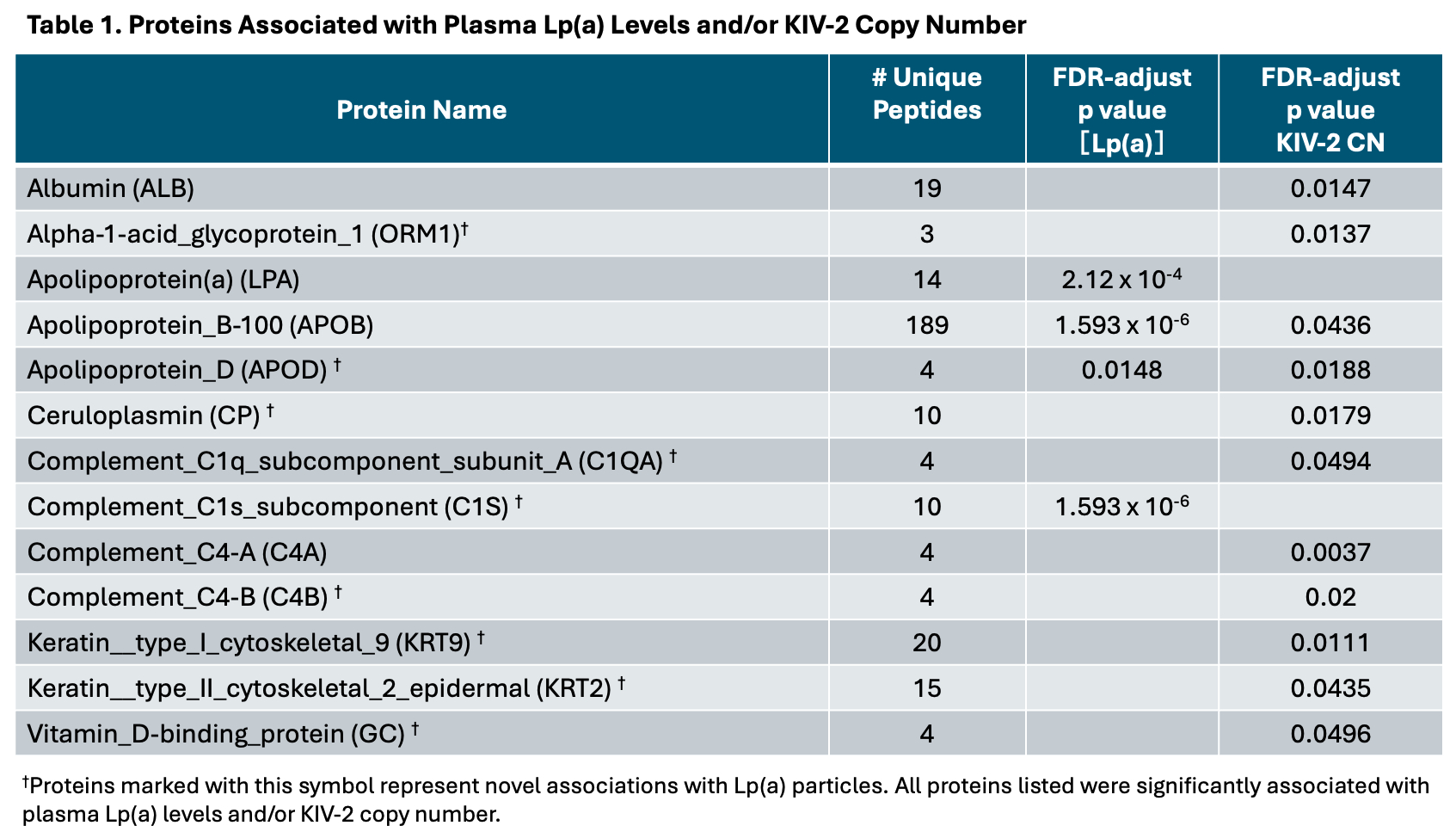
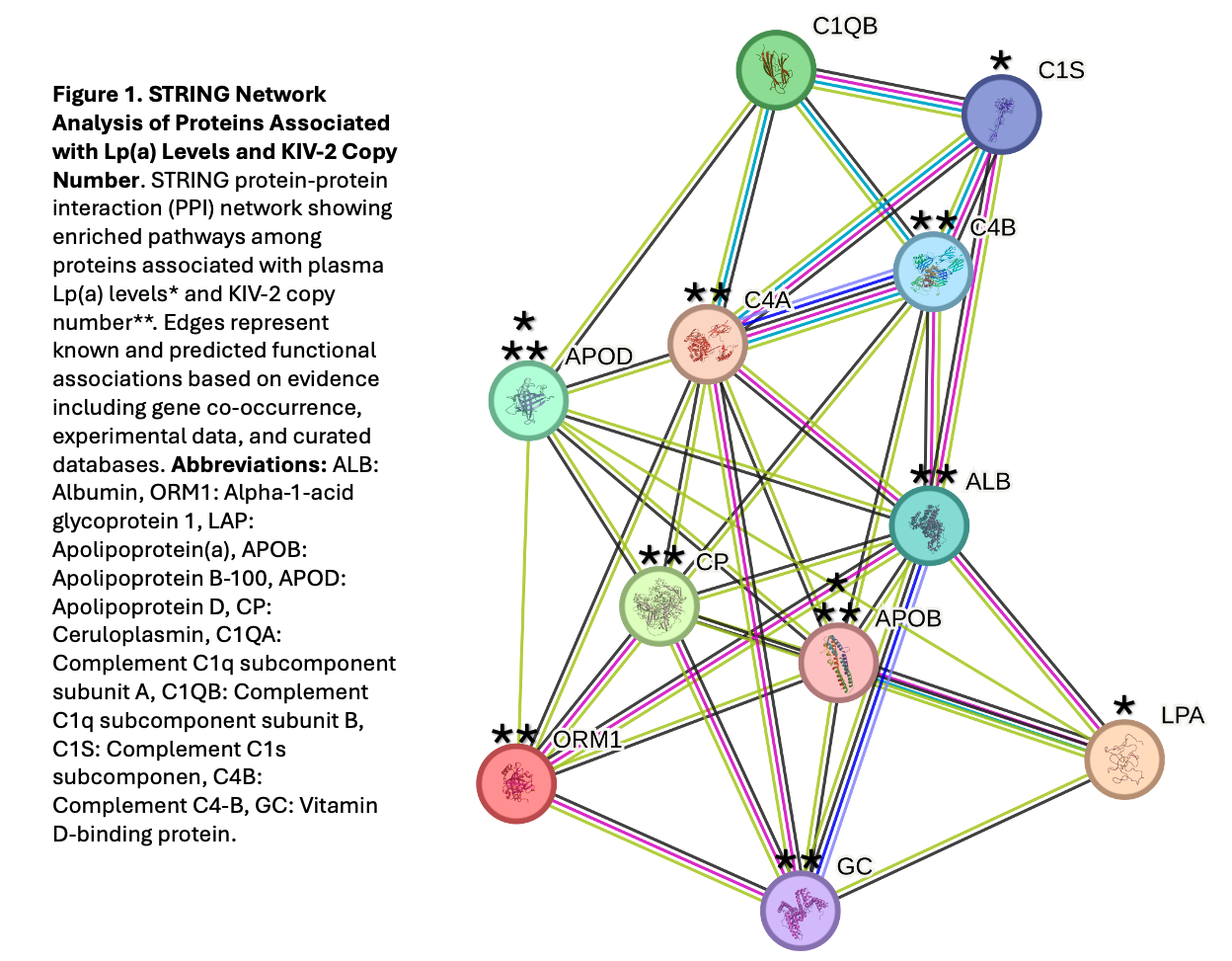
Abstract Body (Do not enter title and authors here): Background: High lipoprotein(a) [Lp(a)] is a causal risk factor for Atherosclerotic Cardiovascular Disease, yet the mechanisms driving this risk remain unclear. Lp(a) levels are largely determined by variation in the LPAgene, but less is known about additional protein components and their relationship to genetic markers such as the kringle IV type 2 copy number (KIV-2 CN). Hypothesis: We hypothesized that the proteomic profile of Lp(a) particles would reveal novel proteins and pathways associated with Lp(a) levels providing mechanistic insight into Lp(a)-mediated risk. Methods: We conducted proteomic profiling of Lp(a) particles in 35 elderly participants (mean age 81 years; 71% female; 63% African American, 37% Caucasian) from the Washington Heights-Inwood Community Aging Project. Plasma Lp(a) was quantified using an isoform-independent ELISA, and KIV-2 CN was estimated using a published calling platform. Lp(a) particles were isolated by immunoprecipitation, and proteomic analysis was performed using liquid chromatography-tandem mass spectrometry. Protein associations with Lp(a) levels and KIV-2 CN were assessed using linear regression, adjusting for multiple testing with the Benjamini–Hochberg false discovery rate (FDR) method. Protein interaction networks were analyzed using the STRING database. Results: The median Lp(a) level was 37.1 nmol/L (interquartile range 13.1–86.2), and the mean KIV-2 CN was 20. In addition to 35 previously reported proteins, we identified two novel proteins: complement C1s (FDR-adjusted p= 2e-6) and apolipoprotein D (FDR-adjusted p=0.0148). Furthermore, several proteins, showed significant associations with KIV-2 CN, highlighting potential genotype-related effects, Table 1. STRING analysis revealed enrichment of immune and lipid metabolism pathways, including complement activation and apolipoprotein binding, Figure 1. Conclusion:The proteome of isolated Lp(a) particles reveals insights into pathways that link Lp(a) to cardiovascular and other disease processes.
  • Mosquera-restrepo, Sergio  ( Pontificia Universidad Católica Madre y Maestra , Santiago de los Caballero , Dominican Republic )
  • Li, Yihao  ( Columbia University Vagelos College of Physicians and Surgeons , New York , New York , United States )
  • Vardarajan, Badri  ( Columbia University Vagelos College of Physicians and Surgeons , New York , New York , United States )
  • Matienzo, Nelsa  ( Columbia University Vagelos College of Physicians and Surgeons , New York , New York , United States )
  • Reyes, Dolly  ( Columbia University Vagelos College of Physicians and Surgeons , New York , New York , United States )
  • Singh, Sasha  ( Brigham and Women's Hospital, Harvard Medical School , Boston , Massachusetts , United States )
  • Aikawa, Masanori  ( Brigham and Women's Hospital, Harvard Medical School , Boston , Massachusetts , United States )
  • Reyes-soffer, Gissette  ( Columbia University Vagelos College of Physicians and Surgeons , New York , New York , United States )
  • Author Disclosures:
    Sergio Mosquera-Restrepo: DO NOT have relevant financial relationships | Yihao Li: DO NOT have relevant financial relationships | Badri Vardarajan: No Answer | Nelsa Matienzo: DO NOT have relevant financial relationships | dolly reyes: No Answer | Sasha Singh: DO NOT have relevant financial relationships | Masanori Aikawa: No Answer | Gissette Reyes-Soffer: DO NOT have relevant financial relationships
Meeting Info:

Scientific Sessions 2025

2025

New Orleans, Louisiana

Session Info:

Bench to Bedside: Translational Multi-omic Models of Cardiovascular Disease 2

Monday, 11/10/2025 , 10:30AM - 11:30AM

Abstract Poster Board Session

More abstracts on this topic:
A Single-Dose of a Novel CasX-Editor Lowers APOC3 Levels In Vivo

Karanth Santhosh, Ripley-phipps Sterling, Miller Katherine, Su Ali, Mrak Anna, Karmarkar Maitreyee, Eggers Michelle, Bardai Farah, Narsineni Lokesh, Li Yuexuan, Langner Heera, Bucher Simon, Szulwach Keith, Goh Natalie, Mok Amanda, Reimer Kirsten, Oakes Benjamin, Khakoo Aarif, Mirotsou Maria, Smekalova Elena, Saraya Jennifer, Stein Shannon, Sato Anna, Bale Shyamsundhar, Krupa Oleh, Mauriello Anthony

Anti-inflammatory effects of colchicine after myocardial infarction

Muroke Valtteri, Diaz Rafael, Maggioni Aldo Pietro, Pinto Fausto, Kouz Simon, Berry Colin, Lopez-sendon Jose, Koenig Wolfgang, Cossette Marieve, Guertin Marie-claude, Rheaume Eric, Rhainds David, Tardif Jean-claude, Brodeur Mathieu, Marchand Claude, Charpentier Daniel, Pedneault-gagnon Valerie, Rivest Patricia, Latour Frederic, Roubille Francois

More abstracts from these authors:
The 5,000+ Plasma Proteome of an Atherosclerosis Mouse Model Identifies Known and Potential Disease Drivers

Delwarde Constance, Matamalas Joan, Chelvanambi Sarvesh, Kasai Taku, Aikawa Masanori, Singh Sasha

Characterization of NIMA-related kinase 7 (NEK7)-NLRP3 inflammasome complex in macrophages by combining CRISPR/Cas9 gene-editing with comprehensive proteomic

Nakamura Yuto, Chelvanambi Sarvesh, Kasai Taku, Whelan Mary, Sasaki Yusuke, Singh Sasha, Aikawa Elena, Aikawa Masanori

You have to be authorized to contact abstract author. Please, Login
Not Available