Self-Reported Loneliness Independently Predicts Cardiovascular Mortality in a Diverse National Cohort
Abstract Body (Do not enter title and authors here): Background: Loneliness is a growing public health concern. In 2022, the AHA identified it as a contributor to poor cardiovascular health, followed by a 2023 U.S. Surgeon General advisory declaring an “Epidemic of Loneliness and Isolation”. Although linked to mortality, its independent effect and generalizability across diverse groups remain understudied. With over half of U.S. adults reporting loneliness, understanding its role may be essential to improving cardiovascular outcomes.
Research Questions/Hypothesis: We examined the association between loneliness and CVD mortality in a diverse national cohort. We hypothesized that loneliness would be associated with increased CVD mortality.
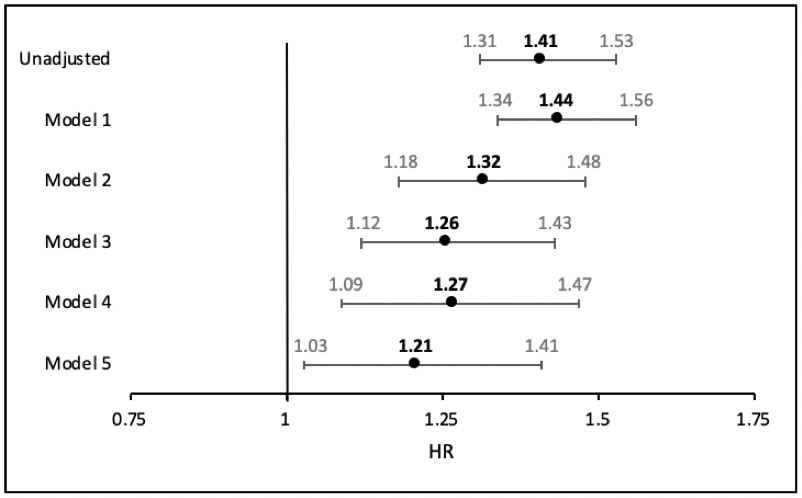
Methods: The Reasons for Geographic and Racial Differences in Stroke (REGARDS) Study is a prospective cohort of 30,239 adults aged ≥45 years recruited from 2003-2007. We included those who completed a baseline loneliness item assessing feelings in the past week. Cox proportional hazards models estimated HRs and 95% CIs for the association between loneliness and time to CVD death. Models were sequentially adjusted for demographics (age, race, gender), SDOH (employment, education, income, insurance, region, poverty, health professional shortage, public health infrastructure), clinical factors (hypertension, diabetes, self-rated physical health, obesity, inflammation, cognition), health behaviors (smoking, activity, diet, medication adherence), and objective social health (partnership, social isolation, social support). Effect modification by age, race, and gender was assessed using interaction terms.
Results: We included 29,387 participants with median follow-up of 13.1 years (IQR 7.3-16.1). Mean age was 65.0 years (SD 9.4); 41% identified as Non-Hispanic Black and 55% were women. Overall, 21% of participants reported loneliness in the past week, with 3,643 CVD deaths observed. Loneliness was associated with a 41% increased hazard of CVD mortality in unadjusted models (HR, 1.41; 95% CI, 1.31-1.53). The association attenuated but remained significant in the fully adjusted model (HR, 1.21; 95% CI, 1.03-1.41). No effect modification was observed.
Conclusion: Loneliness was associated with increased CVD mortality risk, even after accounting for clinical, behavioral, and social factors. A one-time, self-reported loneliness measure may serve as a practical tool for identifying at-risk patients and inform efforts to reduce cardiovascular risk.
Acker, Cheyenne
(
WEILL CORNELL MEDICINE
, New York , New York , United States )
Jumonville, Ghislaine
(
WEILL CORNELL MEDICINE
, New York , New York , United States )
Sterling, Madeline
(
WEILL CORNELL MEDICINE
, New York , New York , United States )
Bowling, Barrett
(
DUKE UNIVERSITY
, Durham , North Carolina , United States )
Howard, Virginia
(
UNIVERSITY OF ALABAMA-BIRMINGH
, Birmingham , Alabama , United States )
Safford, Monika
(
WEILL CORNELL MEDICINE
, New York , New York , United States )
Pinheiro, Laura
(
WEILL CORNELL MEDICINE
, New York , New York , United States )
Author Disclosures:
Cheyenne Acker:DO NOT have relevant financial relationships
| Ghislaine Jumonville:DO NOT have relevant financial relationships
| Madeline Sterling:DO NOT have relevant financial relationships
| Barrett Bowling:DO NOT have relevant financial relationships
| Virginia Howard:DO NOT have relevant financial relationships
| Monika Safford:DO have relevant financial relationships
;
Advisor:MedExplain Inc:Active (exists now)
| Laura Pinheiro:No Answer