Loneliness and Days at Home Before and After Cardiovascular Disease Hospitalization: the REasons for Geographic And Racial Differences in Stroke (REGARDS) Study
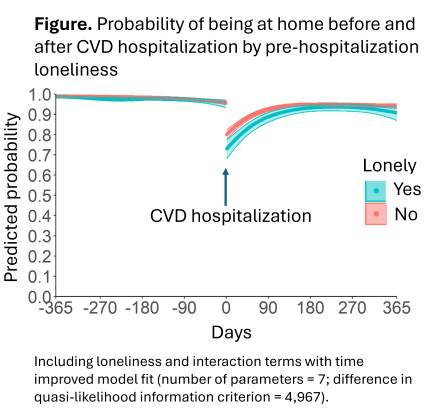
Abstract Body: Background: Social factors may influence older adults’ ability to recover or “bounce back” after a hospitalization for cardiovascular disease (CVD). Loneliness is a potentially modifiable social factor that could be intervened upon post-hospitalization. Objective: To evaluate the association of self-reported loneliness prior to CVD hospitalization (myocardial infarction, heart failure, or stroke) with days at home, defined as being alive and without inpatient, emergency department, observation unit, or skilled nursing facility care. Methods: Loneliness was assessed longitudinally using a single item approximately every 2 years in the REasons for Geographic And Racial Differences in Stroke (REGARDS) study and dichotomized as <1 or ≥1 day in the prior week. The loneliness assessment before and closest to adjudicated CVD hospitalization was selected. Linked Medicare claims were used to detect healthcare utilization. We estimated the probability of being home on each day during the year before and after hospitalization among participants surviving at least that long using a generalized estimating equation with logit link, binomial distribution, exchangeable correlation structure, and restricted quadratic splines for time, allowing for discontinuity at hospitalization and interactions between time and loneliness. Results: Among 1,780 participants with a CVD hospitalization, mean age at hospitalization was 77.9 years (SD 7.2 years), 45.7% were women, 30% Black and 70% White, and 42.4% were hospitalized for myocardial infarction, 37.5% for heart failure, and 33.4% for stroke; 23.5% reported being lonely at least 1 day in the prior week during the most recent assessment prior to hospitalization. Predicted probabilities and 95% confidence intervals for being at home in the year before and after CVD hospitalization are depicted in the Figure. Conclusions: Older adults who felt lonely had similar probability of being at home as those who were not lonely prior to CVD hospitalization, but they had lower probability of being home following CVD hospitalization. Findings suggest that loneliness may identify individuals particularly susceptible to poor recovery after CVD events.
Levitan, Emily
(
UNIVERSITY ALABAMA AT BIRMINGHAM
, Birmingham , Alabama , United States )
Wang, Zhixin
(
UNIVERSITY ALABAMA AT BIRMINGHAM
, Birmingham , Alabama , United States )
Enogela, Ene
(
UNIVERSITY ALABAMA AT BIRMINGHAM
, Birmingham , Alabama , United States )
Zhou, Xiaoxiao
(
UNIVERSITY ALABAMA AT BIRMINGHAM
, Birmingham , Alabama , United States )
Banerjee, Samprit
(
Weill Cornell Medicine
, New York , New York , United States )
Pinheiro, Laura
(
Weill Cornell Medicine
, New York , New York , United States )
Khodneva, Yulia
(
UAB
, Birmingham , Alabama , United States )
Goyal, Parag
(
Weill Cornell Medicine
, New York , New York , United States )
Bowling, Barrett
(
Durham Veterans Affairs Geriatric Research Education and Clinical Center
, Durham , North Carolina , United States )
Hanif, Abu Abdullah Mohammad
(
University of Alabama at Birmingham
, Birmingham , Alabama , United States )
Akinyelure, Oluwasegun
(
UNIVERSITY ALABAMA AT BIRMINGHAM
, Birmingham , Alabama , United States )
Mcdonald, William
(
Weill Cornell Medicine
, New York , New York , United States )
Acker, Cheyenne
(
Weill Cornell Medicine
, New York , New York , United States )
Bayly, Jennifer
(
Weill Cornell Medicine
, New York , New York , United States )
Safford, Monika
(
WEILL CORNELL MEDICINE
, New York , New York , United States )
Sterling, Madeline
(
Weill Cornell Medical College
, New York , New York , United States )